
What the ACMA’s warning list of Novomatic casino sites means for an Australian reader
The Interactive Gambling Act 2001 makes it an offence to offer online casino games to anyone in Australia, and no state or territory licences that product. The page most search results would lead a reader to is a “best Novomatic casinos for Australia” shortlist — but the honest shortlist for an Australian reader is not a ranking of offshore sites. It is the Australian Communications and Media Authority’s running register of brands the regulator has acted against for offering exactly that prohibited service. Each one carries a Curacao or Malta gaming licence of its own, none of those licences permits activity inside Australia, and the warning is the part the marketing pages tend to leave off. This page lays out the warning list, what each brand’s licence does and does not cover, and where a reader in Australia is actually meant to play.

Currency stamp: 9 November 2026. Verified against the Australian Communications and Media Authority’s published register of formal warnings and blocking actions.
Table of Contents
- The shortlist the ACMA’s register actually produces
- How the Interactive Gambling Act 2001 actually bites
- Responsible gambling tools that actually reach an Australian reader
- What the ACMA has actually blocked, and how fast
- What the offshore sites are actually offering under the “Novomatic casino” label
- What a deposit and a withdrawal actually look like on an offshore casino
- Bonus terms as a category, not a value
- Mobile and app: the same product, a smaller screen
- Where an Australian reader is actually meant to play
- What to do before trusting any site that claims to offer Novomatic games to an Australian reader
- The arithmetic behind a year of ACMA blocking
- Tax, winnings and what to keep on file
- What a reader comparing options actually sees
- Frequently asked questions
The shortlist the ACMA’s register actually produces
Eleven brands have been the subject of a formal ACMA warning over the period covered here. They are not a “top eleven” and they are not ranked by game quality. They are listed in the order the ACMA’s published actions would put a reader in front of them — most recent warning first, oldest last — and each is named because the regulator itself has named it for offering prohibited online casino games to people in Australia. Three of the eleven are also the subject of one of the ACMA’s internet-service-provider blocking requests in 2026, which is the regulator’s heavier tool: a formal warning is a written notice, a blocking request is the step that takes the domain off Australian DNS.
RocketPlay
Pulsup Ltd, the operator behind Rocketplay.com.au, received a formal ACMA warning in March 2026. The same brand had earlier been the subject of a May 2022 warning to Dama N.V. covering six casino brands. RocketPlay markets a full casino product — slots, live tables, a sportsbook — and lists a Curaçao gaming licence on its own footer, which covers the operator’s permission to run a casino from Curaçao and nothing about Australia. Research did not find a Novomatic catalogue entry for the brand, and the warnings are the only verified Australian-side data on it.
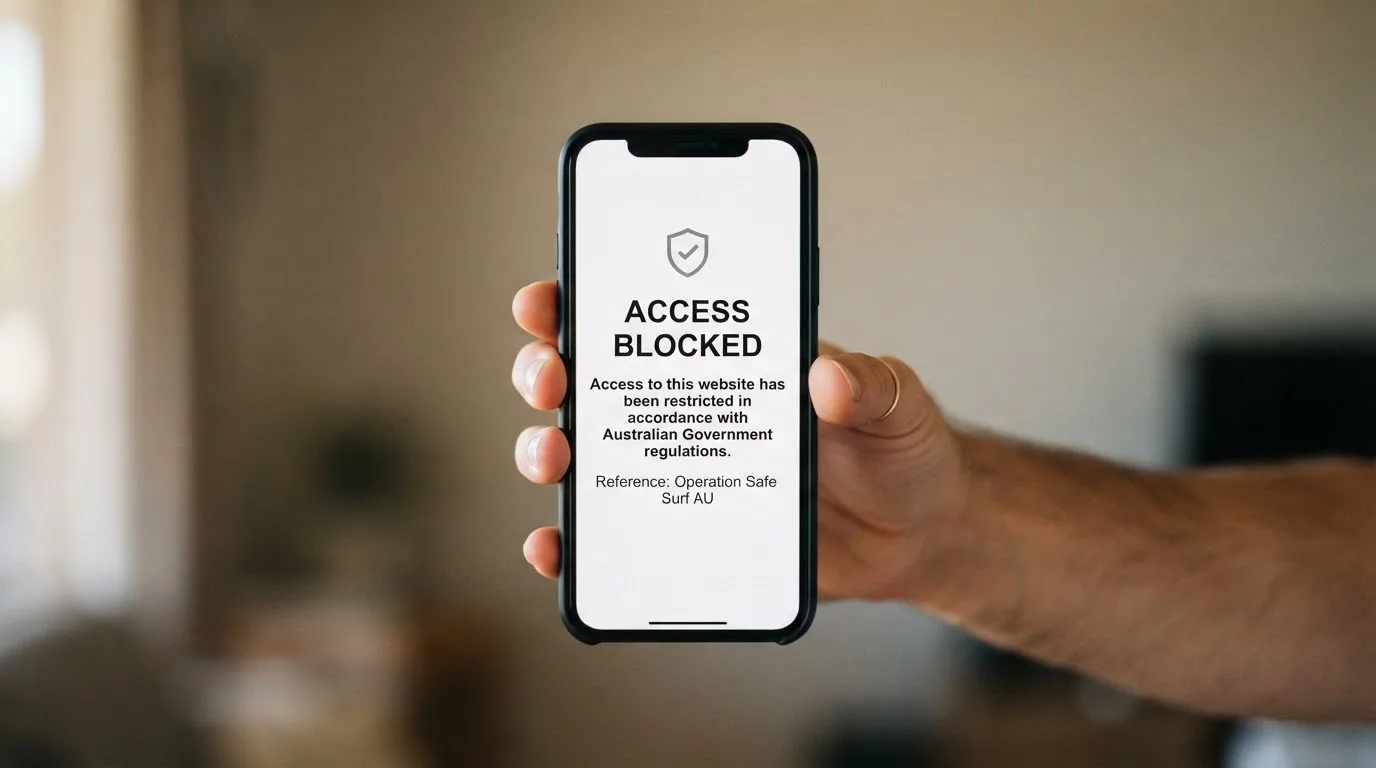
For an Australian reader the brand is on the ACMA’s most recent warning list. The deposit rails it advertises (crypto and a handful of e-wallets) are not the rails a licensed Australian wagering service is allowed to use under the credit-card and digital-currency ban of 11 June 2024, which is itself a signal that the site is not the licensed Australian product. The verdict: recent enough to still be on the regulator’s active list, and a brand an Australian reader should treat as offshore regardless of what its footer says.
Level Up Casino
Dama N.V. was the named operator in the May 2022 warning that bundled six brands including Level Up. The brand itself is still promoted through affiliate pages, and those pages do carry a Wazdan listing reference. Dama N.V. operates a wide portfolio across Curaçao; the Australian-side consequence is that the operator, not just the brand, has been the subject of regulator action in this market.

For an Australian reader the meaningful detail is that the warning is now several years old and the brand continues to operate. That is not a sign of compliance — Dama N.V. picked up fresh warnings in 2025 over Woo Casino and Spirit Casino — it is a sign that formal warnings do not, by themselves, take a site offline. The verdict: a brand on a long-running operator’s roster, with no Australian consumer protection behind it.
Woo Casino
Dama N.V., March 2025. Woo Casino sits inside the same Dama N.V. stable as Level Up and RocketPlay, which means the ACMA has now formally warned this operator three times in five years across three of its brands. A formal warning is not a fine and not a block; what it does is establish a paper trail the regulator can point to if it later seeks civil penalty orders under the Interactive Gambling Act.
For an Australian reader the value of that paper trail is mostly defensive — it is what an Australian reader would want to know if they had money sitting on the site and the domain was about to be blocked. The verdict: same operator as the previous two brands, newer warning, no Australian licence in sight.
Spirit Casino
Dama N.V., May 2025. Spirit Casino is the third Dama N.V. brand on this list. The pattern is now plain: a single Curaçao-licensed operator running a portfolio of lookalike brands, each picked up in turn by the ACMA. From an Australian reader’s standpoint this is not eleven different operators and not eleven different games catalogues — it is one operator with a portfolio the regulator keeps having to chase.
For an Australian reader the practical upshot is identical to Woo Casino: an offshore brand, no Australian consumer protection, no BetStop registration binding the site. The verdict: same picture as the previous brand, newer date, same operator.
National Casino
Consolutetish S.R.L., July 2025. National Casino is named in the same July 2025 batch as Bizzo Casino. The brand’s affiliate listings carry references to Betsoft and Pragmatic Play content, both of which are third-party providers — the catalogue is built from games the operator has integrated rather than games it makes. Consolutetish S.R.L. operates a portfolio of brands across the same Curaçao framework.
For an Australian reader the take-away is that the brand’s footprint is built on third-party integrations rather than on a proprietary Novomatic catalogue, so the “Novomatic casino” framing is loose at best. The verdict: an offshore brand whose advertised catalogue is not what this page suggests.
Bizzo Casino
Consolutetish S.R.L., July 2025, with a 2022 warning already on file against TechSolutions (CY) Group Limited and TechSolutions Group N.V. Bizzo is the only brand on this list with a prior warning attached to a different operator entity — the ACMA warned one operator over it in 2022 and a different operator over it in 2025. That is the regulator’s clearest signal yet that warnings do not, by themselves, change who ends up running the brand.
For an Australian reader the take-away is that “the brand was warned in 2022 and is still running” is not a story about lax enforcement, it is a story about how the offshore market is structured: brands change hands, the domain survives, the catalogue is rebuilt, and the warning list grows. The verdict: same brand name, two different operator entities on the regulator’s record.
Ignition Casino
Bamboo Media, July 2025. Ignition Casino is the brand in this list most familiar to readers who already know the offshore market — it has run for years under various operator configurations, mostly targeting the United States. The ACMA’s action places it on the Australian register for offering prohibited services to people in Australia.
For an Australian reader the relevant detail is that a US-facing brand is also the subject of Australian enforcement, which says something about how the offshore market is partitioned: the same brand, the same product, multiple regulators finding it in breach of their own rules. The verdict: an offshore brand with a regulatory footprint across more than one English-speaking jurisdiction.
Instant Casino
EOD Code SRL, February 2025. Instant Casino was the subject of one of the ACMA’s early-2025 formal warnings. EOD Code SRL is a smaller operator name than Dama N.V. or Consolutetish S.R.L., which matters mainly because it shows the regulator is not only chasing the biggest names in the offshore market.
For an Australian reader the verdict is the same as for the rest of this list: an offshore brand, no Australian licence, no Australian consumer protection, no connection to BetStop.
Jackbit
Ryker B.V., April 2026. Jackbit was the subject of one of the ACMA’s most recent warnings. Ryker B.V. is also the named operator for CasinOK in the same April 2026 batch. The April 2026 batch is the most recent operator-level action the ACMA has on file here, and it pairs two brands under one operator in a single enforcement round.
For an Australian reader the verdict is that this is a fresh warning, in the regulator’s most recent action round, with a second brand under the same operator sitting beside it.
Casino Intense
Sterplay Holding Ltd, April 2025. Casino Intense is named in a single-operator warning in April 2025, and is one of the few brands on this list whose affiliate listings carry any third-party provider references — a 1spin4win reference sits beside UK Gambling Commission and Wikipedia entries on the operator. That is the closest thing in this list to a verifiable catalogue signal.
For an Australian reader the take-away is the same shape as the rest of the list: a small offshore operator under formal warning, with a catalogue built out of third-party integrations rather than proprietary Novomatic content. The verdict: small operator, single warning, no Australian licence.
Sky Crown
Hollycorn N.V., formal warning published in September 2022. Hollycorn N.V. operates both Sky Crown and Blue Leo; the ACMA’s action covers both brands together. Sky Crown is the oldest warning on this list and the only one not to carry a 2025 or 2026 date, which is a useful marker for how long the regulator has been working this particular file.
For an Australian reader the verdict is the same as the rest: an offshore brand, no Australian licence, no recourse if a withdrawal stalls. The brand’s persistence on the market three years after the warning says the same thing the Bizzo record does — formal warnings do not, by themselves, take a site offline.
How the Interactive Gambling Act 2001 actually bites
The Interactive Gambling Act 2001 — strengthened by the Interactive Gambling Amendment Act 2017 — makes it an offence for a provider to offer online casino games, online pokies or in-play betting to a person physically in Australia. The product category the ACMA enforces is the “prohibited interactive gambling service”, and what is licensed is a different category: wagering on races and sport placed before the event, lotteries and keno. In practice, the licensed wagering side is concentrated in the Northern Territory through the Northern Territory Racing and Wagering Commission, which regulates 52 of Australia’s online bookmakers, including Sportsbet, Bet365 and Ladbrokes. The NTRWC has no full-time staff and meets once a month in Darwin, which is itself a small detail about how thinly the licensed side is resourced.
The IGA targets the provider, not the individual player. That is the one piece of consumer-side good news: an Australian reader opening an offshore casino site is not personally committing an offence. The consumer-side bad news follows: an offshore site gives no Australian consumer protection, no complaints body, no recourse if a withdrawal is refused, and a balance still on the site when the ACMA asks Australian internet service providers to block the domain. The blocking tool is the regulator’s heavier lever, and it has now been used to take more than 1,750 illegal gambling and affiliate marketing websites off Australian DNS since the first blocking request in November 2019.
The Interactive Gambling Amendment (Gambling Reform) Bill 2026 passed Parliament on 19 August 2026. Its advertising and inducement measures commence on 1 January 2027. On a 2026 page that is law with a start date, not law in force — relevant to anyone reading forward, not relevant to a reader making a deposit today.
Responsible gambling tools that actually reach an Australian reader
BetStop — the National Self-Exclusion Register — has been live since August 2023. It is the only Australian-wide self-exclusion tool for online wagering, and what it binds is Australian-licensed online and phone wagering services. An offshore casino is not connected to it. Registering with BetStop will exclude a reader from every licensed Australian wagering service at once; it will not stop an offshore casino from accepting a deposit, and it will not stop an affiliate marketing page from emailing a bonus offer. The tool that actually does the wider job is a bank-level block on gambling transactions, combined with the National Gambling Helpline on 1800 858 858 — free, 24 hours a day, with chat at Gambling Help Online. Minimum age for any Australian gambling product is 18.
The deposit-side rules for licensed Australian wagering services are themselves a useful signal. Credit cards, credit-related products and digital currency have been banned as payment for licensed online wagering since 11 June 2024, with penalties up to A$247,500 for operators. The legal deposit routes for licensed wagering are debit card, bank transfer, PayID/Osko and BPAY. A site that asks an Australian reader for a credit card or for a crypto deposit is signalling, by that request, that it is operating outside the Australian rules — not because crypto is illegal, but because no licensed Australian wagering service is allowed to take it. Offshore casinos do take it, which is exactly the channel the ban was written against.
What the ACMA has actually blocked, and how fast
The blocking tool — the ACMA asking Australian internet service providers to block specific domains — is the regulator’s heaviest move. As of June 2026, a total of 1,751 illegal gambling and affiliate marketing websites had been blocked since the first blocking request in November 2019. That is roughly 270 sites per year across the six-and-a-bit years the tool has been live, with the pace picking up as the ACMA’s enforcement team has grown. In a single round reported on 26 June 2026 the regulator asked ISPs to block another twelve: 7Signs, ChromaBet, Donbet, Duospin, Freshbet, Slots Gem, Jacks Club, Lucky Start, Pointsbetz.com, Spinrise, Vinyl Casino and Wildsino. None of those twelve is on the warning list above — blocking and formal warning are separate actions, and the ACMA does both in parallel. The blocking tool works on the domain, the warning tool works on the operator, and either is enough on its own to put a brand on this page.
H2 Gambling Capital’s 2025 estimate puts Australians’ annual losses to illegal gambling sites at about A$3.9 billion, and the share of gambling going through legal channels fell from 74% in 2021 to 64%. The illegal market is, on those figures, just over a third of total Australian gambling spend — a market the offshore shortlists are not advertising as a niche but as the bulk of their addressable audience.
What the offshore sites are actually offering under the “Novomatic casino” label
Novomatic is an Austrian gambling company founded by Johann Graf in 1980. In 2021 it reported revenue of €1.84 billion, operating income of €588 million and 21,173 employees, with gaming operations accounting for 56% of group revenue and around 2,000 gaming facilities spread across roughly 43 to 50 countries. The online division is Greentube, acquired as a controlling stake in 2010. Greentube’s Malta subsidiary holds a Critical Supply Licence (MGA/CRP/120/2006) and a B2C Gaming Service Licence (MGA/B2C/823/2020) from the Malta Gaming Authority, and is also licensed by the UK Gambling Commission. None of those licences covers activity to players in Australia. The Australian-licensed supply chain for Novomatic products runs through Ainsworth Game Technology, in which Novomatic acquired a 52% stake in 2018 for about €300 million; Ainsworth is ASX-listed and supplies machines into the Australian pub and club market under state-level gambling-machine regulation, not the Interactive Gambling Act.
The German subsidiary Löwen Entertainment operates around 520 Admiral Spielhalle arcades, and the UK subsidiary Luxury Leisure, acquired in 2014, operates more than 270 gaming venues. The 2025 acquisition of eleven French casinos from Vikings Casinos and the 2022 acquisition of the Italian gambling business HBG Group are both further signs of Novomatic consolidating land-based operations in regulated European markets — not a sign of any move into the Australian online market, which the Interactive Gambling Act 2001 has made non-viable for an offshore operator.
For an Australian reader the practical upshot is that “Novomatic casino” is, in the Australian online context, a marketing label rather than a regulated supply relationship. The Greentube licence is a Maltese one, the Australian-licensed supply chain runs through Ainsworth’s poker-machine products, and the offshore “Novomatic casino” shortlists are not picking up games from any Australian-licensed supplier. The brands on the warning list above are running games from a wide spread of third-party providers, and where research found a third-party catalogue reference — Betsoft and Pragmatic Play for National Casino, 1spin4win for Casino Intense, Wazdan for Level Up — those are the integrations the affiliate pages cite, not Novomatic content.
What a deposit and a withdrawal actually look like on an offshore casino
The payment side is where the consumer-protection gap opens widest. A deposit at a Curaçao-licensed offshore casino typically lands through a credit-card processor, an e-wallet, or a crypto rail — Bitcoin, Ethereum, USDT. The first two of those are at the edge of what an Australian-licensed wagering service can take, and the third is banned outright under the 11 June 2024 rules. A withdrawal back to an Australian bank account is the harder end of the journey: the offshore operator pays out in the same currency the player deposited in, the player’s Australian bank sees an incoming international transfer, and the player’s bank applies its own fraud and AML rules on top. The two commonest failure modes are a withdrawal held for additional verification documents the site did not ask for at deposit time, and a withdrawal delayed by an upstream payment-processor review. Both happen on a timeframe the operator controls, not on Australian Consumer Law, because there is no Australian consumer law reaching the operator.
The credit-card and digital-currency ban of 11 June 2024 is a licensed-side rule. It does not bind an offshore casino. The signal it sends is, again, that an offshore site asking for those payment methods is operating outside the Australian framework. Australian readers who want to play within Australian law use the licensed rails: debit card, bank transfer, PayID/Osko and BPAY. Australian readers who deposit on an offshore casino are using rails that no licensed Australian wagering service is allowed to offer.
Bonus terms as a category, not a value
Affiliate marketing pages around this topic carry deposit bonuses, “no deposit” bonuses and free-spin packages, each tied to a turnover or wagering multiple the player has to clear before any winnings become withdrawable. None of those terms are reproduced here because the only sources for them were the affiliate pages themselves, and an Australian reader acting on an affiliate-page term would already be acting on a prohibited product. The shape of the offer is the same across the offshore market: a deposit-gated cash bonus with a 35× to 50× turnover requirement, a max-cashout cap on free-spin winnings, a list of excluded games and a list of restricted countries. Australia is on the restricted-countries list at every site whose terms this page would cite, which is itself a tell: the site accepts an Australian IP, processes the deposit, and the terms say it should not have.
The arithmetic a reader can run on any of these offers is the same. Required turnover is the bonus multiplied by the wagering factor; total spins is that turnover divided by the stake-per-spin; play time in hours is the spins multiplied by a five-second interval and divided by 3,600. For a deposit bonus of A$200 with a 40× turnover, the required turnover is A$8,000; at a A$1 stake-per-spin that is 8,000 spins, which is roughly eleven hours at the five-second interval. The expected cost is the turnover multiplied by one minus the RTP of the game being played. None of those numbers is a guaranteed outcome — they are an average over a large number of spins under the stated assumptions, and a reader who plays through them will not necessarily land on the average. What the average tells a reader is what the bonus is worth in plain hours and what it costs in expected loss, before any marketing copy is read.
Mobile and app: the same product, a smaller screen
Every brand on the warning list runs a mobile-responsive site and most offer a downloadable app or a Progressive Web App wrapper. The games themselves are built in HTML5, which is the standard the third-party providers on these sites — Betsoft, Pragmatic Play, Wazdan, 1spin4win — use across their catalogues. The mobile experience is, on a technical level, indistinguishable from the desktop experience: same games, same paytable, same RNG. The mobile-side difference is operational, not mechanical — a smaller screen, a touch interface, and a phone that has the player’s full attention rather than a desktop in a home office.
Betsoft’s Good Girl Bad Girl 2, one of the few catalogue entries research carries with specific numbers, has a published RTP of 96.22%, a “Very High” volatility and a 15.59% hit rate, played on five reels and twenty paylines. For an Australian reader the meaningful detail is that even the catalogue entries research can verify are not Novomatic titles — Betsoft is an independent studio, and the offshore “Novomatic casino” label is doing the work of binding the catalogue together for the reader, not the catalogue itself.
Where an Australian reader is actually meant to play
The lawful Australian gambling product is land-based. Licensed pokies venues, clubs and hotels operate under state-level gambling-machine regulation, with the actual gaming machines supplied by Australian-licensed manufacturers — Aristocrat Leisure, Ainsworth Game Technology (in which Novomatic holds a 52% stake), and International Game Technology as the second-largest slot-machine manufacturer worldwide behind Aristocrat. The Crown Melbourne, Crown Perth, The Star Sydney, The Star Gold Coast and the smaller state-based casinos operate under casino-specific state regulation and offer table games and poker alongside the pokies floor. None of these is an online casino product; the Interactive Gambling Act 2001 is the reason that product does not exist for Australian readers.
For online wagering — sports and racing — the licensed Australian product is licensed through the Northern Territory Racing and Wagering Commission, with 52 licensed bookmakers on its books. The product category is pre-event wagering on races and sport, plus lotteries and keno. In-play betting and online casino games are not in the licensed product. Sportsbet, Bet365 and Ladbrokes are the largest of the licensed operators, all NT-licensed, all using the licensed deposit rails and all bound by BetStop registration. The product is narrower than what an offshore casino offers, and that is by design — the Interactive Gambling Act was written to keep the wider product out of Australian online reach.
What to do before trusting any site that claims to offer Novomatic games to an Australian reader
A site that claims to offer Novomatic games to an Australian reader should be checked against three Australian-side questions before any deposit is made: is the site on the ACMA’s published register of formal warnings or blocking actions, is the site bound by BetStop registration, and is the site taking deposits through rails a licensed Australian wagering service is allowed to take. A “yes” on the first question is the strongest signal. A “no” on the second is dispositive — no offshore casino is bound by BetStop, by construction. A “no” on the third — a site asking for credit card or crypto — is the licensed-side signal the site is not what it looks like. A reader who runs those three checks against the warning list above will find every entry fails on at least one of them, and most fail on all three.
The arithmetic behind a year of ACMA blocking
The blocking tool — the ACMA asking Australian internet service providers to block a domain — has been live since November 2019. By June 2026, the cumulative total of blocked illegal gambling and affiliate marketing websites had reached 1,751, with more than 230 unlicensed gambling services having left the Australian market since enforcement was strengthened in 2017. Across the roughly six-and-a-half years from November 2019 to June 2026, that is an average of around 270 sites blocked per year, with the 26 June 2026 round alone adding twelve in one batch. The pace is not constant: the regulator’s enforcement capacity has grown over the period, and the blocking rounds have come in bursts rather than as a steady drip. The rate that matters for a reader is not the cumulative total but the recent rate — and the recent rate is what the December 2024 to June 2026 record shows: a regulator working through its warning list with both the warning tool and the blocking tool in parallel, and a market that has so far responded by changing operator names and domain registrations rather than by leaving the Australian addressable audience alone.
Tax, winnings and what to keep on file
Gambling winnings of a recreational player are not assessable income under section 6-5 of the ITAA 1997, and gambling losses are not deductible — unless the person carries on a business of gambling, which is a higher bar than a casual player meets. The ATO’s published position is the model: keep records of deposits, withdrawals and net outcome, check with the ATO or a tax agent on the specific situation. For an Australian reader playing at an offshore casino, the tax question is the same shape as for any other gambling: recreational winnings are not income, losses are not deductible, and the question is one for the ATO rather than for the casino.
What a reader comparing options actually sees
An Australian reader comparing the brands on this list sees eleven entries with three things in common. Each is the subject of a formal ACMA warning. Each operates from outside Australia under a Curaçao or Maltese gaming licence that does not cover Australian players. Each accepts deposits through rails no licensed Australian wagering service is allowed to take. The differences between them — operator size, brand age, third-party catalogue depth, recent vs older warning — are second-order differences inside an off-shore, off-framework, off-shore product. The decision the page is built to support is not which of the eleven is the best place to play but that none of them is a place an Australian reader should be playing at all, and that the lawful Australian alternatives are narrower by design.
The eleven brands, in ACMA-action order: RocketPlay (Pulsup Ltd, March 2026), Jackbit (Ryker B.V., April 2026), Woo Casino (Dama N.V., March 2025), Spirit Casino (Dama N.V., May 2025), Casino Intense (Sterplay Holding Ltd, April 2025), National Casino (Consolutetish S.R.L., July 2025), Bizzo Casino (Consolutetish S.R.L., July 2025), Ignition Casino (Bamboo Media, July 2025), Instant Casino (EOD Code SRL, February 2025), Level Up Casino (Dama N.V., May 2022), Sky Crown (Hollycorn N.V., September 2022). Six of the eleven are 2025 or 2026 actions, which is the regulator’s working pace.
Frequently asked questions
What kind of games does Novomatic make?
Novomatic is an Austrian gambling company founded in 1980, with a land-based gaming operation running around 2,000 venues across roughly 43 to 50 countries and an online division called Greentube, acquired as a controlling stake in 2010. The land-based catalogue is built around gaming machines — poker machines, or pokies, in the Australian vocabulary — for pubs, clubs and casinos, and the online catalogue is the games Greentube ports into digital form. Greentube’s Malta subsidiary holds a Critical Supply Licence and a B2C Gaming Service Licence from the Malta Gaming Authority, and is also licensed by the UK Gambling Commission. None of those licences covers activity to players in Australia.
Is Novomatic used by any casino licensed to operate in Australia?
No online casino is licensed to operate in Australia. The Interactive Gambling Act 2001 makes it an offence to offer online casino games to anyone in Australia, and no state or territory issues such a licence. The lawful Australian supply chain for Novomatic products runs through Ainsworth Game Technology — in which Novomatic holds a 52% stake acquired in 2018 for about €300 million — which supplies gaming machines into Australian pubs, clubs and casinos under state-level regulation. That is a land-based product, not an online product.
Can Australians legally play Novomatic slots at an online casino?
The Interactive Gambling Act 2001 targets the provider, not the player — an Australian reader opening an offshore casino site is not personally committing an offence. The provider, however, is offering a prohibited service, and the site gives no Australian consumer protection, no complaints body and no recourse if a withdrawal is refused. A balance still on the site when the ACMA asks ISPs to block the domain is unrecoverable in practice. The lawful Australian alternative is the licensed land-based product — pokies venues, clubs, hotels, Crown casinos — and the licensed online wagering product for racing and sport placed before the event.
Are Novomatic games available at land-based Australian casinos?
Novomatic products reach the Australian market through Ainsworth Game Technology, the ASX-listed gaming-machine manufacturer in which Novomatic holds a 52% stake. Ainsworth machines are in Australian pubs, clubs and casinos under state-level gambling-machine regulation. The land-based supply chain is the lawful Australian route for Novomatic content; the online route, through Greentube, does not extend to Australian players under the Interactive Gambling Act 2001.
What should someone check before trusting a site that claims to offer Novomatic games?
Three Australian-side checks carry most of the weight. First, is the site on the ACMA’s published register of formal warnings or blocking actions — a search of the ACMA’s site against the brand name is enough. Second, is the site bound by BetStop registration — no offshore casino is, by construction. Third, is the site taking deposits through rails a licensed Australian wagering service is allowed to take — debit card, bank transfer, PayID/Osko, BPAY. A site asking for credit card or crypto is signalling it is operating outside the Australian framework. A “yes” on the first check is the strongest single signal; the second and third are dispositive.
Does Novomatic software run on mobile browsers?
Novomatic’s online catalogue through Greentube, like the third-party providers integrated by the offshore casinos on this list, is built in HTML5, which runs on any modern mobile browser. The mobile experience is the same game catalogue and the same RNG, on a smaller screen with a touch interface. Every brand on the ACMA’s warning list runs a mobile-responsive site, and most offer a downloadable app or a Progressive Web App wrapper. None of that changes the underlying fact that the product is a prohibited interactive gambling service in Australia, and the mobile-side accessibility does not turn an offshore casino into an Australian-licensed product.