Best 3-Reel Slots in Australia in 2026: the format, the prohibition, and the offshore reality
 Available in US
Three reels, a single payline, fruit and bell symbols, a coin-in lever and a top prize of ten nickels. That is the canonical image of a 3-reel slot, and it is still the reference point the modern five-by-three video slot is measured against. Australia has more poker-style slot machines per capita than almost any country on earth, and the vast majority are still physical machines in pubs, clubs and casinos — not online products. The 3-reel format exists in that physical world. Online, the picture is different: under the Interactive Gambling Act 2001, online casino games and online pokies cannot be licensed for anyone in Australia, which means every site a reader could type into a browser is operating outside Australian law.

This page is written for readers weighing what the 3-reel format actually is, what Australian regulators have done about the offshore sites offering it, and what a comparison between those sites is honestly able to say. It is not a route to a real-money play recommendation, because none exists under Australian law. It is a description of the terrain, and of the choices the terrain leaves a reader with.
Current as of 24 September 2026. Licence and warning claims were checked against the Australian Communications and Media Authority register.
Table of Contents
- Legality and Regulation: Why Online 3-Reel Play Has No Licensed Home in Australia
- Responsible Play and Consumer Position: What an Offshore Site Cannot Offer
- Bonuses, Free Spins and the Marketing Around 3-Reel Slots
- 3-Reel Slots: Paytables, Reel Mechanics and Where the Format Sits
- Comparison: Offshore Sites Offering 3-Reel Slots and What the ACMA Record Shows
- Operator Write-Ups
- The Blocking Rate as a Picture of the Market
- Overview: What a Reader Holds at the End of the Page
- Frequently Asked Questions
Legality and Regulation: Why Online 3-Reel Play Has No Licensed Home in Australia
Australia’s online gambling law turns on one statute. The Interactive Gambling Act 2001, strengthened by the Interactive Gambling Amendment Act 2017, makes it an offence to provide online casino games, online pokies or in-play betting to a person physically in Australia. No state or territory issues a licence for those products; the Australian Communications and Media Authority, the ACMA, is the body that enforces the prohibition. The legal wagering market that exists — sports and racing bookmakers, lotteries, keno — is licensed chiefly through the Northern Territory Racing and Wagering Commission, which regulates 52 of the country’s online bookmakers (Sportsbet, Bet365, Ladbrokes among them) but holds no full-time staff and meets once a month in Darwin. The commission exists because Northern Territory licensing offers a tax base, not because the Territory is the natural home of the operation.

The consequence is that any site offering 3-reel slot play for real money to an Australian — whatever licence badge it shows on its footer — is offering a product the Interactive Gambling Act 2001 does not permit. The licence it displays, where one exists, is from Curaçao, Anjouan, the Kahnawake Gaming Commission or another offshore jurisdiction, and it does not make the offer lawful in Australia. The ACMA has spent the years since 2017 acting on that distinction. By June 2026 the authority had directed Australian internet service providers to block 1,751 illegal gambling and affiliate marketing websites since the first blocking request in November 2019, and more than 230 unlicensed gambling services had left the Australian market entirely since enforcement was intensified in 2017. A single round reported on 26 June 2026 alone added twelve more sites to the blocked list: 7Signs, ChromaBet, Donbet, Duospin, Freshbet, Slots Gem, Jacks Club, Lucky Start, Pointsbetz (a betting site), Spinrise, Vinyl Casino and Wildsino.
The player side is not prosecuted — the Act targets the provider, not the punter. But that protection does not extend to a player’s money. An offshore casino gives no Australian consumer protection, no Australian complaints body and no Australian recourse if a withdrawal is refused or a balance is left dangling after a blocking order. The site can vanish, the balance with it, and the ACMA’s enforcement against the operator does not return a cent. H2 Gambling Capital’s 2025 estimate puts Australian losses to illegal gambling sites at about A$3.9 billion a year, with the share of gambling going through legal channels falling from 74 per cent in 2021 to 64 per cent — a migration that is, in the same breath, the proof that the prohibition is being tested and the reason the ACMA’s blocking pace has not slowed.
A 3-reel slot does not exist as a licensed Australian online product for the same reason a five-reel video slot does not. The reel count is irrelevant to the law; the offer of online casino play for money, to an Australian, is what the Act prohibits. Several offshore sites that carry 3-reel titles are nonetheless the subject of ACMA action for offering other prohibited products — pokies, live casino, table games — to Australians, and the formal warnings recorded against them cover the site, not just one reel configuration.
The Interactive Gambling Amendment (Gambling Reform) Bill 2026 passed Parliament on 19 August 2026 and its advertising and inducement measures commence on 1 January 2027. The reform is law with a future start date; on a 2026 page it is not yet in force. What is in force is the prohibition itself, the blocking regime, and the formal warning programme, all of which shape the practical experience of anyone who tries to find 3-reel play online from Australia today.
Responsible Play and Consumer Position: What an Offshore Site Cannot Offer
If 3-reel play moves from curiosity to habit, free confidential help is available at any hour through Gambling Help Online, online chat included, and the National Gambling Helpline on 1800 858 858. Both services are free, both run 24/7, and neither asks for a name. They sit alongside the national self-exclusion register, BetStop, which has been live since August 2023 and binds every Australian-licensed online and phone wagering service to honour an exclusion request across the country. The register is the single most consequential piece of consumer-protection infrastructure in Australian online gambling, and it has a sharp outer edge: an offshore casino is not connected to it. A punter who excludes through BetStop has closed the door at every Sportsbet, Ladbrokes and Bet365 in the country, and the offshore site they had been using the day before is unaffected. Self-exclusion is a tool that works only inside the licensed market, and the bulk of the 3-reel slot market in Australia is outside it.
On payments, the position is similarly two-sided. Since 11 June 2024 it has been unlawful to use credit cards, credit-related products or digital currency to fund a bet with a licensed Australian wagering service, with penalties of up to A$247,500 for operators. Legal deposit routes for a licensed bookmaker are debit card, bank transfer, PayID/Osko and BPAY. An offshore site that asks an Australian for a credit card or a crypto deposit is not just outside Australian law on the gambling side; the payment instruction itself falls foul of the credit-card ban. Both rules are written for licensed operators. For an unlicensed one, neither the gambling prohibition nor the credit-card ban gives the punter a recovery when the transaction goes wrong.
On tax, a recreational gambler’s winnings are not assessable income under section 6-5 of the Income Tax Assessment Act 1997, and losses are not deductible. The position changes only where the ATO can show a person is carrying on a business of gambling, which is not a casual punter and not a 3-reel slot player by virtue of playing one. This is the position for a model taxpayer; the ATO’s own guidance is the right place to check an individual case.
Three pieces of consumer position follow from these rules, and a reader comparing options should hold all three at once. First, an offshore site offers no Australian dispute resolution and no Australian enforcement if a withdrawal stalls. Second, the self-exclusion register that exists does not reach the sites most likely to take a 3-reel slot player’s money. Third, the legal payment routes that exist — debit card, bank transfer, PayID, BPAY — are the routes that work at Australian-licensed bookmakers, which do not offer 3-reel slots. The shape of Australian consumer protection in this corner of the market is the shape of a gap.
Bonuses, Free Spins and the Marketing Around 3-Reel Slots
The cluster of search terms behind this page is heavy on bonuses — 3 reel bonus slots, free 3 reel slots with bonus, free 3 reel bonus slots no download — and offshore sites are happy to meet that search traffic with promotion. The structure of what they offer, in general, looks like this. A welcome package attaches bonus credit to a first deposit, often as a percentage match (a 100 per cent match turns a A$100 deposit into A$200 of playable balance). Free-spin bundles come layered on top, usually tied to a shortlist of named titles. Wagering requirements set the turnover multiple the bonus must be played through before any of it can be withdrawn: a 40× multiple on a A$100 bonus means A$4,000 of qualifying bets. Maximum-cashout caps fix a ceiling on what bonus-derived winnings will pay. Game-weighting rules exclude or de-rate certain titles, often including the high-RTP games the bonus is nominally advertised against. The whole structure is built so the headline number reads generously and the conditions govern what actually comes out the other end.
A 3-reel slot is, for the marketing department, a particular kind of asset. The format’s nostalgia value sells to players who came up on mechanical machines; its single-payline structure is easy to explain in a banner; its low-volatility profile makes for predictable short sessions that suit a free-spin bundle. The market language around it borrows the words of the pub — “classic reels”, “fruit machine”, “one-armed bandit” — and dresses them in the language of the offshore casino. A reader holding a promotional page in one hand and this page in the other is well placed to notice which sentences belong to which hand.
Two practical cautions matter before a reader treats the marketing as a description. The wagering multiple is the cost of the offer, not its face value, and the difference can be an order of magnitude; a 200 per cent match with a 50× multiple clears in many more turns of the reels than a 100 per cent match with a 20× multiple, and the headline that names only the percentage is the half of the story. Maximum-cashout caps quietly limit upside — a cap of five times the bonus amount is not rare, and it converts what reads as a large prize into a smaller one once the cap is applied. Game weighting is the term the marketing page is least likely to print, and it is the term most likely to decide whether the offer is playable in practice; an excluded game contributes nothing to wagering, so the player who chases the bonus onto a de-rated title is playing for the house. None of these observations is specific to 3-reel slots, and that is the point. The format is the wrapper; the conditions are the substance.
The honest reading of an offshore bonus offer for 3-reel play, on a page that takes Australian law as a given, is that the offer exists, that it carries real conditions, and that the conditions are written by the offeror. A punter who chooses to claim one is doing so outside the Australian framework and without Australian recourse if the conditions are read against them. The bonus does not change the legal status of the play; it sits on top of a transaction the Interactive Gambling Act 2001 prohibits, and it does so on terms the operator drafted.
3-Reel Slots: Paytables, Reel Mechanics and Where the Format Sits
A 3-reel slot is, in its original form, the simplest machine in the casino. Charles Fey of San Francisco developed the first automatic payout mechanism in the late nineteenth century: three reels, five symbols per reel (horseshoes, diamonds, spades, hearts and the Liberty Bell), and a top prize of ten nickels paid for three bells in a row across the centre line. The format held for sixty years. Bally’s Money Honey in 1963 added the bottomless hopper and automatic payout of up to 500 coins without an attendant, and the mechanical 3-reel machine that resulted is the one most readers over a certain age will remember from a pub back room. The first video slot machine came from Fortune Coin Co. in Kearny Mesa, California in 1976, and the five-reel video format that took over from the 1980s onward grew out of it.
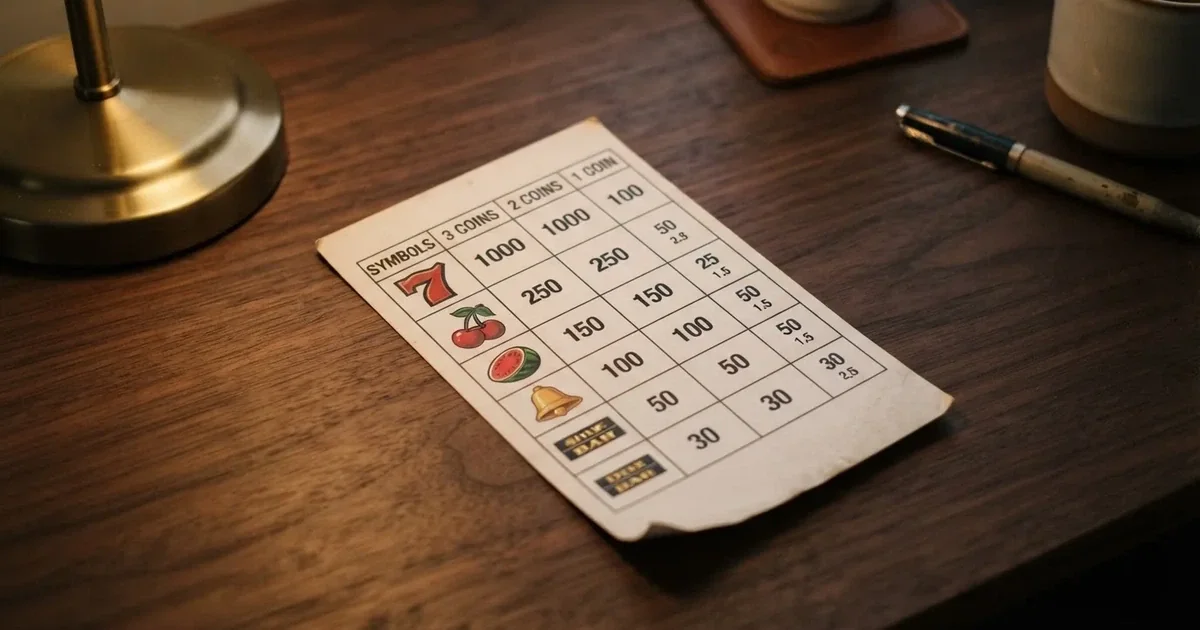
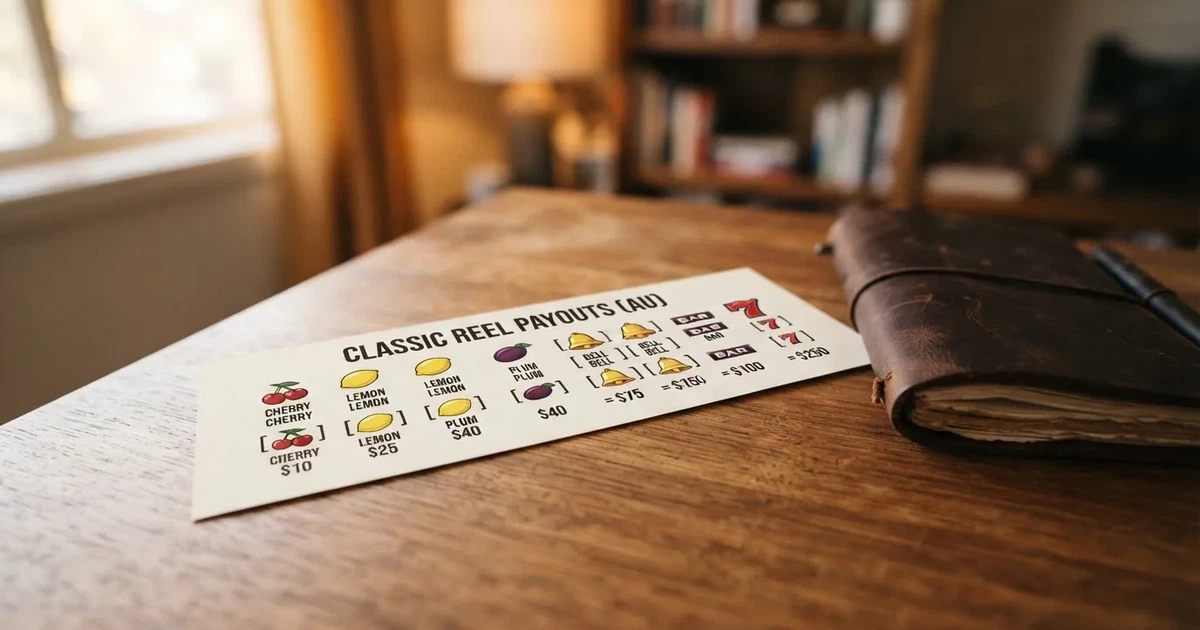
What the format looks like on a paytable is straightforward. Each reel carries a small set of symbols — typically eight to twelve — and a single horizontal payline crosses the centre. A win lands when a defined combination of symbols sits across that payline after the spin. The payouts are listed on the paytable: three of the rarest symbol pays the most, two of the rarest symbol pays less, mixed combinations pay less again. A wild symbol, where one exists, substitutes for others. A scatter symbol, where one exists, pays anywhere on the screen rather than only on the payline. Some 3-reel titles carry a small bonus feature — a second-screen pick, a nudge, a hold — but the format’s signature is what is not on the screen: no avalanche reels, no expanding wilds, no Megaways-style ways-to-win counters, no cascading bonus rounds. The reels spin, the line judges the result, the paytable tells you in advance what the result is worth.
The volatility comparison is where the format’s reputation was made. A classic mechanical 3-reel machine with about 10 symbols per reel has roughly 1,000 possible three-symbol combinations, and the longest-odds combination is in the order of one in a thousand. A modern video slot with five reels and fifty or more symbols per reel can carry combinations with odds as high as 300 million to one against, and the design budget that pays for those long shots comes out of the symbol distribution elsewhere on the reels. That is why a 3-reel machine tends to read as a steadier proposition: smaller top prizes, more frequent small wins, and a return-to-player profile that sits closer to the theoretical maximum than the volatile five-reel titles do. The house edge on a well-designed 3-reel machine is in the same general territory as on a five-reel video slot — typically a few per cent of turnover — but the variance is lower and the session looks flatter.
The Australian physical-pokies market is enormous, and it skews toward the five-reel video format that came after Money Honey. New South Wales recorded 87,298 pokies-style machines outside casinos in June 2023, Victoria 26,380 in 2021–22, Queensland 21,122 in October 2023, South Australia 11,672 in September 2023 and the ACT 3,587 in November 2023. By 2010 Australia was operating an estimated 97,103 gaming machines outside casinos, a per-capita rate about five times that of the United States. The 3-reel format persists on Australian floors — most pub and club venues still carry a small bank of classics alongside the video titles — but it is the smaller bank of the two. The pub punter looking for a 3-reel machine is generally looking at one of two or three machines in a row of forty.
A useful point of comparison is the regulatory minimum payout in jurisdictions that publish one. In the United States, Nevada requires a minimum slot payout of 75 per cent, Mississippi 80 per cent and New Jersey 83 per cent. These are floors, not the typical return on a modern machine, and the Australian market does not operate with an equivalent published minimum for gaming machines in pubs and clubs — the state and territory regulators approve games on a case-by-case basis under their own acts. The point of the comparison is to anchor the intuition that a 3-reel machine’s return is set in advance, on a paytable that the player can read, and that what the paytable says is closer to the truth on a 3-reel machine than on a five-reel title with a long odds tail.
The Australian regulatory frame that touches these machines on the floor is not the Interactive Gambling Act 2001 but the Casino Control Acts of each state and the gaming-machine acts that govern pubs and clubs. The NSW Casino Control Act 1992, for example, requires a casino operator not to permit a game to be played unless its rules are approved by the regulator, with a copy of those rules available to patrons on request. Victoria’s Casino Control Act 1991 places the same gatekeeper role on the Victorian Gambling and Casino Control Commission, which approved Crown Melbourne’s blackjack rule changes in 2024 (renaming the “Perfect Pairs” side bet to “Crown Pairs” on 23 December 2024 and introducing a “Free Bet” option with a new “Pot of Gold” side bet on 25 March 2024) and approved three baccarat variants at the Melbourne casino — Traditional Baccarat, Crown Baccarat and 2 to 1 Baccarat — under the regime that replaced the VCGLR on 1 July 2022. None of this is online, and none of it is the 3-reel format specifically; the relevance is that the regime that governs a real-money 3-reel machine in Australia is built around approved games, published rules and an in-person venue, and the online offshore market sits outside all of it.
The format, then, is a real thing, with a real history, and a real presence on Australian floors. Online, in Australia, it is the same format repackaged and offered by a market the law does not recognise.
Comparison: Offshore Sites Offering 3-Reel Slots and What the ACMA Record Shows
A comparison of offshore sites offering 3-reel slots in Australia has, by definition, a strange shape. Every site is unlawful to use from Australia, and the differences between them are not the differences between legal products. The comparison that is honest is a comparison of what the regulator has said about each: who runs it, when the ACMA warned it, what product the warning covered. The table below is built from the ACMA’s own formal warning publications, and the “brand”, “ACMA action and date” and “operator named by the ACMA” columns reflect those publications directly. The “subject support” column lists the third-party sources that associate each brand with 3-reel slot content — sources that confirm the brand carries the format on its platform, without vouching for the offer’s legality for Australians.
A reader looking at the table should hold two things in mind at once. The first is that the dates and operators in the ACMA column are the dates and operators the ACMA itself named in a formal warning; an earlier or later warning for the same brand is listed in the same cell. The second is that the entire field of “sites a player can compare” exists outside Australian law, and the comparison the table makes possible is a comparison of regulatory exposure, not a comparison of products a reader is free to choose from. No site on this list can be recommended to a reader as a place to play.
Operator Enforcement Summary
| Operator | Warning Dates | Brands Listed |
|---|---|---|
| Dama N.V. | 2022, 2025 | RocketPlay, Level Up, Woo, Spirit |
| Consolutetish S.R.L. | 2025 | National, Bizzo |
| Hollycorn N.V. | 2022 | Sky Crown |
| Ryker B.V. | 2026 | Jackbit |
| Bamboo Media | 2025 | Ignition |
| EOD Code SRL | 2025 | Instant |
| Sterplay Holding | 2025 | Casino Intense |
| Brand | ACMA action and date | Operator named by the ACMA | Subject support |
|---|---|---|---|
| RocketPlay | Formal warning, March 2026 (Pulsup Ltd) and May 2022 (Dama N.V.) | Pulsup Ltd / Dama N.V. | — |
| Level Up Casino | Formal warning, May 2022 | Dama N.V. | BGaming (content provider) |
| Woo Casino | Formal warning, March 2025 | Dama N.V. | No data |
| Spirit Casino | Formal warning, May 2025 | Dama N.V. | No data |
| National Casino | Formal warning, July 2025 | Consolutetish S.R.L. | Wikipedia (directory) |
| Bizzo Casino | Formal warning, July 2025 (Consolutetish S.R.L.) and 2022 (TechSolutions) | Consolutetish S.R.L. / TechSolutions | No data |
| Ignition Casino | Formal warning, July 2025 | Bamboo Media | No data |
| Instant Casino | Formal warning, February 2025 | EOD Code SRL | No data |
| Jackbit | Formal warning, April 2026 | Ryker B.V. | No data |
| Casino Intense | Formal warning, April 2025 | Sterplay Holding Ltd | ABC, ACMA, Crown Melbourne |
| Sky Crown | Formal warning, September 2022 | Hollycorn N.V. | No data |
The pattern in the table is not a ranking and is not a recommendation. It is the shape of the regulator’s enforcement activity, and the shape is uneven by design. Dama N.V. is the operator most often named — across RocketPlay, Level Up Casino, Woo Casino and Spirit Casino — and that repetition is itself the point: the same corporate group has been the subject of four ACMA formal warnings over a four-year span, and the warning cycle at the ACMA operates brand by brand, not operator by operator, so each appearance on the list is a separate brand the regulator has named. Consolutetish S.R.L. is the operator behind National Casino and Bizzo Casino, with Bizzo carrying the further weight of a 2022 warning to TechSolutions. Bamboo Media, EOD Code SRL, Ryker B.V., Sterplay Holding Ltd and Hollycorn N.V. each appear once.
What a player comparing options can take from the table is which brands have the longest regulator history and which operators keep appearing under new brand names. What a player cannot take is a recommendation. The Interactive Gambling Act 2001 prohibits the offer of online casino games and online pokies to Australians regardless of which offshore entity is making the offer, and an ACMA formal warning is the regulator’s public statement that the offer has been made. A reader who is choosing to play at any site on this list is choosing to do so outside Australian law, on terms the operator sets, with no Australian recourse if the terms are read against them.
Operator Write-Ups
The write-ups below describe each of the eleven brands the ACMA has acted against. The descriptions draw on the ACMA’s own formal warning publications for the regulator’s actions, on third-party listings for what the brand offers, and on the fact that no site on the list operates lawfully from within Australia. None of the write-ups is a recommendation, and none of them closes by suggesting the reader use the site.
RocketPlay
The ACMA issued a formal warning over RocketPlay (the operator’s site) in March 2026, naming Pulsup Ltd as the operator. The same brand had earlier been the subject of a May 2022 formal warning to Dama N.V., one of six Dama brands named in that round. The warning is the regulator’s statement that the operator offered prohibited interactive gambling services to Australians, and RocketPlay (the URL named) is the specific site the authority named in the March 2026 warning. No third-party source listed in research connects the brand to 3-reel slot content specifically, so the offer of the format on the platform cannot be affirmed from the inputs. The brand sits at the front of the table because it is the most recent ACMA action in the dataset; the regulatory exposure is the freshest on the list.
Level Up Casino
Dama N.V. was the named operator in the May 2022 ACMA formal warning that included Level Up Casino among six brands. No further ACMA action over the brand has been published in the inputs, and the brand is not listed in any of the more recent Dama rounds (March 2025, May 2025) that named Woo Casino and Spirit Casino respectively. Third-party listings at BGaming (a content provider) place Level Up Casino in a directory of casino brands that host its content, which is consistent with the brand carrying 3-reel slot titles from a provider with a substantial classic-format catalogue. The brand’s regulatory history is the single 2022 warning; nothing in the inputs suggests the ACMA has returned to it under a different name.
Woo Casino
The ACMA issued a formal warning over Woo Casino in March 2025, naming Dama N.V. as the operator. Dama N.V. is the same operator named in the May 2022 round that included RocketPlay and Level Up Casino, so the Woo Casino warning is the operator’s second appearance on the ACMA’s list. No third-party source listed in research connects Woo Casino specifically to 3-reel slot content; the listing is a no-data marker. The brand sits inside the Dama cluster and inherits the operator-level enforcement history that comes with that grouping.
Spirit Casino
The ACMA issued a formal warning over Spirit Casino in May 2025, naming Dama N.V. as the operator. This is the most recent Dama-related warning in the inputs, and the third brand in the cluster to carry a Dama operator name alongside RocketPlay, Level Up Casino and Woo Casino. No third-party source in the inputs associates Spirit Casino specifically with 3-reel slot content. The pattern across the Dama cluster is the comparison a reader can draw from the table: one operator, four brands, four ACMA formal warnings across four years.
National Casino
The ACMA issued a formal warning over National Casino in July 2025, naming Consolutetish S.R.L. as the operator. The same operator was named in the July 2025 warning over Bizzo Casino, and the same enforcement round covered Ignition Casino under a different operator (Bamboo Media). Third-party listings at en.wikipedia.org include National Casino in a directory of brands that carry online casino content, which is consistent with the brand hosting 3-reel slot titles alongside other formats. The brand’s specific regulatory exposure is the July 2025 warning; the operator-level exposure extends to Bizzo Casino.
Bizzo Casino
The ACMA issued a formal warning over Bizzo Casino in July 2025, naming Consolutetish S.R.L. as the operator. The brand had earlier been the subject of a 2022 formal warning to TechSolutions (CY) Group Limited and TechSolutions Group N.V., making Bizzo the only brand on the list with two operator names attached in the ACMA’s own publications. The pattern is a brand moving between corporate groups and the regulator following it across the change. No third-party source in the inputs associates Bizzo Casino specifically with 3-reel slot content. The two-warnings-across-two-operators structure is the comparison that matters here.
Ignition Casino
The ACMA issued a formal warning over Ignition Casino in July 2025, naming Bamboo Media as the operator. The brand name is shared with several offshore casino brands operating in multiple markets, and the ACMA’s formal warning identifies the specific Australian-facing service the regulator found in breach. No third-party source in the inputs connects Ignition Casino to 3-reel slot content specifically. The brand’s regulatory exposure is the July 2025 warning; the operator, Bamboo Media, is not named elsewhere on the ACMA list in the inputs.
Instant Casino
The ACMA issued a formal warning over Instant Casino in February 2025, naming EOD Code SRL as the operator. The warning is one of the earlier 2025 actions in the dataset and precedes the broader July 2025 round that named National Casino, Bizzo Casino and Ignition Casino. No third-party source in the inputs associates Instant Casino with 3-reel slot content. The brand sits outside both the Dama cluster and the Consolutetish cluster, and its regulatory history is the single February 2025 warning.
Jackbit
The ACMA issued a formal warning over Jackbit in April 2026, naming Ryker B.V. as the operator. The same warning also named CasinOK, with both brands falling under the same Ryker B.V. corporate group. No third-party source in the inputs associates Jackbit with 3-reel slot content specifically. The April 2026 warning is among the most recent in the dataset and places the brand inside the post-reform enforcement window — the Interactive Gambling Amendment (Gambling Reform) Bill 2026 had passed Parliament by August of the same year, but in April 2026 the law in force was the 2017 amendment to the Interactive Gambling Act 2001.
Casino Intense
The ACMA issued a formal warning over Casino Intense in April 2025, naming Sterplay Holding Ltd as the operator. Third-party listings in the inputs include ABC, the ACMA and Crown Melbourne among the sources that mention the brand — a list dominated by regulator and news sources rather than affiliate pages, which is consistent with the brand’s primary visibility in the Australian context being through the ACMA’s own action rather than through promotional coverage. No third-party source in the inputs confirms 3-reel slot content on the Casino Intense platform. The brand’s regulatory exposure is the single April 2025 warning.
Sky Crown
The ACMA issued a formal warning over Sky Crown, naming Hollycorn N.V. as the operator. The same formal warning also named Blue Leo, with both brands falling under the same Hollycorn N.V. corporate group. The warning publication is the September 2022 PDF on the ACMA’s site, which makes Sky Crown the oldest formal warning in the dataset alongside the Dama cluster’s May 2022 publication. No third-party source in the inputs associates Sky Crown with 3-reel slot content specifically. The brand’s regulatory exposure is the oldest on the list, which means the longest period during which the operator has been on the ACMA’s public record.
The Blocking Rate as a Picture of the Market
The arithmetic that belongs to this page is the pace of the ACMA’s blocking programme — how many sites the regulator has removed from Australian reach, and how that figure has built up since the first blocking request in November 2019. The total of 1,751 blocked websites by June 2026, against the November 2019 starting point, gives a running rate that can be stated as a band. Across roughly 79 months from November 2019 to June 2026, the average works out to about 22 blocked sites per month, or roughly 265 per year. The figure is not a calendar rate — the ACMA’s blocking requests are issued in rounds of varying size, with the single round of 26 June 2026 alone adding 12 sites — and the right way to read it is as an average over the full period, not as a forecast of any single month’s activity.
A reader weighing what the figure means is weighing three things at once. The first is that the average is built on the regulator’s own blocking requests, which are the cases the ACMA investigated, found to be in breach, and referred to Australian ISPs for blocking. The second is that the 1,751 total includes both illegal gambling services and affiliate marketing websites, so the count of casino sites specifically is lower than the headline. The third is that the same period saw more than 230 unlicensed gambling services leave the Australian market entirely without a blocking order, which is the cleaner outcome from a regulator’s perspective — a service that withdraws removes itself from the question.
The blocking rate is the visible edge of a larger picture, and the larger picture is the H2 Gambling Capital estimate of A$3.9 billion a year in losses to illegal gambling sites in Australia, against the 74-to-64 per cent fall in the share of gambling going through legal channels between 2021 and the 2025 estimate. The block-and-leave programme has not reversed that fall. It has, by the inputs the regulator publishes, removed the most flagrant cases from Australian reach. The punter looking for 3-reel slot play online today is, in practice, looking at sites outside the 1,751 — and outside them does not mean safe, only means not yet on the list.
Overview: What a Reader Holds at the End of the Page
A 3-reel slot is a real format with a real history and a real presence on Australian pub and club floors. The pub punter who walks into a venue with 200 poker machines and finds two 3-reel classics in a corner of the gaming floor is looking at a format that has not disappeared, only been out-marketed. The format’s paytable is simpler than a five-reel video slot’s, its volatility is lower, and its session profile is flatter. None of those facts depends on whether the punter is looking at the format online or on a venue floor.
Online, the picture is shaped by the Interactive Gambling Act 2001. The product is prohibited, the offer is prohibited, and the ACMA enforces the prohibition through blocking requests, formal warnings and referral of the most flagrant operators to ISPs. The 1,751 blocked sites since November 2019 are the visible output of that enforcement, and the eleven brands named in ACMA formal warnings in the inputs above are a slice of the operator population the regulator has named. A punter comparing those eleven brands is comparing offshore corporate structures and the regulator’s record against them, not products that are lawful to choose between in Australia.
The choice the law leaves a reader is not between sites; it is between the legal Australian wagering market, which does not offer 3-reel slots, and the offshore market, which does and which sits outside Australian consumer protection. For a punter who wants 3-reel play specifically, the legal alternative is the venue floor — a pub, a club, a casino — and the format is available on those floors. For a punter who has been playing offshore and wants to bring their play back inside the Australian framework, BetStop and the National Gambling Helpline are the right next move, and a 1800 858 858 call is free, confidential and 24/7. The page closes by holding both sides of the choice plainly: the format exists, the prohibition exists, and the reader’s path through them is theirs to choose.
Frequently Asked Questions
What makes a 3-reel slot different from a standard five-reel video slot?
A 3-reel slot uses three reels, usually eight to twelve symbols per reel, and a single horizontal payline across the centre. A five-reel video slot uses five reels with many more symbols and multiple paylines, ways-to-win patterns or both. The 3-reel format has fewer possible combinations — roughly a thousand on a classic mechanical build against hundreds of millions on a long-odds video title — and tends to deliver flatter, lower-volatility sessions.
Can 3-reel slot machines be found in licensed Australian pubs and clubs?
Yes. Australian pubs and clubs operate close to 200,000 poker-style machines outside casinos, with New South Wales holding the largest share at 87,298 as of June 2023. The vast majority of those are five-reel video titles, but most venues keep a small bank of 3-reel classics on the floor, and the format persists on the legal Australian market in physical venues.
Do 3-reel slots typically pay out differently than newer five-reel formats?
The return-to-player percentage is set by the paytable on both formats and is published (or made available on request) for approved games. The 3-reel format tends to deliver smaller, more frequent wins because the symbol distribution is concentrated, while five-reel video slots concentrate the design budget into rare long-shot combinations. Volatility differs even when the headline return is similar.
Is a 3-reel slot online the same game as a 3-reel machine on a casino floor?
The paytable structure is the same — three reels, a small symbol set, a single payline, a top prize for three of the rarest symbol — but the underlying machine is different. A casino-floor 3-reel machine is mechanical or electromechanical and is approved by a state regulator under the relevant Casino Control Act. An online 3-reel slot is a software emulation hosted by an offshore operator and is not approved by an Australian regulator. The game looks the same; the legal framework does not.
Are 3-reel slots for real money available legally from an Australian-based site?
No. The Interactive Gambling Act 2001, as amended in 2017, prohibits the offer of online casino games and online pokies to anyone in Australia, and no state or territory licenses them. A 3-reel slot offered online to an Australian is offered in breach of the Act, regardless of any offshore licence the operator displays on its site.
Do reel count and paytable structure affect how a slot’s volatility is described?
Yes. Volatility is a function of the symbol distribution and the paytable, and a 3-reel machine with a small, evenly weighted symbol set has lower volatility than a five-reel video slot with rare long-shot symbols even when the theoretical return is similar. Reel count, paytable weighting and the presence or absence of features like scatters and wilds all feed into the volatility profile a player experiences in a session.
Created by the ”Casino Mobile Hub AU” editorial team.