
Picking Your Way Through $5 PayID No-Deposit Casino Offers in Australia
 Available in US
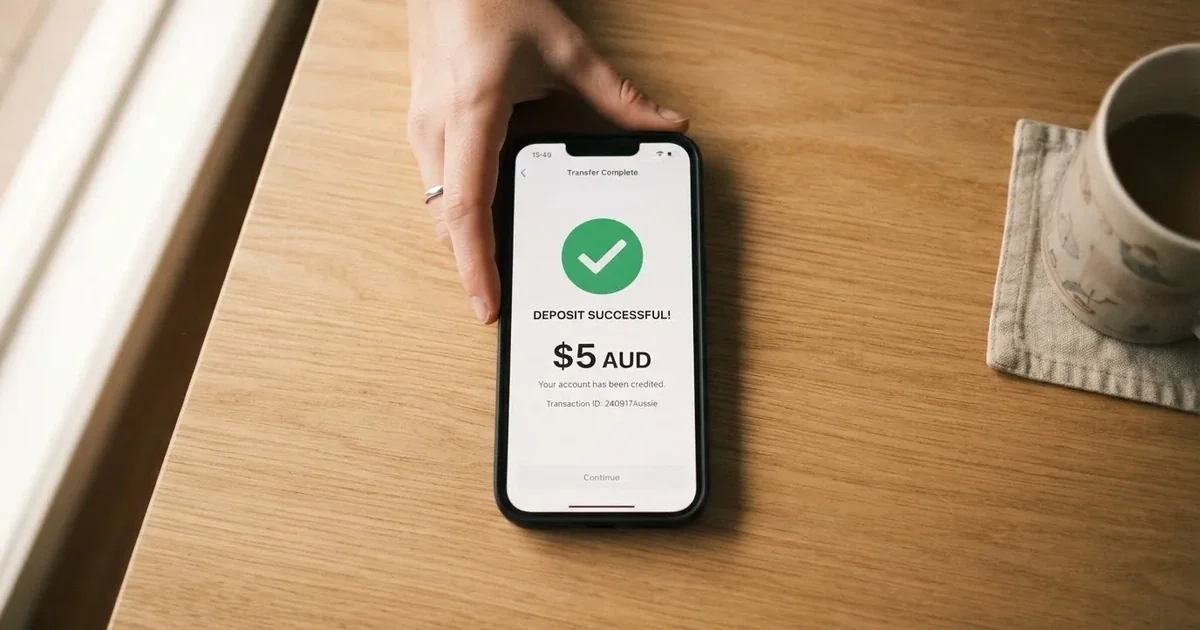
A “free $5 PayID no-deposit casino bonus” looks like the easiest way to test a pokies site — hand over a PayID, the site credits five dollars, no money leaves the bank account. The mechanism is half Australian and half offshore, and the split matters more than the headline number. PayID is real, ubiquitous, and runs on the Reserve Bank’s New Payments Platform. The casino that wants to credit you that $5 is not. Online casino games and online pokies cannot be licensed in any Australian state or territory, and every brand behind one of these offers sits somewhere else. The choice on this page is therefore not which operator to trust with your PayID but which kind of risk you are accepting, and what the PayID half actually does for you when the casino half is not what it appears to be.
Data current as of 24 September 2026 and checked against the ACMA’s formal-warning register.
Table of Contents
- The settlement picture: what a PayID no-deposit bonus legally sits on
- When the offer itself feels like a problem
- The payments half: how PayID actually behaves
- What a “$5 no-deposit bonus” generally involves
- How to compare these offers fairly — without ranking the sites
- What actually sits in front of the player
- What choosing actually looks like
- The fundamentals: what this market is
- What the choice comes down to
- Frequently asked questions
The settlement picture: what a PayID no-deposit bonus legally sits on
The Interactive Gambling Act makes the offer, not the payment
The Interactive Gambling Act 2001 (IGA), tightened by the Interactive Gambling Amendment Act 2017, makes it an offence to provide online casino games, online pokies or in-play betting to a person physically in Australia. No state or territory issues a licence for any of those products. What is licensable is wagering on races and sport placed before the event, lotteries, and keno — and even those are effectively licensed through one body, the Northern Territory Racing and Wagering Commission, which oversees 52 of Australia’s online bookmakers including Sportsbet, Bet365 and Ladbrokes, has no full-time staff and meets once a month in Darwin.

A “casino bonus” sits outside everything the NTRWC covers. The moment the offer says “pokies”, “table games”, “live dealer” or any equivalent, the site behind it is not licensed in Australia. It may display a Curaçao, Anjouan or Kahnawake seal, but those licences do not give it any standing under the IGA, and they do not put it inside BetStop or any Australian complaints process. The player side is not prosecuted — the IGA targets the provider — but the practical consequence of a withdrawal refusal, a frozen balance or a site going dark is that you have no Australian body to take it to.
What the ACMA has actually done about it
The Australian Communications and Media Authority investigates, issues formal warnings and can direct Australian internet service providers to block illegal sites. As reported in June 2026, a running total of 1,751 illegal gambling and affiliate marketing websites had been blocked since the first blocking request in November 2019, and more than 230 unlicensed gambling services had left the Australian market since enforcement was strengthened in 2017. A single round reported on 26 June 2026 alone added 12 more names: 7Signs, ChromaBet, Donbet, Duospin, Freshbet, Slots Gem, Jacks Club, Lucky Start, Pointsbetz, Spinrise, Vinyl Casino and Wildsino. The blocking list is long because the entry list is long — and the names on the list shift every few months.
H2 Gambling Capital’s 2025 report estimates Australians lose about A$3.9 billion a year to illegal gambling sites, and the share of gambling going through legal channels fell from 74% in 2021 to 64%. Both directions of that move matter: more money is going to offshore sites, and a smaller proportion of total gambling is reaching the channels an Australian regulator can reach.
The reforms that have not yet taken effect
The Interactive Gambling Amendment (Gambling Reform) Bill 2026 passed Parliament on 19 August 2026. Its advertising and inducement measures commence on 1 January 2027. On a 2026 page, that is a law with a start date rather than a law already biting — worth knowing, not worth treating as the current state of play.
When the offer itself feels like a problem
Help is free, confidential, and around the clock
A $5 no-deposit bonus is a small number next to the kind of deposit that causes people harm. The size is not what matters. What matters is whether the act of chasing the offer, depositing for the next one, or chasing losses after the bonus runs out has started to feel compulsive or stressful. If it has, free confidential help is available around the clock through Gambling Help Online and the National Gambling Helpline on 1800 858 858.
Self-exclusion only binds the operators it covers
BetStop, the National Self-Exclusion Register, has been live since August 2023 and binds every Australian-licensed online and phone wagering service. Offshore casinos are not connected to it. Registering with BetStop closes off the legal side of the market; it does not close off a single offshore site. A punter using a self-exclusion tool needs to know exactly what that tool covers and what it does not, and treat the two halves separately.
Where winnings and losses sit with the ATO
Gambling winnings of a recreational player are not assessable income under section 6-5 of the ITAA 1997, and losses are not deductible, unless the person carries on a business of gambling. The model answer, for almost any reader of this page, is recreational, and the ATO answer is “no tax, no deduction”. Anyone uncertain should check with the ATO directly.
The payments half: how PayID actually behaves
What PayID is and is not
A PayID is an easy-to-remember identifier — a mobile number, email address, ABN or Organisation Identifier — linked to a bank account. It is operated by Australian Payments Plus (AP+), the country’s domestic payments provider, and is offered by over 100 Australian financial institutions, built directly into their online banking. As of April 2025 there were more than 25 million registered PayIDs in Australia. The system runs on the Reserve Bank of Australia’s New Payments Platform (NPP), which launched in February 2018, and the RBA also operates the Fast Settlement Service that settles NPP transactions individually in close to real time, around the clock.
PayID is a way to address a payment to a person or business in Australia. It is not a way to identify who is on the other side of an offshore casino. Paying to a PayID shows the name of the account holder before the transfer is sent — that is the check that protects against scams and mistaken payments. AP+ makes the warning explicit: if a person is asked to transfer funds to a PayID on an illegal gambling site, it is almost certainly a “scambling” website — AP+’s own term for illegal online gambling platforms advertised on social media and messaging apps that trick people into gambling on a scam site. PayID itself will never contact a customer directly; emails or texts claiming to be from PayID are scams, and PayID never asks anyone to send money in order to receive money or to “upgrade” an account.
Osko and what “instant” actually means
With Osko by AP+, a bank transfer between participating Australian banks arrives in under a minute, twenty-four hours a day including weekends, whether addressed to a BSB and account number or to a PayID. The transfer is instant on the Australian side — the money leaves the sender’s account and lands in the receiver’s account almost immediately, with the receiver’s name shown before confirmation. What Osko does not do is touch the offshore casino at the other end. The speed stops at the Australian bank boundary; whether the receiving entity deposits the funds into a casino balance, refunds them, or disappears with them is a separate question the PayID mechanism does not answer.
Bank-side gambling blocks bite at the card, not the PayID
Westpac’s gambling block works at card level: it refuses authorisation of transactions registered under the merchant category code “Betting/Casino Gambling” on eligible personal credit and debit cards. ANZ’s gambling transaction block, activated in the ANZ app, also blocks gambling transactions made through a digital wallet such as Apple Pay on an eligible card, and turning the block off again requires a 48-hour waiting period. Both banks warn that not all gambling transactions will be blocked, and that some non-gambling transactions might be blocked in error.
By the end of 2025, Apple Pay, Google Pay and Samsung Pay collectively accounted for around 45% of all card payments in Australia by number. Apple does not charge fees to consumers for using Apple Pay in stores, online or in apps — any surcharge is the merchant’s own card-processing fees. Apple sets no transaction limits or PIN requirements; those are set by the card issuer or merchant.
These card-level blocks do not automatically intercept a PayID transfer. The PayID path bypasses the card network entirely. A punter who has turned on a gambling block at the bank to keep themselves off casino sites can still move money through PayID to a PayID the bank cannot recognise as gambling-related. The block is a useful guardrail for card transactions; it is not a guardrail for everything.
What a PayID on an offshore casino looks like in practice
The PayID presented to an Australian player is, almost always, an account belonging to a payment processor or a corporate entity rather than to the casino brand itself. The casino hides behind a layer the player cannot see, and the AP+ warning applies directly: being asked to transfer money to a PayID on an illegal gambling site almost certainly means a scam site. The “instant” feeling of the transfer, and the appearance of a familiar Australian identifier, is the part of the experience that is genuinely Australian. The decision about what to do with the money once it arrives is not.
What a “$5 no-deposit bonus” generally involves
The shape of the offer without naming a brand
A no-deposit bonus credits a small amount — typically A$5 to A$20 — to a new account on registration, before any deposit. The marketing proposition is “free money to try the site”. In practice, the terms attached to that A$5 are where the cost lives. The common pattern is a wagering requirement: the bonus, or any winnings from it, must be turned over a set number of times before a withdrawal is permitted. Wagering multiples of thirty to fifty times the bonus are common in this corner of the market. A $5 bonus with a 40x multiplier means A$200 of qualifying bets before any cash can be taken out.
A second common pattern is a maximum cashout cap — even if the wagering is cleared, the bonus terms may limit withdrawals from no-deposit play to a fixed figure, often in the A$50 to A$100 range. A third is a restricted game list: the bonus may only be played on specified slots, sometimes only one slot, and playing outside that list voids the bonus. A fourth is a time limit, often 7 days, after which the bonus and any winnings from it expire.
The house edge is the part the offer does not advertise
Every slot and table game has a house edge. The marketing material says “free $5”. The arithmetic says the player has to win enough to clear the wagering requirement before the house edge has had its full effect on those $200 of qualifying bets. For a typical online slot with an RTP around 96%, the expected loss across A$200 of qualifying bets is A$8 — which means the A$5 bonus is, on average, worth less than A$0 to a player who plays it to completion. The bonus is not “free”. It is “free to claim, expensive to clear”.
What “PayID” does and does not change about the offer
PayID is a payment rail. It does not change the wagering requirement, the cashout cap, the game list, or the time limit. What it does change is the appearance of legitimacy at the deposit and withdrawal moment: a familiar Australian identifier, a fast transfer, a name attached. That appearance is the marketing value of pairing a no-deposit bonus with PayID rather than with, say, a credit card. The substantive terms of the offer are unaffected.
Why the offer exists at all
A no-deposit bonus is a customer-acquisition cost. The casino writes off, on average, the A$5 plus the cost of the wagering churn, in exchange for a player who has registered, supplied identification documents, and supplied a PayID the casino can target with future deposit offers. The $5 is the price of entry into a longer marketing relationship. A player who reads it as a one-off gamble is reading it the way the marketing copy is written; a player who reads it as the first step of an ongoing relationship is reading it the way the operator’s spreadsheet sees it.
How to compare these offers fairly — without ranking the sites
What a fair comparison would weigh
The factors that decide what a $5 no-deposit bonus is actually worth are the wagering multiple, the maximum cashout, the eligible games, the time limit, and whether any deposit is required to withdraw. The factors that decide whether the offer is a safe place to put a PayID are the licence the site displays, who the operator behind it actually is, where the company is registered, and whether the ACMA or any Australian regulator has acted against it.
What the comparison cannot weigh
It cannot weigh trust. There is no Australian complaints body to take a complaint to, no Australian regulator to complain to, and no Australian deposit guarantee. A site that displays a Curaçao or Anjouan licence is regulated by that jurisdiction, not by Australia, and an Australian punter who has a dispute has the dispute in a foreign jurisdiction under a foreign regime. The bonus terms may be fair; the recourse is not.
What the comparison can weigh
It can weigh the offer against the IGA: any site offering online casino games or online pokies to a person in Australia is operating outside Australian law. That is a yes-or-no test, not a comparison. It can weigh the offer against the ACMA register: every brand named below has had a formal warning issued against it under the IGA. That is a yes-or-no test, also not a comparison. Inside those two tests, the wagering terms, the cashout cap, the eligible games and the time limit are the only things left to compare — and those are the only terms the affiliate marketing pages that carry these offers do not publish.
What the rest of this page does instead of comparing
The table below does not rank the brands. It records, against each one, what the ACMA has actually done, when, and against which corporate entity. The wagering terms, cashout caps, eligible games and time limits are not recorded because no source independent of the affiliate marketing pages carries them, and what those pages publish is not what the audit would accept as a figure. A reader who wants the bonus terms goes to the operator’s own page; a reader who wants the regulatory record comes here.
The brands the ACMA has acted against
| Brand | ACMA action and date | Operator named by the ACMA | Subject support |
|---|---|---|---|
| RocketPlay | Warning under the IGA — March 2026; earlier warning under the same Act in May 2022 | Pulsup Ltd (Rocketplay); earlier Dama N.V. | — |
| Level Up Casino | Warning under the IGA — May 2022 | Dama N.V. | Listings reference Westpac’s gambling block |
| Woo Casino | Warning under the IGA — March 2025 | Dama N.V. | — |
| Spirit Casino | Warning under the IGA — May 2025 | Dama N.V. | — |
| National Casino | Warning under the IGA — July 2025 | Consolutetish S.R.L. | Listings reference AUSTRAC and Wikipedia entries |
| Bizzo Casino | Warning under the IGA — July 2025; earlier warning in 2022 | Consolutetish S.R.L.; earlier TechSolutions (CY) Group Ltd and TechSolutions Group N.V. | — |
| Ignition Casino | Warning under the IGA — July 2025 | Bamboo Media | — |
| Instant Casino | Warning under the IGA — February 2025 | EOD Code SRL | Listings reference ecoPayz and PayID |
| Jackbit | Warning under the IGA — April 2026 | Ryker B.V. | — |
| Casino Intense | Warning under the IGA — April 2025 | Sterplay Holding Ltd | Listings reference AUSTRAC, iTnews and NAB |
| Sky Crown | Warning under the IGA — September 2022 | Hollycorn N.V. | — |
The “Subject support” column records where independent listings mention the brand in a non-marketing context — a regulator page, a banking reference, an encyclopedia entry. Where the column is empty, the only references found were affiliate marketing pages, and those have not been used as a source. The “listings reference” entries are not endorsements. AUSTRAC pages, for instance, cover reporting obligations rather than player protection; NAB’s and iTnews’s references concern bank-side transaction blocking; the PayID reference in the Instant Casino row is AP+’s general gambling warning, not a recommendation. None of these changes the regulatory status of the brand.
What the picture says, and what it does not
The picture says the ACMA has acted against every brand on the list. Some have been acted against twice — Bizzo Casino, RocketPlay, with multiple operators named over the lifetime of the warnings. Some of the operators named are the same corporate entity operating under different brand names — Dama N.V. covers Woo Casino, Spirit Casino, Level Up Casino and earlier RocketPlay. The picture does not say any of these brands has been convicted of an offence; the IGA’s enforcement tool here is the formal warning, not prosecution. The picture also does not say the bonus terms are bad. The terms are not in the audit’s evidence base at all.
What actually sits in front of the player
The mechanism from the player’s side
A player signs up, supplies a PayID, sees an A$5 bonus credited, plays through the wagering requirement, and tries to withdraw. The withdrawal path runs through the same PayID, normally. The Australian side of that withdrawal is fast; the casino’s decision to release the funds is separate. The bank’s gambling block does not block PayID transfers, so it does not block the withdrawal either. What blocks the withdrawal is the casino’s own terms — a wagering requirement not met, a maximum cashout exceeded, a game played that was not on the eligible list, or a withdrawal request from an account the casino has decided to close. None of those are PayID problems.
The mechanism from the regulator’s side
The ACMA’s blocking tool works at the internet-service-provider level, not at the payment level. A blocked site does not process a withdrawal to a PayID; a balance can sit on the site until the site is unblocked or until the operator decides to release it. The player has no Australian body to escalate to. The PayID mechanism on the Australian side cannot do anything about a casino that has decided to keep the money.
The mechanism from the bank’s side
A bank can block card transactions coded as gambling, and ANZ’s block covers Apple Pay transactions on a blocked card, but neither bank blocks PayID transfers to a non-gambling-coded recipient. The PayID, in practice, will be registered to a payment processor or a corporate entity, and the bank’s gambling-coded merchant block will not catch it. The bank’s tools stop at the card network. The PayID is outside it.
The mechanism from the operator’s side
The casino sees the PayID as a payment route and as a marketing channel. The PayID itself is not a regulatory signal. A casino that takes PayID is no more licensed, no more accountable, and no more recourse-bearing for an Australian player than a casino that takes cryptocurrency or a wire transfer. PayID is the payment rail; it is not the licence.
What choosing actually looks like
The path for a reader who has decided the risk is acceptable
For a reader who understands the offer is offshore, accepts that no Australian regulator covers it, accepts that no Australian complaints body covers it, and has decided to engage anyway, the comparison between brands is narrow. The two things that vary between brands are the operator behind the licence and the ACMA record. The ACMA record is in the table above. The operator behind the licence is what the affiliate page may or may not publish.
The path for a reader who wants PayID without the offshore casino
PayID and Osko work with Australian-licensed wagering services — bookmakers licensed by the NTRWC and similar. The product set is narrower: pre-event sports and racing bets, lotteries, keno. There is no “casino bonus” against any of these, because online casino games and online pokies are not licensed products. PayID and Osko on this side of the market are real, fast and Australian-regulated. They are also not what an offshore casino is offering.
The path for a reader who has decided not to engage
For a reader who has decided the offer is not worth the regulatory gap, the only thing the ACMA register and the operator warnings are needed for is to confirm the decision. The 1,751 sites blocked since November 2019 and the A$3.9 billion estimated lost annually to illegal gambling sites are the numbers that justify the decision, not a comparison to be made inside it.
The path for a reader who is being marketed to
AP+’s term — “scambling” — describes a specific pattern: illegal online gambling platforms advertised on social media and messaging apps that trick people into gambling on a scam site. Anyone who has arrived at an offer through an Instagram post, a Telegram channel or a text message is in the pattern AP+ is warning about. PayID’s own guidance is direct: being asked to transfer money to a PayID on an illegal gambling site almost certainly means a scam site. The mechanism of how the offer arrived is a signal, not a coincidence.
The path for a reader whose gambling is starting to feel out of control
The National Gambling Helpline on 1800 858 858, Gambling Help Online chat, and BetStop registration are free, confidential, and available regardless of whether the reader has decided to engage with an offer or not. BetStop covers the legal side of the market; the helpline covers everything else. The two together are the answer to a question that has nothing to do with PayID and everything to do with what comes after it.
The fundamentals: what this market is
What it is not
It is not a market. There is no Australian-licensed supply of online casino games and online pokies, and the Interactive Gambling Act 2001 explicitly prohibits one. The brands on this page are not a market in the sense a comparison of bookmakers would be a market — competing products under one regulator with one complaints process and one set of consumer protections. They are a marketing channel that addresses Australians from outside the Australian regulatory perimeter.

What it is
It is the demand for online casino games and online pokies that the IGA makes unlawful to supply from inside Australia, met by offshore operators who are not licensed in Australia, are not connected to BetStop, and have been issued formal warnings by the ACMA at various points for offering prohibited services to people in Australia. The $5 PayID no-deposit bonus is the entry point of that channel. PayID is the part of the experience that feels Australian. The casino is not.
The pacing of the enforcement picture
A rough sense of the pace: from the first ACMA blocking request in November 2019 to the running total reported in June 2026, the cumulative count has reached 1,751 illegal gambling and affiliate marketing websites. That is an average in the order of 250 to 275 sites added to the blocking list per year, or roughly 20 to 23 per month, with the monthly figure fluctuating around the timing of individual blocking rounds — some months carry a single round adding a dozen sites, others carry nothing. The pace has held steady enough to suggest the supply side is not contracting in response to enforcement; it is rotating. A site blocked today is replaced by a new one next month under a different brand name and a different corporate entity. The 230-plus unlicensed services that have left the Australian market since 2017 reflect that rotation — services that moved on, were wound up, or were never replaced in the same form.
Why the rotation matters to a reader
A reader who is comparing two specific offers is comparing them at one point in time. The ACMA register is a moving picture: a brand that has been warned twice has been warned for offering prohibited services to Australians on two separate occasions, and a brand that has not yet been warned may be warned next month. The table on this page is a snapshot, not a seal of approval, and reading it as either a blacklist or a whitelist is the wrong frame. The frame is that every brand on it has been told, formally, that what it is doing to Australians is illegal, and has continued.
The two questions a reader actually has
The first is whether the bonus is worth the regulatory gap. That is a question about appetite for risk with no Australian recourse, and it is not a question this page answers for anyone. The second is what PayID itself is doing in the experience. The answer to that is: PayID is making the deposit and withdrawal feel Australian. It is not making the casino Australian.
What this page is for
It is for a reader who wants to know what is actually behind a “$5 PayID no-deposit casino bonus” in Australia, who wants to know what the regulator has done, and who wants to know what PayID itself contributes to the experience. It is not for a reader looking for a recommendation of where to play, and it does not contain one.
What the choice comes down to
The market this search lands in is the offshore market. Every brand behind a $5 PayID no-deposit bonus operates outside the Interactive Gambling Act 2001, has been the subject of an ACMA formal warning or is one blocking round away from being one, and offers no Australian consumer protection, no Australian complaints body, and no connection to BetStop. PayID makes the money move quickly and makes the casino feel familiar; it does not make the casino legal. The $5 is a customer-acquisition cost the casino writes off in exchange for an account the casino can market to. The wagering terms on the bonus are where the actual cost lives for a player who clears them, and the typical shape of those terms makes the bonus worth less than the headline figure on average. Anyone who has decided to engage is choosing between brands whose ACMA records are in the table above, and the differences between them are smaller than the differences between any of them and an Australian-licensed wagering service. For a reader who has decided not to engage, the path through BetStop, the National Gambling Helpline and Gambling Help Online is open and free.
Frequently asked questions
Does the ACMA actually block the sites offering these bonuses?
Yes. The ACMA has directed Australian internet service providers to block illegal gambling sites since November 2019, and as reported in June 2026 the running total had reached 1,751 illegal gambling and affiliate marketing websites. A single round reported on 26 June 2026 added twelve more names. The blocking is at the ISP level; it does not freeze balances on those sites, and it does not give a player a complaints channel.
Is PayID itself proof the casino is Australian?
No. PayID is operated by Australian Payments Plus and is offered by over 100 Australian financial institutions, but a PayID is just an address for a payment. AP+ warns directly that being asked to transfer funds to a PayID on an illegal gambling site almost certainly means a scam site, and the PayID on an offshore casino is normally registered to a payment processor or a corporate entity, not to the casino brand itself. The speed and the name display are Australian; the recipient usually is not.
Why is a no-deposit bonus paired with PayID specifically?
PayID makes the deposit and the future withdrawal feel Australian. The familiarity of the identifier and the instant arrival are a marketing asset to an offshore casino trying to look legitimate. The wagering terms, the cashout cap, the eligible games and the time limit on the bonus are unaffected by the payment rail. What PayID adds is the appearance of trust; what PayID does not add is the substance.
Does sending money via PayID change which country regulates the casino?
No. The country that regulates the casino is the country that issued the licence the casino displays — typically Curaçao, Anjouan or Kahnawake for the brands on this page. PayID is a payment rail that starts and ends at an Australian bank, but the casino sits outside that rail. The Interactive Gambling Act 2001 prohibits the supply of online casino games and online pokies to a person in Australia regardless of how the money moves.
Is the $5 bonus actually free?
On average, no. A typical no-deposit bonus in this corner of the market carries a wagering multiple of thirty to fifty times the bonus amount, a maximum cashout cap, a restricted game list and a short expiry. Across A$200 of qualifying bets on a slot with an RTP around 96%, the expected house-edge loss is in the order of A$8. The bonus is free to claim and, on average, more expensive to clear than the headline figure suggests.
Prepared by the Casino Mobile Hub AU editorial staff.