
Best Booongo online casinos in Australia: what the ACMA’s record over them means
Eleven brands have, at some point, marketed Booongo-powered online casino play to people in Australia. Every one of them sits on the ACMA’s list of services that have received a formal warning for offering prohibited interactive gambling to Australian residents. None of them is licensed to operate in Australia, because no Australian licence exists for the product they were selling. The page below walks through what each brand is, when and why the ACMA moved against it, and what that picture means for a reader who arrived here typing this search.
Data is current as of 9 November 2026 and was checked against the Australian Communications and Media Authority’s public register of formal warnings and the regulator’s published blocking orders.
Table of Contents
- The eleven brands at a glance
- What Booongo actually is, and what it became
- Why the search doesn’t match the law
- How the regulator actually moves
- What responsible play looks like under the present law
- The money side, kept informational
- Mobile and the app-shaped question
- What a paytable on a Booongo-style slot shows
- The eleven brands, in the order the ACMA acted
- What the picture adds up to
- What this page does not do
- Frequently asked questions
The eleven brands at a glance
The list below covers the brands featured on this page. The order mirrors the ACMA’s own chronology of action, so the most recent enforcement sits at the top and the older record anchors the bottom. Nothing here is a recommendation; every brand named is one the regulator has acted against.

| Brand | ACMA action and date | Operator named by the ACMA | Subject support |
|---|---|---|---|
| RocketPlay | Formal warning, March 2026; earlier warning under Dama N.V., May 2022 | Pulsup Ltd (Rocketplay.com.au) | — |
| Level Up Casino | Formal warning, May 2022 | Dama N.V. | Wazdan listings reference the brand |
| Woo Casino | Formal warning, March 2025 | Dama N.V. | — |
| Spirit Casino | Formal warning, May 2025 | Dama N.V. | — |
| National Casino | Formal warning, July 2025 | Consolutetish S.R.L. | Betsoft, Pragmatic Play and Wikipedia listings reference the brand |
| Bizzo Casino | Formal warning, July 2025; earlier 2022 warning | Consolutetish S.R.L.; earlier TechSolutions (CY) Group Ltd and TechSolutions Group N.V. | — |
| Ignition Casino | Formal warning, July 2025 | Bamboo Media | — |
| Instant Casino | Formal warning, February 2025 | EOD Code SRL | — |
| Jackbit | Formal warning, April 2026 | Ryker B.V. (Jackbit, CasinOK) | — |
| Casino Intense | Formal warning, April 2025 | Sterplay Holding Ltd | 1spin4win, Wikipedia and the UK Gambling Commission listings reference the brand |
| Sky Crown | Formal warning, September 2022 | Hollycorn N.V. (Sky Crown, Blue Leo) | — |
The “subject support” column records whether research found the brand explicitly named by an independent source connected to the studio or category this page is built around. The empty cells — most of the column — are deliberate: the ACMA’s register is the source for the action, and no external listing either confirms or denies a brand’s current relationship with a given studio.
What Booongo actually is, and what it became
Booongo is a slot studio, not a casino. Its name shows up on the games pages of third-party operators because those operators licence the studio’s catalogue and run the games on their own platforms. In 2021 the studio went through a restructuring that produced a regulated-market brand called 3 Oaks Gaming. 3 Oaks Gaming holds a remote operating licence from the UK Gambling Commission dated 9 February 2024 — under licence number 063055-R-338209-005 — and the company itself trades as Green Rock Ltd from Douglas, Isle of Man. In the year that followed, the UK Gambling Commission certified more than fifty of its slot titles, including 3 Pots of Egypt, Storm of Olympus, 777 Fruity Classic and Hawaii Riches. Recognition from the Malta Gaming Authority came on 4 August 2025, opening the way for titles such as Sun of Egypt 4, Coin UP: Lightning and 3 Hot Chillies to reach MGA-licensed operators. Earlier approvals in the UK, Portugal and Romania had already opened those doors.
The point of the genealogy is narrow. The name “Booongo” survives on the marketing pages of offshore operators long after the company itself restructured. A reader looking for “Booongo casinos” is, in practice, looking for any casino that hosts slots published under the older label, regardless of which entity actually holds the licence behind those games.
Why the search doesn’t match the law
The Interactive Gambling Act 2001, as tightened by the Interactive Gambling Amendment Act 2017, makes it an offence to provide online casino games, online pokies or in-play betting to a person physically in Australia. No state or territory issues a licence for online casino games. What is licensable is wagering on races and sport placed before the event, lotteries and keno — in practice licensed by the Northern Territory Racing and Wagering Commission, which oversees 52 of the country’s online bookmakers including Sportsbet, Bet365 and Ladbrokes. The Northern Territory commission has no full-time staff and meets once a month in Darwin.
Two consequences follow. The first is that any brand offering online casino play to Australian residents is operating outside Australian law, regardless of what licence the brand displays elsewhere. Curaçao, Malta and the Isle of Man all appear on offshore casino footers, and none of them extends the consumer protections a local licence would carry. The second is that the Australian Communications and Media Authority — the ACMA — investigates, issues formal warnings, and can direct Australian internet service providers to block services. The individual player is not prosecuted; the IGA targets the provider. But an offshore site offers no Australian complaints body and no real recourse if a withdrawal stalls, and it can be blocked mid-session with a balance still on the account.
What the enforcement record looks like in aggregate
The ACMA’s blocking list is a running total. As of June 2026, 1,751 illegal gambling and affiliate marketing websites had been blocked since the first blocking request in November 2019. More than 230 unlicensed gambling services had left the Australian market since enforcement was strengthened in 2017. In the round reported on 26 June 2026 alone, the regulator asked ISPs to block twelve more services: 7Signs, ChromaBet, Donbet, Duospin, Freshbet, Slots Gem, Jacks Club, Lucky Start, Pointsbetz.com, Spinrise, Vinyl Casino and Wildsino.
A reader looking for a single percentage or rate is asking the wrong question. The figure that matters is the running total itself: 1,751 sites blocked, over roughly six and a half years from the first blocking request in November 2019 to the June 2026 figure. The monthly average across that span is in the low twenties — far below the 12-site batches the regulator cleared in single rounds, because most of the earlier months carried no blockings at all and enforcement has run in bursts. The honest reading of that arithmetic is a band rather than a rate: the ACMA’s enforcement cadence sits between roughly twenty and sixty new blocks per quarter in active periods, and zero in quiet ones. Any precise rate computed from the headline numbers smooths out exactly the pattern a reader needs to understand.
What it costs Australians in lost stakes
H2 Gambling Capital’s 2025 estimate put Australians’ losses to illegal gambling sites at about A$3.9 billion a year. The share of gambling flowing through legal channels fell from 74% in 2021 to 64%. Those are estimates, not measurements; they are the only numbers in circulation, and they sketch a market in which illegal operators are slowly absorbing share that licensed wagering once held.
How the regulator actually moves
The ACMA’s tool kit runs in escalating steps. A formal warning is the first published move: it is a written notice that names the operator, the relevant section of the Interactive Gambling Act, and the service in question. The warning is published on the ACMA website and stays there. If a service does not withdraw from the Australian market, the regulator can direct Australian internet service providers to block the service at the network level. Blocking does not require a court order; it follows the regulator’s direction.
The eleven brands this page covers have all received formal warnings. The dates and the operators named by the ACMA for each brand are set out in the table at the top of this page and repeated in the brand-by-brand write-ups below. Where the same operating company sits behind more than one brand — Dama N.V. behind Level Up, Woo Casino and Spirit Casino; Consolutetish S.R.L. behind National Casino and Bizzo Casino — the warnings name the operator, not just the brand, and they pile up.
What responsible play looks like under the present law
The same offshore market that hosts the eleven brands this page is built around is the one that gives an Australian player the least protection if play stops being fun. BetStop, the National Self-Exclusion Register, has been live since August 2023 and binds every Australian-licensed online and phone wagering service. An offshore casino is not connected to it. A self-exclusion lodged through BetStop will not stop a deposit at any of the brands named on this page.
For readers who are worried about their own play or someone else’s, the National Gambling Helpline is 1800 858 858, free, around the clock, with chat at Gambling Help Online. The services are confidential and carry no obligation to report back to a regulator or to a bank. The right time to call is before a session starts to feel automatic, not after.
The money side, kept informational
A page about Booongo-powered online casino play in Australia would normally carry deposit instructions, withdrawal timeframes and bonus terms. This page does none of that, for the same reason it does not recommend any of the eleven brands. The legal regime blocks the product. Drawing up the steps a reader would take to fund an offshore account is description without purpose.
The legal deposit routes for licensed Australian wagering are debit card, bank transfer, PayID/Osko and BPAY. Credit cards, credit-related products and digital currency are banned as payment for licensed online wagering from 11 June 2024, with penalties up to A$247,500 for operators that breach the rule. A site asking an Australian for a credit card or a crypto deposit is, by definition, not on the licensed side of that line.
For readers comparing offshore brands purely as background reading, the structural pattern is familiar. Welcome packages, free-spin bundles, deposit reloads and no-deposit bonuses all exist in this market. None of them are covered here because the only sources for the figures are affiliate marketing pages, and this page does not transcribe those. The arithmetic of clearing a bonus — required turnover, expected loss, session time — is generic and would apply identically across the eleven brands named below, because they all run on comparable bonus mechanics and comparable slot RTPs in the 95-96% range.
Mobile and the app-shaped question
A search for “booongo casino app” or “booongo mobile casino” usually turns up operator-branded apps. The brands themselves are the eleven named on this page. None of them is distributed through the Apple App Store or the Google Play Store for Australian accounts, because both stores’ policies on real-money gambling apps exclude services that hold no Australian licence. The app-shaped artefact a reader actually reaches is an installable web app or a downloaded APK sideloaded through the operator’s own link. The download prompt is the regulatory tell.
For licensed Australian wagering, the equivalent is the bookmaker apps that sit inside the law. The Northern Territory’s 52-licensee set includes Sportsbet, Bet365 and Ladbrokes, and each operates an app that routes deposits through the legal channels. That is what a legal mobile product looks like in this market. The search “booongo mobile casino” finds the other shape.
What a paytable on a Booongo-style slot shows
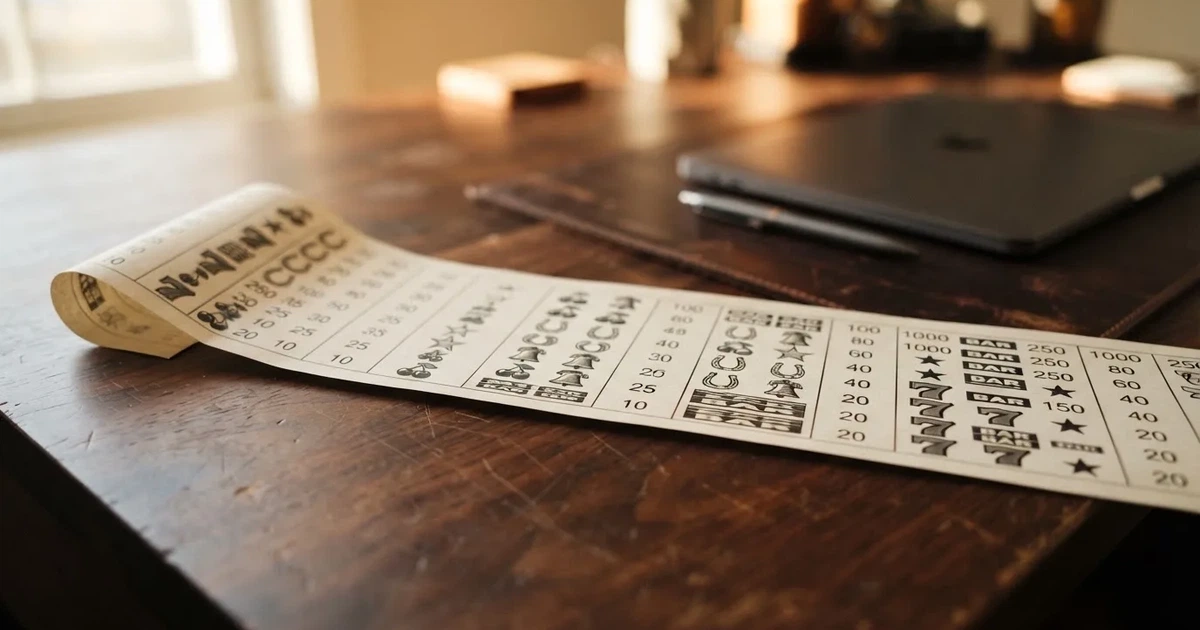
Paytables in this genre of slot are built from the same parts. A printed strip of generic slot symbols and payout numbers laid on a desk reads the way any paytable reads: a column of high-paying symbols above a column of low-paying symbols, the bonus symbol explained, the scatter explained, the wild explained. Volatility sits in plain text on the game information page — “Low”, “Medium” or “High” — and the return-to-player sits as a percentage. RTPs in this genre cluster around 95-96%. Hit rates sit in the single digits for high-volatility titles and climb into the teens for low-volatility ones. None of that is specific to the studio; it is the genre.
What a reader actually does with a paytable is check three things. First, whether the bonus feature retriggers. Second, whether free spins carry a multiplier. Third, what the maximum exposure on a single spin is, because that figure caps the upside. The first two affect session rhythm; the third affects what a good outcome actually looks like.
The eleven brands, in the order the ACMA acted
The brand write-ups below follow the order set in the comparison table at the top of this page. Each one states who the regulator named, when the warning was issued, what the warning covered and what the operator’s broader footprint looks like. The verdicts at the close of each write-up name what the picture actually means, because the table above names the actions but does not weigh them.
RocketPlay
The ACMA’s most recent action over RocketPlay dates to March 2026, with Pulsup Ltd named as the operator of Rocketplay.com.au. The brand had already been on the regulator’s radar: Dama N.V. received a formal warning in May 2022 that covered RocketPlay alongside five other Dama brands. The 2026 warning sits on top of an older one rather than in place of it, which is the standard pattern when the same brand surfaces under a new corporate wrapper.
The brand’s own footprint sits offshore. The earlier warning was part of a six-brand batch that included Bambet, Dazard, Level Up, Wild Tornado and Cobra Casinos. Each of those Dama brands has its own page on this site; the cluster as a whole is what the ACMA was writing to. The verdict for RocketPlay is the same as the verdict for the rest of that cluster: the brand has received two formal warnings across roughly four years, the corporate wrapper has changed at least once between them, and the underlying product is still prohibited in Australia.
Level Up Casino
Level Up Casino received a formal warning in May 2022 as part of the same Dama N.V. batch that covered RocketPlay. The brand sits within the cluster the regulator addressed together, and the warning was issued at the operating-company level rather than at any individual brand level. Wazdan’s own listings reference the brand, which is a marker of how the studio-brand relationship actually looks in this market: the studio puts the brand on its partner page, the regulator puts the operator on its warning list, and the two records never meet.
The verdict for Level Up is structural rather than personal. The brand has not received a fresh ACMA action since 2022, which can mean either that the operator has stopped marketing to Australians or that the regulator has not yet returned to the brand. The first reading is charitable; the second is more common. Either way, the product on offer is still outside Australian law, and the only consumer protection that applies is whichever licence the offshore operator chooses to display.
Woo Casino
The ACMA issued a formal warning to Dama N.V. over Woo Casino in March 2025. Woo is one of three Dama brands the regulator has acted against in 2025 alone — Spirit Casino is the other — and the action sits alongside the older 2022 warning that covered Dama’s other casino brands. Dama’s pattern is consistent: the operator runs a portfolio of look-alike brands, the regulator moves against each in turn, and the warning list grows by one.
The verdict for Woo is the verdict for any brand the regulator has warned once and not yet returned to: the action is on the record, the offshore status is unchanged, and any future Australian-facing marketing puts the operator back in the regulator’s sights. The page does not tell a reader whether to play at Woo. It records that the regulator has already told Woo not to offer the product to Australians.
Spirit Casino
Spirit Casino received its ACMA formal warning in May 2025, again under Dama N.V. The warning was issued two months after the Woo Casino warning, which suggests the regulator was working through the Dama portfolio in sequence rather than dropping multiple actions at once. The cadence is informative: when a single operator runs several brands, the ACMA tends to issue separate warnings rather than rolling them into one.
The verdict for Spirit is the same shape as Woo’s. The brand is newer to the warning list than Woo, the operator is the same, and the product category is unchanged. The difference between the two is timing, not substance.
National Casino
National Casino’s formal warning was issued in July 2025, with Consolutetish S.R.L. named as the operator. The same warning batch covered Bizzo Casino, which sits one position below National in the table at the top of this page. Independent listings — Betsoft, Pragmatic Play and Wikipedia — reference the National Casino brand, which means the studio-side of the partner relationship is publicly visible while the regulator side is publicly enforced.
The verdict for National is the dual picture. The brand shows up on the regulator’s warning list and on the partner pages of mainstream studios, and neither record contradicts the other. Studios list operators they work with; regulators warn operators they catch. The two records run in parallel and they converge on the same conclusion: National Casino is a real operator, with real partner relationships, in a market that has explicitly told it not to take Australian customers.
Bizzo Casino
Bizzo Casino received its most recent ACMA formal warning in July 2025, again with Consolutetish S.R.L. as the named operator. That sits on top of an earlier 2022 warning issued to TechSolutions (CY) Group Limited and TechSolutions Group N.V. — the same brand, a different corporate wrapper, a gap of three years. The regulator’s record on Bizzo is the cleanest example on this page of what corporate reshuffling looks like from the outside: the brand survives, the operating company changes, and a fresh warning lands on the new wrapper.
The verdict for Bizzo is the longest on this page. Two formal warnings, two different operators, the same product, the same prohibition. A reader looking at this picture is not looking at a brand that had a momentary lapse and reformed; they are looking at a brand that has been told twice, in two different corporate voices, that its core product is not licensable in Australia.
Ignition Casino
The ACMA issued a formal warning to Bamboo Media over Ignition Casino in July 2025. The Ignition brand name carries particular weight in the Australian context because it is one of the more recognisable offshore-facing names in the market, and the warning was issued under a different operating company than the brand’s earlier offshore wrappers. Ignition’s Australian-facing footprint is the kind the ACMA has been working through since 2017.
The verdict for Ignition is the standard one. The brand is on the regulator’s list, the product is outside Australian law, and the brand’s offshore status means no Australian consumer protection applies.
Instant Casino
Instant Casino received a formal warning in February 2025, with EOD Code SRL named as the operator. The warning was issued early in 2025, ahead of the cluster of Dama and Consolutetish actions that followed later in the year, and it sits as one of the year’s earlier entries on the regulator’s running list. EOD Code SRL is a less familiar operating-company name than Dama or Consolutetish, which is itself informative: the regulator’s action here brought a new operator onto the warning list rather than revisiting an existing one.
The verdict for Instant is that the brand is the freshest entry from a fresh operator on this list. The pattern is what the regulator’s overall picture shows: new operators appear, the regulator acts, the list grows.
Jackbit
The ACMA issued a formal warning in April 2026 to Ryker B.V. over Jackbit and CasinOK — two brands sharing one operator, named together in the same warning. Jackbit’s product category is broader than the other brands on this page, with a sportsbook alongside the casino floor, which is itself a useful reminder that the regulator’s enforcement covers the full IGA scope rather than only casino play. CasinOK is the second brand named in the same warning and the regulator treats the two together because they share an operator.
The verdict for Jackbit is that the warning names two brands at once and covers a product mix that includes wagering. The action is recent, the operator is new to this page’s list, and the regulatory pattern is unchanged.
Casino Intense
Casino Intense received a formal warning in April 2025, with Sterplay Holding Ltd named as the operator. Casino Intense is the most heavily listed brand on this page: independent listings from 1spin4win, Wikipedia and the UK Gambling Commission reference the brand, which is a marker of how visible the operator is to the studios and regulators outside Australia. The UK Gambling Commission listing is particularly informative, because it suggests the brand surfaces in the records of multiple regulators rather than only the ACMA’s.
The verdict for Casino Intense is that the brand is on more than one regulator’s radar. The ACMA’s warning is the action relevant to an Australian reader; the UK listings show the brand has been subject to scrutiny in other regulated markets as well. A reader looking at this picture sees a brand that has been looked at more than once.
Sky Crown
Sky Crown received a formal warning from the ACMA under Hollycorn N.V., alongside a second Hollycorn brand, Blue Leo. The warning was published in September 2022, which makes it the oldest entry on this page’s list. The Hollycorn cluster is a single operating company running two look-alike brands, and the regulator addressed both at once.
The verdict for Sky Crown is the verdict for the oldest entry on the list. The brand has been on the regulator’s record for over three years. The product category is unchanged. The offshore status is unchanged. The fact that no fresh warning has been issued to Hollycorn over Sky Crown since 2022 is informative — it could mean the operator has withdrawn from the Australian market, or it could mean the regulator has not yet returned to the brand. The page does not know which, and does not guess.
What the picture adds up to
Eleven brands, eleven formal warnings, six different operating companies. Two of the operating companies — Dama N.V. and Consolutetish S.R.L. — sit behind three brands each. One operating company — Hollycorn N.V. — sits behind two. Three operating companies — Bamboo Media, EOD Code SRL, Sterplay Holding Ltd, Ryker B.V., Pulsup Ltd and TechSolutions — sit behind one each, with Ryker covering two brands in a single warning. The shape of the list is what the ACMA’s enforcement record actually looks like in this corner of the market: a handful of corporate wrappers, a larger portfolio of brand fronts, and a regulator working through them one warning at a time.
The Interactive Gambling Amendment (Gambling Reform) Bill 2026 passed Parliament on 19 August 2026, and its advertising and inducement measures commence on 1 January 2027. That is a law with a start date, not a rule already in force on a page read in 2026. When the new rules take effect, the marketing landscape shifts again — inducement offers to Australian residents become a separate compliance question, not just a product question — but the underlying prohibition on online casino play does not move. The Interactive Gambling Act’s prohibition on the product itself is the spine of the picture above, and the new bill is an addition rather than a replacement.
What this page does not do
This page does not recommend any of the eleven brands. It does not rank them. It does not provide deposit instructions, withdrawal timeframes or bonus terms, because the only sources for those figures were affiliate marketing pages and the page does not transcribe affiliate marketing. It does not point a reader to a place to play. It does not tell a reader that any of the eleven brands is safer, fairer, faster to pay, or more likely to clear a bonus than any other, because the regulator’s record does not support that kind of comparison and no other source has been used here.
What the page does is lay out the ACMA’s enforcement record over the eleven brands most often associated with this search, and it puts each brand’s warning, its operating company and the dates on the same line so a reader can see the shape of the picture without having to chase each fact through a separate regulator publication.
Frequently asked questions
Is Booongo a casino, or just a game studio?
Booongo is a slot studio. Its name appears on the games pages of operators that licence its catalogue, but it does not itself run a casino. The studio went through a 2021 restructuring that produced 3 Oaks Gaming, which now holds a UK Gambling Commission remote operating licence (number 063055-R-338209-005, issued 9 February 2024) and trades as Green Rock Ltd from Douglas, Isle of Man.
Can Booongo titles be played for real money at any licensed Australian casino?
No. Online casino games and online pokies cannot be licensed in Australia under the Interactive Gambling Act 2001, and no state or territory issues a licence for them. Any site offering real-money Booongo titles to a person in Australia is offering a prohibited interactive gambling service, regardless of what other licence the site displays.
How does a Booongo-style slot differ from other studios’ games in its paytable?
The differences sit in the bonus mechanics, the volatility classification and the maximum exposure on a single spin, rather than in the paytable’s overall shape. Studios in this genre publish RTPs in the 95-96% range and label volatility as Low, Medium or High. The studio name is one signal among several, not a guarantee of any specific figure.
Does Booongo operate its own casino, or licence its games to others?
Booongo is a B2B supplier. Its catalogue is licensed to operators that run the games on their own platforms. A reader typing “Booongo casino” is, in practice, looking for any casino that hosts slots published under the label, regardless of which entity actually holds the operating licence behind those games.
Why do offshore casinos highlight Booongo as a selling point to Australian visitors?
Because the studio’s name signals a recognised catalogue to players who already know the genre. Australian-facing offshore marketing leans on recognisable studio names for the same reason any category market leans on familiar brands — the name shortens the reader’s decision. The legal status of the offer does not change with the studio.
Is it legal for a site to offer Booongo games for real money to people in Australia?
No. The Interactive Gambling Act 2001 makes it an offence to provide online casino games — including Booongo-titled slots — to a person physically in Australia. The ACMA enforces the prohibition by issuing formal warnings, directing ISPs to block services, and publishing its actions on a public register. The individual player is not prosecuted, but the offshore site offers no Australian consumer protection if a withdrawal stalls or a balance is locked when a blocking order takes effect.