
Best online pokies for real money in Australia in 2026 — the lawful paths and what the ACMA has acted against
Real money online pokies are not legally on offer to anyone in Australia. The Interactive Gambling Act 2001, strengthened in 2017, makes it an offence to provide online casino games — including online pokies — to a person physically in Australia, and no state or territory licenses them. That is the first fact a reader needs, and it is also the reason this page is shaped the way it is: the comparison a reader typing “best online pokies real money” expects is not a comparison a serious page can honestly give. Instead, the page lays out the gap plainly, names the brands the ACMA has formally warned for offering exactly that product, and points to what is actually open to an Australian player in 2026 — licensed land-based venues, the Northern Territory wagering market that does exist, and the BetStop self-exclusion tool that does reach the offshore sites where money is still flowing.

Current as of 30 October 2026 and cross-checked against the ACMA’s published list of formal warnings and blocking requests.
Table of Contents
- Why an Australian reader cannot simply sign up and play
- The legal frame: what the Interactive Gambling Act 2001 actually covers
- How the ACMA enforces the prohibition
- The scale of money moving through offshore sites
- The state-by-state design rules on pokies
- PayID, deposits and how money actually moves
- Mobile and app experience: the gap between licensed and offshore
- The games themselves: baccarat and blackjack at licensed venues
- The brands the ACMA has formally warned
- What the player-protection frame looks like in 2026
- What an Australian reader is actually choosing between
- What changes for a reader using the comparison
- The blocking-rate arithmetic, in plain prose
- Where the money goes when it leaves the licensed frame
- Frequently asked questions
Why an Australian reader cannot simply sign up and play
The headline sits in plain sight: section 15 of the Interactive Gambling Act 2001 makes it an offence to provide a “prohibited interactive gambling service” to a person in Australia, and the 2017 amendments extended that prohibition to online casino games, online pokies and in-play betting on sport. The statute is built around the provider, not the individual player, so an Australian who opens an account with an offshore casino commits no offence — the operator offering the service is the one exposed. The exposure is real: the ACMA (Australian Communications and Media Authority) can direct Australian internet service providers to block a website, issue formal warnings that are published on its website, and refer matters to the Australian Federal Police. The block comes with no warning and no notice to the player, and any balance left in an offshore account at the moment of blocking is, in practice, stranded behind a wall the operator has no Australian obligation to help the player around.

What this page does, then, is not pretend the market exists. It shows what the ACMA’s enforcement record looks like, what the lawful alternatives are, and where the player’s money actually ends up when it leaves Australia through an offshore site. The choice is a real one — between licensed venues, licensed wagering operators, and offshore sites that the regulator has explicitly named — and each of those paths carries a different cost to the person using it.
The legal frame: what the Interactive Gambling Act 2001 actually covers
The IGA distinguishes between services that are prohibited and services that are licensed. Online casino games — table games, online pokies, live dealer games — are prohibited and cannot be licensed anywhere in Australia. What is licensed is wagering on racing and sport placed before the event (pre-match, not in-play), lotteries and keno. In practice the licensed online wagering market is concentrated in the Northern Territory: the Northern Territory Racing and Wagering Commission (NTRWC) regulates 52 of Australia’s online bookmakers, including Sportsbet, Bet365 and Ladbrokes, with the Territory licences held for tax reasons. The commission itself is small — no full-time staff, monthly meetings in Darwin — and it is the de facto national regulator for online wagering without being styled as one.
What is banned as a payment route for licensed wagering has been narrowed since 2024. Credit cards, credit-related products and digital currency have been banned as a deposit method since 11 June 2024, with penalties up to A$247,500 for operators that break the rule. The legal deposit routes for an Australian-licensed wagering account are debit card, bank transfer, PayID/Osko and BPAY. A site asking for a credit card or a crypto deposit is therefore operating outside the Australian rules even if it claims a Curaçao or Anjouan licence elsewhere.
The 2026 reform sits in a specific spot: the Interactive Gambling Amendment (Gambling Reform) Bill 2026 passed Parliament on 19 August 2026, with its advertising and inducement measures commencing on 1 January 2027. The law is enacted but not yet in force on a 2026 page, so the conduct it covers remains governed by the existing regime until that date. A reader asking about an offer in late 2026 is still on the old framework; a reader asking about one in February 2027 is on the new one.
On age, the floor is uniform: 18 across every Australian jurisdiction for any gambling product.
How the ACMA enforces the prohibition
The ACMA’s enforcement toolbox has three visible instruments. First, formal warnings — public documents naming the operator and the brand, dated and posted on the regulator’s site. Second, blocking requests to Australian ISPs, which produce an actual block on the website for Australian users. Third, referrals and civil penalty proceedings where the conduct warrants them.
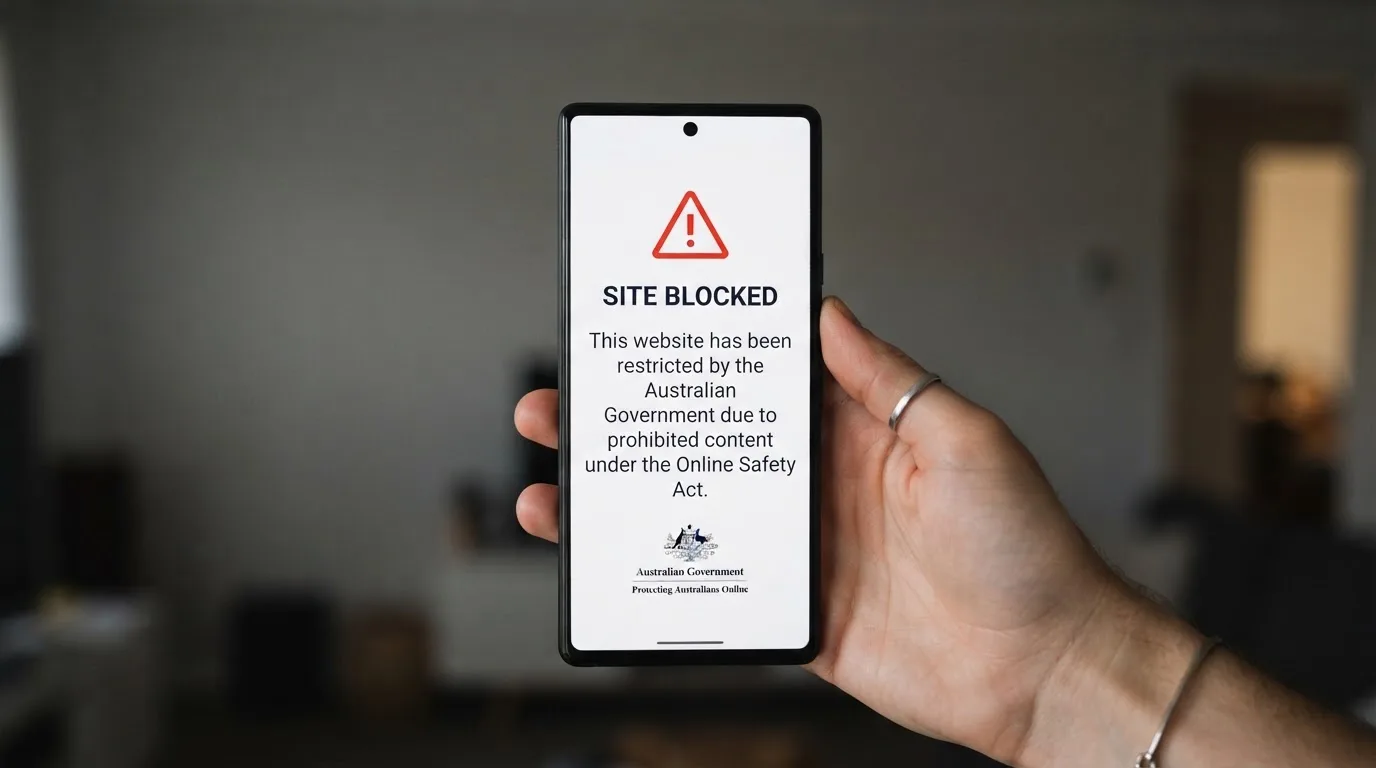
The blocking instrument is the one with the cleanest data. The ACMA’s own running total, reported in June 2026, is that 1,751 illegal gambling and affiliate marketing websites have been blocked since the first blocking request in November 2019 — a running tally kept over six and a half years. In the same period, more than 230 unlicensed gambling services left the Australian market after enforcement was strengthened in 2017. A single blocking round in 2026 (reported 26 June 2026) asked Australian ISPs to block 12 more sites: 7Signs, ChromaBet, Donbet, Duospin, Freshbet, Slots Gem, Jacks Club, Lucky Start, Pointsbetz.com, Spinrise, Vinyl Casino and Wildsino. The blocking rate is therefore not a steady drip — it is a series of larger monthly or quarterly rounds, with the cumulative total rising on a known trajectory since 2019. The rate at which the total grew, from the first blocking request in November 2019 to a published 1,751 in June 2026, works out to a band of roughly 235 to 270 sites blocked per year across that period, with the year-to-year figure varying as the ACMA’s monthly rounds have grown or shrunk. The condition on that band matters: it counts only sites the regulator has acted on, which is a subset of the offshore market, and the cumulative figure is what the regulator publishes — not the total universe of illegal sites ever to exist.
The formal-warning instrument tells a different story, because it is a public record of who the operator behind a blocked site actually is. The ACMA names a corporate entity — Dama N.V., Hollycorn N.V., Bamboo Media, Consolutetish S.R.L., EOD Code SRL, Ryker B.V., Sterplay Holding Ltd, Pulsup Ltd — and attaches that entity to one or more brands. Several operators own multiple brands: Dama N.V. alone has been warned over Bambet, Dazard, Level Up, Rocketplay, Wild Tornado and Cobra Casinos in May 2022, with further warnings over Woo Casino in March 2025 and Spirit Casino in May 2025. Consolutetish S.R.L. has been warned over National Casino and Bizzo Casino in July 2025, with Bizzo Casino previously warned over TechSolutions in 2022. The brand an Australian player sees on the page is, in many cases, one of several sitting behind the same parent entity — a structural feature of the offshore market that the warnings lay bare.
The third instrument — referrals and civil penalty proceedings — is the regulator’s escalation route when warnings do not change conduct. It is the one that produces penalties the operator can feel, and it has been used against several of the entities named in the warning record. A reader who sees a brand on this page has seen it for a reason: the ACMA has already acted on it.
The scale of money moving through offshore sites
H2 Gambling Capital’s 2025 estimate puts Australian losses through illegal offshore gambling sites at roughly A$3.9 billion a year. The same data shows the share of gambling going through legal channels falling from 74% in 2021 to 64% in the 2025 estimate — a 10-point swing in four years, with the offshore share absorbing the difference. The trend matters because it shows the regulator’s enforcement is operating against a rising tide of demand, not against a residual market.
On the lawful side, the 2020–21 figures from the Australian Bureau of Statistics and the state regulators show the scale of the land-based market Australians actually do spend on: roughly A$150 billion was bet through gaming machines in 2020–21, with A$12.18 billion lost on them. Australia has about 3% of the world’s pub and club poker machines with 0.3% of the global population. New South Wales alone had 87,298 gaming machines outside casinos across 2,195 venues in June 2023, with player losses of A$8.18 billion in 2022–23. Queensland had 21,122 machines across 351 venues in October 2023; Victoria had 26,380 outside Crown Casino across 488 venues in 2021–22, against a 30,000-machine statewide cap. These are the machines Australians do play — and the online product the searcher is asking about is the offshore version of the same machine.
The state-by-state design rules on pokies
What the law actually requires of a legal pokie is set state by state, not federally, and the minimum return-to-player (RTP) figures vary accordingly. New South Wales, the Northern Territory, Queensland and Victoria (with the exception of Crown Melbourne, which sits at 87%) all run at a minimum RTP of 85%. The Australian Capital Territory and Tasmania require 87%; South Australia 87.5%; Western Australia 90%. The floor matters because it is the regulator’s guarantee that the machine returns a stated proportion of turnover over its design life — a guarantee that has no Australian equivalent for an offshore online pokie.
Crown Perth is the structural exception in Western Australia: poker machines were banned in pubs and clubs when Crown Perth opened in 1985, but the casino’s own machine count has since grown from roughly 200 in 1985 to around 2,500, all approved by the state’s Gaming and Wagering Commission. Tasmania held a Federal Group monopoly over poker machines from 1968, ended by legislation passed in November 2021, with oversight moved to the Tasmanian Liquor and Gaming Commission. Tasmania’s planned nation-leading mandatory pre-commitment cards were delayed until late 2025 — a reform that would have set a binding per-player loss limit on every machine in the state, and that has not yet shipped in full. Each jurisdiction regulates design, venue count and player protections separately; what the federal law does not touch, the state regime does.
PayID, deposits and how money actually moves
PayID sits inside the legal payment set for licensed Australian wagering — it is one of the four allowed deposit routes, alongside debit card, bank transfer and BPAY. What PayID is, in plain terms, is a way of attaching a memorable identifier (a phone number, an email, an ABN) to a bank account so that transfers clear via the Osko rails in near-real time, usually within seconds. For a player with a licensed Australian wagering account, that means a deposit arrives in the account the moment it is sent, with no card processing and no chargeback route.
For an offshore casino, PayID is not on the list of approved payment methods at the Australian end — the operator may accept it from its side, but the player’s bank may treat the transaction as a transfer to an unverified payee and apply its own risk controls. The legal position is the same regardless of the deposit rail: an offshore casino offering online pokies is offering a prohibited service, and PayID does not change that. What PayID does change is the practical question of how the player’s money reaches the operator and how easily it can be recovered if the operator refuses a withdrawal.
The 2024 credit-card and crypto ban closes the deposit routes that gave a player any meaningful recourse: a credit-card chargeback could be raised through the card issuer, and a crypto deposit could be tracked on-chain. With those routes closed for licensed operators and in any case ineffective for offshore ones, an Australian using PayID or a bank transfer to fund an offshore account is funding a service the regulator has already named, with no Australian complaints body and no Australian consumer protection behind it.
Mobile and app experience: the gap between licensed and offshore
A licensed Australian wagering operator’s app sits in the standard iOS or Android stores, is published by the licensed entity, and is subject to the 11 June 2024 payment rules at the deposit stage. The product set is racing and sport, not pokies or casino games — the app exists to place a pre-event wager, watch a livestream of a meeting, and manage the account balance.
An offshore casino’s mobile experience is delivered two ways. Some sites are mobile-browser only, requiring no download and exposing the player to the full site. Others ship an APK sideloaded outside the store, or an installable PWA. Either way the player is using software published by an entity the ACMA has named in a formal warning, with no store review and no recourse if the software behaves unexpectedly. The mobile question for an Australian player is therefore not which app has the better interface — it is which product the app is offering, and what Australian protection sits behind the interface.
A real money pokies app for Australian players, in the sense the search phrase implies, does not exist as a licensed product. What does exist is licensed wagering apps that carry no pokies content, and offshore apps that carry pokies content and that the ACMA has acted against.
The games themselves: baccarat and blackjack at licensed venues
Two games that recur in any real money discussion — baccarat and blackjack — are both available at Crown Melbourne and other licensed Australian casinos, and both carry rule sets approved by the relevant state regulator. Under section 66 of the NSW Casino Control Act 1992, a casino operator must not permit a game such as baccarat to be played unless the game and its rules are approved by the regulator, and the operator must make a copy of the approved rules available to patrons on request. Crown Melbourne offers three baccarat variants — Traditional Baccarat, Crown Baccarat and 2 to 1 Baccarat — as approved table games regulated by the Victorian Gambling and Casino Control Commission, which replaced the VCGLR as Victoria’s casino regulator on 1 July 2022.
Baccarat’s house edge is set by the bet chosen: 1.06% on the Banker bet, 1.24% on the Player bet, 14.36% on the Tie. The game is dealt from a six- or eight-deck shoe in its most-played modern variant, punto banco, developed in Havana during the 1940s. Number cards count at face value, 10/J/Q/K count as zero and aces count as one, with hand totals taken modulo 10. Chemin de fer — a two-player variant named for being quicker to play than the original — emerged from baccarat banque in the late 19th century, and the game’s broader origins are disputed, with some accounts placing it in 19th-century France and others pointing to Italy at the end of the 15th century during the reign of King Charles VIII.
Blackjack’s house edge sits lower than baccarat’s: about 0.28% under liberal Las Vegas Strip rules (dealer stands on soft 17, double on any two cards, double after split, resplit aces, late surrender), and about 0.43% under Atlantic City rules. The game is a descendant of the English vingt-un, with a related veintiuno described in Miguel de Cervantes’ Rinconete y Cortadillo around 1601-1602 and formal rules published in Britain in 1800. The name “blackjack” dates from around 1899, with prospectors during the Klondike Gold Rush of 1896–99 credited with giving it its modern name. Number cards count as their number, jack/queen/king count as 10, and an ace counts as 1 or 11; a starting two-card total of 21 is called a “blackjack” or “natural” and is the strongest hand. Variants at licensed venues include Spanish 21 (played without 10s but with liberal player-favourable rules), Double Exposure (both dealer cards dealt face-up), Blackjack Switch (swap cards between two hands) and Super Fun 21 (up to four splits).
These two games carry rule sets and house edges that a player can know precisely because the venue is regulated. An offshore online pokie — the actual subject of the search phrase — does not carry that guarantee, and the offshore site’s own RTP disclosure is not enforceable by any Australian regulator.
The brands the ACMA has formally warned
The brands below are not a recommendation and not a ranking. Each is included because the ACMA issued a formal warning over it for offering prohibited online gambling services to Australians, and the warning was published on the regulator’s website. The table reads across what the ACMA has said, what company the regulator named, and what other inputs tell us about the brand. Where a brand’s own product profile is not independently documented in research, no claim is made — the row stays on what the regulator and the listings it appears in actually show.
| Brand | ACMA action and date | Operator named by the ACMA | Subject support |
|---|---|---|---|
| RocketPlay | Formal warning, March 2026; earlier warning to Dama N.V. covering the brand, May 2022 | Pulsup Ltd (2026); Dama N.V. (2022) | — |
| Level Up Casino | Formal warning, May 2022 | Dama N.V. | Listed by BGaming as a partner casino |
| Woo Casino | Formal warning, March 2025 | Dama N.V. | — |
| Spirit Casino | Formal warning, May 2025 | Dama N.V. | — |
| National Casino | Formal warning, July 2025 | Consolutetish S.R.L. | Listed in industry coverage as an active casino brand |
| Bizzo Casino | Formal warning, July 2025; earlier warning, 2022 | Consolutetish S.R.L. (2025); TechSolutions (2022) | — |
| Ignition Casino | Formal warning, July 2025 | Bamboo Media | — |
| Instant Casino | Formal warning, February 2025 | EOD Code SRL | — |
| Jackbit | Formal warning, April 2026 | Ryker B.V. | — |
| Casino Intense | Formal warning, April 2025 | Sterplay Holding Ltd | Listed in coverage of Australian-facing operators |
| Sky Crown | Formal warning, September 2022 | Hollycorn N.V. | — |
The same operator owning several brands is the structural pattern the warnings reveal. Dama N.V. sits behind RocketPlay, Level Up, Woo Casino, Spirit Casino and several other brands warned in the same set; Hollycorn N.V. sits behind Sky Crown and Blue Leo; Consolutetish S.R.L. sits behind National Casino and Bizzo Casino. A reader who treats each brand as a separate operation is reading the offshore market as it is marketed, not as the regulator sees it.
RocketPlay
RocketPlay is the brand the ACMA most recently named in March 2026, with Pulsup Ltd as the operator on the regulator’s published record. The brand was earlier caught up in the May 2022 warning to Dama N.V. that covered six brands at once, which means an Australian reader who tried RocketPlay in 2022 and again in 2026 was dealing with the same regulator finding and a different corporate entity named for the conduct. What the brand’s own product page carries, beyond the regulator’s record, is not independently documented in research — so no claim about its game catalogue, payment set or bonus structure is made here. The reader is left with what the ACMA actually said and when it said it.
Level Up Casino
Level Up Casino is named in the May 2022 warning to Dama N.V. The brand is documented as a partner casino in BGaming’s published partner list, which is an industry-side listing rather than an Australian regulatory record — what it tells a reader is that the brand carried BGaming’s content at some point, not that any of the conduct the regulator acted against is changed. The two pieces of information sit on different sides of the page: one is the regulator’s enforcement record, the other is the brand’s own market footprint.
Woo Casino
Woo Casino sits in the March 2025 batch of formal warnings over Dama N.V., following the May 2022 set. Two warnings to the same parent entity for two different brands, two and a half years apart, indicate that the regulator’s findings have not produced a change in conduct at the entity level. The brand does not appear on independently documented listings in research, so the row stays on the warning record and nothing more.
Spirit Casino
Spirit Casino is named in the May 2025 warning to Dama N.V. — the most recent of the three Dama N.V. warnings in the regulator’s record. The brand sits in the same parent-entity cluster as RocketPlay, Level Up, Woo Casino and several others, and the reader who reaches Spirit Casino via an affiliate link is reaching one of several skins of the same offshore operation.
National Casino
National Casino is named in the July 2025 warning to Consolutetish S.R.L., the same warning that named Bizzo Casino. The brand is documented as an active casino brand in published industry coverage. Independent verification aside, the primary fact for an Australian reader remains the regulator’s formal warning and the entity it identified.
Bizzo Casino
Bizzo Casino carries two warnings: the July 2025 warning to Consolutetish S.R.L. and the earlier 2022 warning to TechSolutions (CY) Group Limited and TechSolutions Group N.V. The 2022 warning is the regulator’s first formal action over the brand; the 2025 warning is the second, with a different parent entity named. Two warnings to two different corporate owners for the same brand is the structural pattern of the offshore market — the brand is sold or transferred, the conduct continues, and the regulator names the new owner.
Ignition Casino
Ignition Casino sits in the July 2025 warning to Bamboo Media. The brand is one of several offshore casinos that market to Australian players under a parent entity the regulator has named, and the brand’s own product set is not independently documented in research — so the write-up stays on the warning record and on the structural point that a brand-level search misses the operator-level enforcement record.
Instant Casino
Instant Casino is named in the February 2025 warning to EOD Code SRL, the earliest of the 2025 warnings in the regulator’s record. The brand surfaces in affiliate marketing to Australian players, operating entirely outside the domestic licensing frame. An Australian reader should treat the regulator’s public warning as the definitive record of the entity’s status.
Jackbit
Jackbit is named in the April 2026 warning to Ryker B.V., the same warning that named CasinOK. The brand sits in the cluster of crypto-friendly offshore operators that the regulator has named in recent months, and the reader who reaches it via a search should know that the brand has been named by the regulator within the last year.
Casino Intense
Casino Intense is named in the April 2025 warning to Sterplay Holding Ltd. The brand appears in published coverage of Australian-facing operators, which is the only piece of independent documentation research carries — the regulator’s record is the operative fact for an Australian reader.
Sky Crown
Sky Crown sits in the September 2022 warning to Hollycorn N.V., the same warning that named Blue Leo. Hollycorn N.V. has not been named again in the regulator’s record that research carries, so the row stays on the 2022 warning and on what the regulator’s published PDF says about the parent entity.
What the player-protection frame looks like in 2026
The Australian player-protection frame has two layers, and they do not both reach an offshore casino. The first layer is BetStop, the National Self-Exclusion Register, live since August 2023 — a register that lets a person exclude themselves from every Australian-licensed online and phone wagering service at once. BetStop binds licensed operators; an offshore casino is not connected to it, because the offshore casino is not licensed in Australia. A person who registers with BetStop has excluded themselves from licensed wagering but not from the offshore sites the ACMA has been blocking.
The second layer is the National Gambling Helpline at 1800 858 858, free and 24/7, with chat at Gambling Help Online. The helpline is the route that does reach someone considering an offshore site, because it sits outside the licensing frame entirely — it is a service for any Australian whose gambling is causing harm, regardless of which channel the gambling is happening on.
What the protection frame does not do is reach an offshore casino’s withdrawal decision. The casino is not subject to any Australian consumer law; the player has no complaints body to take a refused withdrawal to; and the regulator’s recourse against the operator is the regulator’s, not the player’s.
What an Australian reader is actually choosing between
The choice the search phrase implies — between offshore casinos offering real money online pokies — is not a real choice in the Australian legal frame, because every operator on the offshore side is offering a prohibited service. The choice that is real is between three paths an Australian player can actually take:
The first path is the licensed land-based venue: a pub, club or casino in the player’s state or territory, playing a pokie whose design and RTP are regulated and whose complaints route goes to the state regulator. The minimum RTP varies from 85% to 90% by jurisdiction, the venue count and machine caps are public, and the player’s loss is bounded by the time and money the player brings to the venue. New South Wales alone has 87,298 machines outside casinos across 2,195 venues; Queensland, Victoria, the ACT, Tasmania, South Australia, Western Australia and the Northern Territory each carry their own machine counts, venue caps and design rules. Crown Melbourne’s baccarat and blackjack tables are approved by the Victorian regulator; Crown Perth’s roughly 2,500 machines are the only legal machines in Western Australia.
The second path is the licensed online wagering market: racing and sport, placed before the event, with operators licensed in the Northern Territory. The product set is not pokies and not casino games, and the licensed operator is bound by the 11 June 2024 payment rules and by BetStop. A player choosing this path is choosing a different product, not the same product through a different door.
The third path is the offshore site the ACMA has named — and the path that the search phrase “best online pokies real money” implicitly asks about. The path offers the product the searcher wants, but it is prohibited, the regulator has acted against the operators behind it, the player has no Australian consumer protection, and a balance in the account at the moment of a blocking request is, in practice, stranded. A reader who knows this and chooses the path anyway is making a choice with the regulator’s record on one side of it.
What changes for a reader using the comparison
The comparison a serious page can offer is not the one the search phrase asks for. A reader comparing eleven offshore casinos on bonus size, payout speed or game catalogue is comparing eleven offers of a prohibited service, none of which carries Australian consumer protection. The honest comparison is on three axes the offshore market cannot match: legal status (prohibited under the IGA), Australian consumer protection (none for offshore sites, full state regulator coverage for licensed venues), and player-protection tools (BetStop binds licensed operators only, the helpline at 1800 858 858 reaches anyone). On those axes, the licensed venue and the licensed wagering operator are on one side, and the offshore sites the ACMA has warned are on the other.
What the offshore sites do offer — the product, the catalogue, the bonus structures that the affiliate pages describe — is real as a product, but it is the product of a prohibited service, and the offer itself is the thing the regulator has named. A reader weighing the offer against the regulator’s record is making the only comparison the page can honestly frame.
The blocking-rate arithmetic, in plain prose
The arithmetic the regulator’s record makes possible is the rate at which the cumulative blocking total has grown since the first blocking request in November 2019. The cumulative total of 1,751 sites blocked by June 2026, measured against the roughly six-and-a-half-year window from November 2019 to June 2026, gives a band of roughly 235 to 270 sites blocked per year across that period, with the year-to-year figure varying as the ACMA’s monthly blocking rounds have grown or shrunk. The condition on the band matters: it counts only the sites the regulator has acted on, the cumulative figure is what the regulator publishes, and the figure rises on a known trajectory rather than a flat rate. The band is what the regulator’s own published data supports; it is not a forecast and not a target.
Where the money goes when it leaves the licensed frame
The A$3.9 billion a year H2 Gambling Capital estimates flows to illegal offshore sites is the practical scale of the gap between the licensed market and the offshore market. The same data shows the share of gambling going through legal channels falling from 74% in 2021 to 64% in the 2025 estimate — a 10-point swing that has happened against the regulator’s blocking and warning record. The swing matters because it shows enforcement is operating against rising demand, and that the offshore sites named on this page are not a fringe: they are the destination for nearly A$4 billion a year of Australian money.
What a reader can take from that figure is what the licensed market does not capture. The licensed market captures racing and sport, lotteries and keno, and the land-based pokie network. It does not capture online casino games or online pokies, because it cannot license them. The A$3.9 billion a year is the spend the licensing frame does not reach, and the ACMA’s enforcement record is the regulator’s response to that gap.
Frequently asked questions
What is the difference between a free-play pokie and a real money one?
A free-play pokie runs on credits the game itself issues, with no cash at stake and no cash to win — the player is using the game as a demo, with the paytable and bonus features working exactly as they would on a real spin. A real money pokie runs on cash deposited to an operator, with the spins costing a stated stake and the wins paying into the same account. The mechanics are the same; the difference is whether real money is at stake, which is the difference between a regulated Australian-licensed venue or licensed wagering account and an offshore site the ACMA has acted against.
Can real money online pokies be played using PayID in Australia?
PayID is one of four approved deposit methods for Australian-licensed wagering operators — alongside debit card, bank transfer and BPAY — and a PayID transfer clears via the Osko rails in near-real time. For an offshore casino, PayID may be accepted from the operator’s side, but the transaction is a transfer from an Australian bank account to an offshore entity the regulator has named, with no Australian consumer protection behind it. The payment rail does not change the legal status of the service being paid for.
Is it legal for an online casino to offer real money pokies to Australians?
No. Under section 15 of the Interactive Gambling Act 2001, as amended by the Interactive Gambling Amendment Act 2017, it is an offence to provide a prohibited interactive gambling service — including online casino games and online pokies — to a person in Australia. No state or territory licenses online casino games or online pokies. The individual player is not prosecuted; the operator is. The ACMA enforces the prohibition through formal warnings, blocking requests to Australian ISPs, and referrals.
Is there a dedicated real money pokies app for Australian players?
No licensed app offers real money pokies to Australian players, because no Australian jurisdiction licenses the product. What exists is licensed wagering apps from Australian-licensed bookmakers offering racing and sport, and offshore casino apps offered by entities the ACMA has formally warned. The licensed app has Australian consumer protection behind it; the offshore app does not.
How much did Australians wager on gaming machines in 2020-21?
According to the figures compiled for the Gambling in Australia record, Australians bet almost A$150 billion through gaming machines in 2020–21 and lost A$12.18 billion on them. Australia has about 3% of the world’s pub and club poker machines with 0.3% of the global population. New South Wales alone recorded player losses of A$8.18 billion on pokie machines outside casinos in 2022–23, against 87,298 machines across 2,195 venues. These are the legal machines the offshore product mimics.