
Best Australian Online Pokies: The Offshore Brands the ACMA Has Acted Against, and What They Cost
A reader looking for “the best Australian online pokies” is searching for something the Australian licensing system does not produce. Online casino games, including the online version of the poker machine called a “pokie,” are prohibited outright for anyone in Australia under the Interactive Gambling Act 2001, and no state or territory issues a licence for them. The page below treats that prohibition as the starting fact and looks at what sits on the other side of it: eleven offshore brands the Australian Communications and Media Authority (ACMA) has issued formal warnings over, what those warnings actually covered, and what playing on any of them runs a person into.
Data current as of 30 October 2026, cross-checked against ACMA formal-warning publications and licensed-wagering registry listings.
Table of Contents
- The Eleven Brands: A Comparison of What Is on Offer
- The Australian Online Pokies Market in 2026
- What “Online Pokies” Means in an Australian Venue Versus Online
- The Regulatory Frame: What the Interactive Gambling Act 2001 Actually Says
- Responsible Gambling: What Protections an Offshore Site Cannot Offer
- PayID, Crypto and the Money Side of an Offshore Pokies Site
- Bonuses and Free Spins: What an Offshore “Welcome Package” Actually Costs
- Mobile and App: What an Offshore Mobile Site Looks Like
- Specific Games: What a Pokies Paytable Generally Shows
- The Blocking Rate: How Quickly the ACMA Removes Sites From Reach
- Brand-Level Read of the Eleven Operators
- The Money Side of a Single Session
- The Landscape After Every Warning Round
- What the ACMA’s Own Record Shows About Operator Groups
- How a Reader Should Read This Page
- Frequently Asked Questions
The Eleven Brands: A Comparison of What Is on Offer
Eleven operators occupy the comparison below. Each one has been the subject of a formal ACMA warning under the Interactive Gambling Act, which is the most concrete public fact attached to them. They are not a recommendation. They are the operators for whom the ACMA has published an action, and they sit alongside one another in the order research fixes, not in any order of merit.

| Brand | ACMA action and date | Operator named by the ACMA | Listed support for pokies |
|---|---|---|---|
| RocketPlay | Formal warning, March 2026 | Pulsup Ltd (RocketPlay) | — |
| Level Up Casino | Formal warning, May 2022 | Dama N.V. | BGaming (per third-party listings) |
| Woo Casino | Formal warning, March 2025 | Dama N.V. | — |
| Spirit Casino | Formal warning, May 2025 | Dama N.V. | — |
| National Casino | Formal warning, July 2025 | Consolutetish S.R.L. | Wikipedia listings |
| Bizzo Casino | Formal warning, July 2025 (earlier 2022 to TechSolutions) | Consolutetish S.R.L. | — |
| Ignition Casino | Formal warning, July 2025 | Bamboo Media | — |
| Instant Casino | Formal warning, February 2025 | EOD Code SRL | — |
| Jackbit | Formal warning, April 2026 | Ryker B.V. | — |
| Casino Intense | Formal warning, April 2025 | Sterplay Holding Ltd | ABC, ACMA, Crown Melbourne listings |
| Sky Crown | Formal warning (Hollycorn N.V., PDF September 2022) | Hollycorn N.V. | — |
Three points the table makes without help. First, the ACMA names parent companies rather than brand names in some cases (Dama N.V. sits behind RocketPlay, Level Up, Woo Casino and Spirit Casino), which means the offshore corporate structure can shelter the same operator behind several retail fronts. Second, only two of the eleven brands carry any verifiable third-party listing for pokies games at all — Level Up via BGaming’s own catalogue, National Casino via a general Wikipedia mention — and the rest have no listing that the research could source. Third, the warning dates stretch from 2022 to 2026, so this is not a stale list: the ACMA is still issuing new warnings in the calendar year this page is read in.
The Australian Online Pokies Market in 2026
Australia does not have an online pokies market in the sense a reader might assume. The pokies that exist are the electronic gaming machines on club and pub floors, in casinos, and nowhere else; the online version of those machines is the specific product the Interactive Gambling Act 2001 prohibits. What does exist is an offshore market that targets Australian players from Curaçao, Cyprus and similar jurisdictions, accepts deposits in Australian dollars through PayID and other local rails, advertises heavily through affiliate sites, and is wholly unlicensed under Australian law. The market’s own scale is the H2 Gambling Capital figure of A$3.9 billion a year in losses to illegal sites, and the same source records the share of gambling going through legal Australian channels falling from 74% in 2021 to 64% — so the illegal market is not shrinking.
| Market Aspect | Regulatory Status |
|---|---|
| Online Pokies | Prohibited for Australians |
| Licensed Wagering | Permitted via Northern Territory |
| Regulatory Enforcement | Formal warnings & ISP blocking |
Why no Australian licence appears on any of these sites
The minimum return-to-player for a legal Australian pokie is set state by state: 85% in New South Wales, the Northern Territory, Queensland and (generally) Victoria, 87% at Crown Melbourne, 87% in the ACT and Tasmania, 87.5% in South Australia and 90% in Western Australia. None of those minima applies to an offshore site. The offshore site displays a Curaçao eGaming licence or an Anjouan licence, neither of which extends any protection to an Australian customer. The “Australian” in the brand name is marketing language, not a jurisdictional claim.
The 1,751 illegal websites the ACMA has asked to be blocked since November 2019, and the 12 added in the most recent reported round, are the visible edge of this market. The rest sits underneath, reachable through mirror domains and affiliate links and changing its skin as each round of blocks lands.
What “Online Pokies” Means in an Australian Venue Versus Online
The word “pokies” in Australian English refers specifically to the electronic gaming machine on a licensed venue floor. Registered clubs operated the first legal machines in New South Wales in 1956, and every Australian state and territory now regulates them separately. New South Wales alone had 87,298 machines outside casinos across 2,195 venues as of June 2023, with player losses of A$8.18 billion in 2022–23; Queensland had 21,122 machines across 351 venues in October 2023; Victoria operated 26,380 machines outside Crown Casino in 488 venues under a 30,000 statewide limit in 2021–22. These are the legal machines, and the player loss figure for them runs into the billions.
What an “online pokie” refers to is the same kind of machine rendered as software, generally a five-reel video slot with a random number generator underneath. The mechanics look the same on a screen: reels spin, paylines evaluate, bonus features trigger, free-spin rounds play out. The legal status is the difference. A machine on a club floor in Sydney or Brisbane sits inside the state regulatory regime; the same game on an offshore server sits outside it, which means a smaller minimum return-to-player where any minimum is enforced at all, no state-mandated harm-reduction features, and no Australian complaints body to approach if a withdrawal stalls.
A note on the Northern Territory Racing and Wagering Commission
The NTRWC regulates 52 of Australia’s online bookmakers — Sportsbet, Bet365, Ladbrokes among them — because Australian-licensed wagering happens through the Northern Territory for tax and licensing reasons. The commission has no full-time staff and meets once a month in Darwin, which is the institutional shape of Australian online wagering licensing. None of the eleven brands in the comparison table holds an NTRWC licence, because the IGA does not allow one for casino games. The bookmaker licence and the casino licence are different products, and only the bookmaker product exists.
The Regulatory Frame: What the Interactive Gambling Act 2001 Actually Says
The Interactive Gambling Act 2001, strengthened by the Interactive Gambling Amendment Act 2017, makes it an offence to provide online casino games, online pokies or in-play betting to a person physically in Australia. The offence sits with the provider, not the player — an Australian individual is not prosecuted for playing — but the offshore operator itself faces the regulator’s full enforcement toolkit: formal warnings, civil penalty proceedings, and requests to Australian internet service providers to block the site at the network level. The ACMA carries that enforcement out.
The minimum age for any Australian-licensed gambling product is 18. Offshore sites enforce their own age checks, often weakly; the ACMA cannot compel a Curaçao-licensed operator to verify an Australian customer’s age against Australian records. A player below 18 is the offshore operator’s problem only, and the operator’s age-verification standard is the one the operator chooses to keep.
How payments sit inside the regime
A licensed Australian wagering operator cannot accept credit cards, credit-related products or digital currency for a wagering deposit since 11 June 2024, with penalties up to A$247,500 for an operator that takes one. Legal deposit routes for licensed wagering are debit card, bank transfer, PayID/Osko and BPAY. The offshore pokies sites do not sit inside that rule. They accept a wider range of payment methods, including crypto, and they ask for a credit card if they want to — operating outside the Australian framework entirely. A player who wants a regulated deposit route is, by definition, looking at a different kind of operator than the eleven in the comparison table.
The 2026 reform
The Interactive Gambling Amendment (Gambling Reform) Bill 2026 passed Parliament on 19 August 2026. Its advertising and inducement measures commence on 1 January 2027, which means the law exists now and the implementation date is a few months ahead. On a page read in 2026, those measures are not yet in force. They will reshape what affiliate marketing for offshore pokies looks like in Australia once they bite.
Responsible Gambling: What Protections an Offshore Site Cannot Offer
If the question of playing online pokies — offshore or otherwise — ever starts to feel compulsive or stressful, free confidential help is available around the clock. Gambling Help Online runs a 24/7 chat service, and the National Gambling Helpline on 1800 858 858 is free from any Australian phone.
BetStop, the National Self-Exclusion Register, has been live since August 2023. It binds Australian-licensed online and phone wagering services, which means every bookmaker that holds an NTRWC licence is connected to it, and a person who self-excludes through BetStop is blocked from those licensed services. An offshore casino is not connected to BetStop. A self-exclusion through BetStop does not reach RocketPlay, Woo Casino, Ignition Casino or any of the other nine in the comparison table. A player who wants a register that actually covers offshore sites does not have one available under Australian law.
What harm-reduction looks like inside the regulated venues
The legal Australian pokies regime runs harm-reduction features into the machine design itself. Tasmania’s mandatory pre-commitment card reform was delayed to late 2025 and would have been nation-leading. The Federal Group held a monopoly licence over Tasmania’s poker machines from 1968 until legislation passed in November 2021 ended it; oversight now sits with the Tasmanian Liquor and Gaming Commission. Western Australia banned poker machines in pubs and clubs when Crown Perth opened in 1985; Crown Perth’s own machine count has grown from about 200 in 1985 to roughly 2,500 since. Each of those features is jurisdiction-specific and applies only to machines on a licensed venue floor.
PayID, Crypto and the Money Side of an Offshore Pokies Site
PayID is the Australian real-time payment rail that sits on the New Payments Platform, and Osko is the brand most banks use to send money through it. A player who searches for “PayID pokies” is searching for an offshore site that accepts a PayID deposit — and the research does not list which of the eleven brands accepts PayID specifically. The site’s own payment page would tell a player that, if the player were willing to register an account on a site the ACMA has formally warned.
Crypto deposits are a different matter. Digital currency is banned as payment for licensed Australian wagering since 11 June 2024, and the same rule does not bind the offshore sites. Several of the eleven in the comparison table accept Bitcoin, Ethereum and USDT for deposits, and the offshore operator’s only customer-protection framework is its own terms page. A withdrawal from a crypto-funded balance goes back through the same channel, on the operator’s timeline, with no Australian complaints body to approach if the operator declines to pay.
What a payout actually looks like on an offshore site
The ACMA’s enforcement record makes one pattern visible. An offshore site that has been formally warned has, in the regulator’s published view, continued to offer prohibited services to Australian customers. A withdrawal that stalls is then a withdrawal an Australian player has no domestic mechanism to dispute. The complaint bodies — the Northern Territory’s, the state gaming commissions’ — do not extend to operators they do not license. A player whose withdrawal is refused has, in practical terms, the operator’s own customer support and whatever the operator’s terms page says about dispute resolution.
The promise of “instant withdrawal” or “fast payout” on affiliate marketing copy is a marketing claim. The research does not carry a payout-speed figure for any of the eleven brands, and the only source for such a figure would be the operator itself.
Bonuses and Free Spins: What an Offshore “Welcome Package” Actually Costs
No bonus terms are listed for any of the eleven brands, because the only sources research could find for them were affiliate marketing pages — and the page does not pass marketing copy into an article the reader might use to make a deposit decision. What the research does carry, and what a reader can use to read the bonus terms when they meet them, is the structure those terms generally take on the offshore market.
A welcome bonus on an offshore pokies site is usually a deposit-gated package: deposit $100, the operator matches some percentage up to a ceiling, and the combined bonus-and-deposit sum carries a wagering requirement. The wagering requirement is the number that decides whether the bonus is worth taking. A 35x requirement on a $100 bonus is $3,500 of required turnover before any of the bonus money is withdrawable; a 50x requirement on the same bonus is $5,000. Free spins attached to the same welcome package usually carry their own wagering multiple and a maximum cashout ceiling on the spin winnings — a $10 maximum cashout on a free-spin win is a number a player discovers only at the withdrawal screen.
What the wagering requirement means in plain time
A 35x bonus wagering requirement on a $100 bonus, played at a $1 stake per spin on a 96% return-to-player slot, runs to roughly $3,500 of required turnover. At five seconds per spin, that is about 290 minutes of continuous play — close to five hours — to clear the bonus alone. A 50x requirement doubles the time. The slot’s house edge of 4% on a 96% RTP means the expected loss on the clearing play is around $140 on a 35x and around $200 on a 50x, on a $100 bonus. The bonus costs the player the clearing time and the expected loss, and the question each reader has to answer is whether the bonus is worth either cost against a deposit that would otherwise be played once and cashed out.
The arithmetic for the eleven brands
None of the eleven in the comparison table has a wagering multiple published in research. The point above is a generic reading of what an offshore welcome package runs into, applicable across the market. The page does not pretend to know the specific number for RocketPlay, Woo Casino, National Casino or any other name in the table.
Mobile and App: What an Offshore Mobile Site Looks Like
No licensed Australian “online pokies app” exists. The IGA prohibits the offering of an app that provides online casino games to an Australian customer in the same way it prohibits the website. What does exist, on an offshore site, is a mobile-optimised browser version of the same pokies lobby, with the games running in HTML5 on the device’s browser rather than as a native app. Some offshore operators do distribute native apps through the Apple App Store or Google Play, but the ACMA has acted against specific operators for offering prohibited services, and an app from one of those operators is, in the regulator’s view, the same product on a different screen.
A player who searches for an “Australian online pokies app” is, in practice, searching for an offshore app store listing. The research carries no app-store listing for any of the eleven brands. The mobile experience on each of them is the site rendered for a phone screen, which works in any modern browser without installation.
Specific Games: What a Pokies Paytable Generally Shows
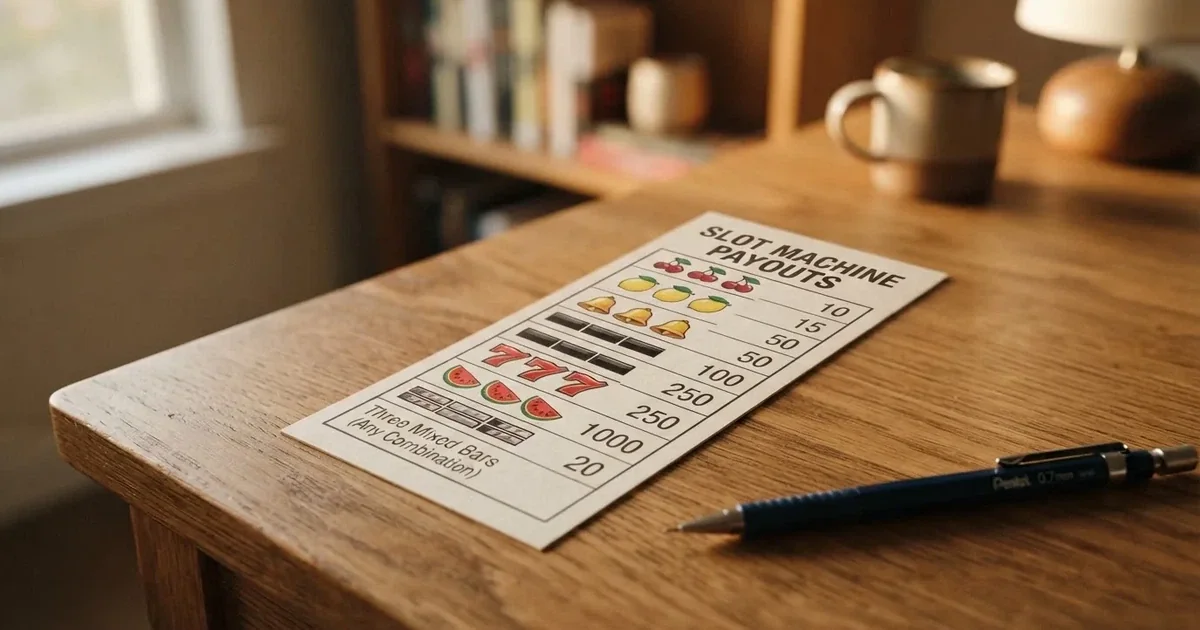
A pokies paytable is the on-screen reference for what each symbol is worth, how the paylines run, what the bonus features trigger and what the maximum payout is. It sits behind an “i” or a “?” button on most games. Reading it is the only way to know what a specific game actually does — and the research carries no paytable for any specific title, because the eleven operators in the comparison table are offshore and their game catalogues are large, fluid and not independently audited for the Australian reader.
The structural elements a paytable carries are consistent across the market. A five-reel, three-row video slot with 25 paylines evaluates each spin across the line set. The wild symbol substitutes for any other symbol except the scatter. The scatter symbol triggers the free-spin feature when three or more land anywhere on the reels. The bonus feature, where one exists, is generally a pick-em round or a wheel spin that pays a multiplier. The maximum payout on a single spin is generally a multiple of the stake — 1,000x to 5,000x on the higher-volatility games — and the return-to-player percentage sits somewhere between 94% and 97% on most modern video slots. None of those figures is specific to any of the eleven brands in the comparison table.
What an Australian reader comparing the eleven is actually choosing between
A reader who lands on this page looking for “the best Australian online pokies” has, in the strict regulatory sense, nothing to choose between. The eleven brands on the comparison table are all offering a prohibited product to Australians. The decision a reader is actually making is whether to play at all, and the comparison table is the public record of how many offshore operators the ACMA has had to warn to keep the market honest — eleven named brands across four years of formal warnings, several of them under the same parent company.
The Blocking Rate: How Quickly the ACMA Removes Sites From Reach
A blocking request is the ACMA’s heaviest enforcement step: the regulator asks Australian internet service providers to block the offending site at the DNS level, and an Australian customer trying to reach the URL gets a dead page. The arithmetic the prescribed calculation asks for is the running total of blocked sites as a fraction of the period since the first blocking request.
The ACMA reported in June 2026 that a total of 1,751 illegal gambling and affiliate marketing websites had been blocked since the first blocking request in November 2019. That is roughly six and a half years of enforcement and 1,751 blockings — a rate of about 269 blocked sites per year, or close to one site every working day, sustained across the period. The most recent reported round, on 26 June 2026, added 12 sites in one batch: 7Signs, ChromaBet, Donbet, Duospin, Freshbet, Slots Gem, Jacks Club, Lucky Start, Pointsbetz, Spinrise, Vinyl Casino and Wildsino.
What the rate tells the reader
The blocking rate is the central metric here, and the condition it sits under is “since the first blocking request in November 2019.” Without that condition, the number floats. With it, the number says something concrete: the ACMA’s enforcement pipeline has been running at a sustained clip, not a one-off spike, and the offshore market is large enough to keep refilling it. A reader who treats the 1,751 figure as proof that the problem is shrinking is reading the number without the condition. The condition is the date the pipeline started, and the 269 per year average is the only honest way to carry the headline figure.
The 12 added in the most recent round is not the same number as 269. The annual average smooths out the work the ACMA does in batches, and a single round’s 12 additions is one of those batches. Both numbers are correct, but they say different things about scale, and the page carries both.
Brand-Level Read of the Eleven Operators
RocketPlay
RocketPlay was the subject of a fresh ACMA formal warning in March 2026, addressed to Pulsup Ltd, and the same brand had been warned earlier as a Dama N.V. property in May 2022. Two warnings across four years is the pattern that suggests an operator that continues to offer the prohibited product after the regulator has already acted. The research carries no verifiable third-party listing for pokies support on RocketPlay, and the page does not manufacture one.
The brand is one of the eleven for the regulator’s enforcement record. A player who reads that record and decides to play on RocketPlay anyway is making the decision in view of two published warnings, no Australian complaints body, and no protection under the Interactive Gambling Act — and that is the full picture, not a recommendation to play.
Level Up Casino
Level Up Casino is a Dama N.V. brand, formally warned in May 2022. BGaming’s own third-party catalogue lists Level Up as carrying BGaming pokies, which is the most concrete game-supplier connection the research carries for any of the eleven. A Dama N.V. property sharing a corporate parent with RocketPlay, Woo Casino and Spirit Casino means a reader looking at Level Up is, in the corporate sense, looking at the same operator group behind several brand fronts. The warning is the regulator’s; the BGaming listing is the supplier’s; neither is a recommendation.
Woo Casino
Woo Casino was formally warned in March 2025, again as a Dama N.V. brand. The proximity of the Dama N.V. warnings — Woo Casino in March 2025, Spirit Casino in May 2025 — suggests the ACMA’s enforcement against that operator group was a coordinated effort, not a series of isolated cases. The research carries no verifiable third-party pokies listing for Woo Casino.
A reader reading the Woo Casino block should know that the regulator’s view is that Woo Casino offered prohibited services to Australians in 2025, and the operator’s response is not on the public record. The brand sits in the comparison table because the warning sits on the regulator’s website.
Spirit Casino
Spirit Casino was formally warned in May 2025, again as a Dama N.V. brand. The same parent company, the same year, the same prohibited product. Spirit Casino’s warning is the third of the Dama N.V. cluster in the comparison table, and the cluster itself is the relevant fact — not because any one of the three brands is the worst operator in the market, but because the ACMA’s enforcement picture of the offshore market is shaped by operator groups more than by individual brands.
National Casino
National Casino was formally warned in July 2025, addressed to Consolutetish S.R.L. A general Wikipedia entry mentions National Casino as a pokies-carrying brand, which is the most generic third-party listing the research carries. The Consolutetish S.R.L. parent also controls Bizzo Casino, which the ACMA warned at the same time — and Bizzo Casino had already been warned in 2022, this time to TechSolutions (CY) Group Limited and TechSolutions Group N.V. The same operator group, in other words, had been warned under one corporate form in 2022 and re-emerged under another corporate form by 2025. That is the pattern the regulator’s enforcement record shows for the Consolutetish side of the table.
Bizzo Casino
Bizzo Casino’s regulatory history is the longest in the comparison table: a 2022 formal warning to TechSolutions (CY) Group Limited and TechSolutions Group N.V., and a July 2025 formal warning to Consolutetish S.R.L. Two warnings across roughly three years, addressed to different legal entities that the regulator treats as the same operator group. A reader looking at Bizzo Casino is looking at an offshore operator the ACMA has had to warn twice under different company names. The page records that and does not pass a judgement that the marketing copy might.
Ignition Casino
Ignition Casino was formally warned in July 2025, addressed to Bamboo Media. Ignition Casino lacks any verifiable third-party listing for pokies games in the research, so the brand sits in the comparison table on the regulator’s action alone. A reader who has seen Ignition Casino advertised through affiliate marketing should know that the ACMA’s view is that the brand offered prohibited services to Australians as of July 2025.
Instant Casino
Instant Casino was formally warned in February 2025, addressed to EOD Code SRL. The EOD Code SRL operator group does not appear elsewhere in the comparison table, so the warning is a one-off in this dataset. No third-party pokies game listings were found for Instant Casino.
Jackbit
Jackbit was formally warned in April 2026, addressed to Ryker B.V. The Ryker B.V. operator group also controls CasinOK, which the ACMA warned in the same April 2026 action. Two brands, one parent, one round of warnings. The research database does not include any third-party pokies game listings for Jackbit.
Casino Intense
Casino Intense was formally warned in April 2025, addressed to Sterplay Holding Ltd. The third-party listings research found — ABC News, ACMA and Crown Melbourne — do not constitute a pokies-game listing in the supplier-catalogue sense; they are references in news and regulator contexts. A reader looking at Casino Intense should know that the ACMA has acted and that the research carries no verifiable game-supplier connection.
Sky Crown
Sky Crown was the subject of a Hollycorn N.V. formal warning published in September 2022. Hollycorn N.V. also controls Blue Leo, which the regulator addressed in the same publication. The Hollycorn N.V. entry is the oldest in the comparison table by publication date, and a reader looking at Sky Crown is looking at a brand the ACMA warned almost four years ago. There are no third-party pokies listings for Sky Crown in the available research.
The Money Side of a Single Session
The session-cost calculation is a useful tool for understanding what an offshore pokies session runs into. A session of 500 spins at $1 per spin on a 96% return-to-player game carries an expected loss of $20 — not a guaranteed loss, but the statistical average over many spins at those parameters. The session is independent of any bonus attached to the deposit, and the bonus’s wagering requirement adds its own turnover on top of the session’s play.
The relationship between session cost, wagering requirement and bonus size is the one the research does not carry per-brand figures for. What it carries in general terms is the structure: the bonus’s wagering multiple, multiplied by the bonus size, divided by the stake-per-spin, gives the number of spins the clearing play takes; the same clearing play carries its own expected loss based on the game’s RTP. A reader working through the structure for any specific bonus is running the arithmetic themselves, and the page does not pass off its own numbers for ones the research did not source.
What a player should expect in plain terms
A player who deposits $100 with no bonus attached plays $100 through 500 spins at $1 per spin, with an expected loss of $4 on a 96% RTP game. A player who deposits $100 and takes a $100 bonus with a 35x wagering requirement plays $3,500 through 3,500 spins at $1 per spin, with an expected loss of $140 on the same RTP. The bonus costs the player an extra $3,400 in turnover and an extra $136 in expected loss to clear, on those parameters, against the prospect of withdrawing the bonus money at the end.
The Landscape After Every Warning Round
The 1,751 figure is a snapshot, and the snapshot moves. The most recent reported round added 12 sites, and the next round will add more. The 269-per-year average is the rate at which the ACMA’s pipeline has run since November 2019, and the pipeline does not appear to be slowing.
What this means for a reader in 2026 is that the offshore market is active enough to refill the regulator’s enforcement queue, large enough that an Australian player with a search engine and a PayID can reach a prohibited service in under a minute, and lightly enough audited at the consumer-protection level that a withdrawal dispute has no domestic mechanism to resolve it. The licensed alternative — a pokie on a licensed club or casino floor, regulated state by state, with a complaints body attached — is the product the Interactive Gambling Act 2001 allows. The offshore alternative is the product the Interactive Gambling Act 2001 prohibits. Both sit on the same page because both are part of what a reader typing “best Australian online pokies” actually finds.
What the ACMA’s Own Record Shows About Operator Groups
The eleven brands in the comparison table reduce to a smaller number of operator groups once the parent companies are named. Dama N.V. controls RocketPlay (via Pulsup Ltd as of 2026), Level Up Casino, Woo Casino and Spirit Casino. Consolutetish S.R.L. controls National Casino and Bizzo Casino (with Bizzo having previously been warned under TechSolutions). Ryker B.V. controls Jackbit and CasinOK. Hollycorn N.V. controls Sky Crown and Blue Leo. Bamboo Media controls Ignition Casino. EOD Code SRL controls Instant Casino. Sterplay Holding Ltd controls Casino Intense. Six operator groups, eleven brands, one regulator’s enforcement pipeline.
That is the market’s actual shape. A reader who sees eleven brands on a comparison table is seeing four Dama N.V. skins, two Consolutetish skins and five single-brand operator groups. The brand proliferation is real, but the operator-group concentration is what the ACMA’s enforcement record shows.
How a Reader Should Read This Page
The page is not a recommendation. It is a record. The eleven brands above are the operators the ACMA has formally warned, with the dates and the parent companies named in the warnings. The licensed alternative is the venue pokie, regulated state by state, with its own minimum return-to-player and its own harm-reduction framework. The offshore alternative is the eleven brands above, outside Australian law, with no domestic complaints body and no protection under the Interactive Gambling Act.
A reader who lands on the page looking for “the best Australian online pokies” should leave it knowing three things: that no licensed Australian online pokies product exists, that the eleven offshore brands the ACMA has warned are the public face of the illegal market, and that the choice between playing on one of those brands and not playing is a choice the reader makes alone, with the regulator’s record in view.
Frequently Asked Questions
Is “Australian pokies online” a licensed product recognised by any state regulator?
No. Online casino games, including the online version of the poker machine called a pokie, are prohibited for Australians under the Interactive Gambling Act 2001, and no state or territory issues a licence for them. The “Australian” in an offshore brand name is a marketing word, not a jurisdictional claim, and the minimum return-to-player percentages that apply to legal Australian pokies do not apply offshore.
Is there a legal Australian online pokies app, as opposed to a mobile browser site?
No. The Interactive Gambling Act 2001 prohibits offering an online casino app to a person in Australia in the same way it prohibits the website. What exists is a mobile-optimised browser version of an offshore pokies lobby, and the research carries no app-store listing for any of the eleven brands in this comparison. A legal pokie is a machine on a licensed club, pub or casino floor, not an application running on a phone.
What is the difference between online pokies and the pokies in an Australian venue?
The legal pokies are electronic gaming machines on licensed venue floors, regulated state by state, with a minimum return-to-player set per jurisdiction and harm-reduction features built into the design. Online pokies are the same kind of machine rendered as software, running on offshore servers, with no Australian licence, no minimum return-to-player enforced by a state regulator and no Australian complaints body attached. The mechanics on a screen look similar; the legal status is what differs.
Do sign-up bonuses offered on offshore pokies sites come from a local operator?
No. The eleven brands in the comparison table are all offshore operators, and their welcome bonuses are the operators’ own marketing, not offers from an Australian-licensed business. The wagering requirements, the maximum cashout caps and the bonus-eligible game lists are the operator’s terms, and an Australian player has no Australian regulator to appeal to if a bonus term is enforced against them.
Can a PayID-friendly offshore pokies site still be operating from outside Australia?
Yes. PayID is an Australian payment rail, and offshore operators can accept a PayID deposit from an Australian bank account while remaining wholly unlicensed under Australian law. The deposit method does not determine the regulatory status of the operator. A site that accepts PayID and offers online pokies to Australians is offering a prohibited product, whatever the deposit rail looks like.
Does the word “Australian” in a pokies site’s name indicate its actual licensing jurisdiction?
No. The “Australian” in an offshore brand name is a marketing word, and the actual licensing jurisdiction is generally Curaçao, Anjouan or another small regulatory regime that does not extend any protection to Australian customers. A reader who treats the brand name as a jurisdictional claim will read the operator incorrectly. The ACMA’s enforcement record is the most reliable public indicator of an operator’s actual relationship to the Australian market.