
Casinos that take Google Pay from Australian players in 2026, and what the Interactive Gambling Act does to the list
A player who searches for a casino site that takes Google Pay in Australia in 2026 is working through a question with two halves. The first half is mechanical: does the cashier list Google Pay, what is the minimum deposit, how quickly does a withdrawal land. The second half is the one most comparison pages skip, and it is the more expensive one to find out about after the fact. Every offshore casino site that accepts Australian players is offering a prohibited interactive gambling service under the Interactive Gambling Act 2001, regardless of what payment methods it lists in its cashier. The Interactive Gambling Amendment (Gambling Reform) Bill 2026 passed Parliament on 19 August 2026 and adds advertising and inducement rules that commence on 1 January 2027, which is law with a start date, not something that changes the picture on a 2026 page. This page works through both halves, with the eleven operators the ACMA has formally warned over since 2022 forming the comparison block, and the legal frame spelled out before any of them.
Data current as of 31 October 2026, checked against the ACMA’s published formal warnings register and the central bank’s July 2025 review of card payments and surcharging.
Table of Contents
- Responsible gaming: what a Google Pay deposit still cannot do for an Australian player
- Payments and payout speed: how a Google Pay deposit actually flows at these sites
- The comparison: ACMA-warned operators offering Google Pay or wallet deposits to Australian accounts
- How a Google Pay casino balance actually works: the mechanics underneath the cashier button
- Legality and regulation: what the Interactive Gambling Act 2001 actually does
- How fast the ACMA’s blocking list has grown since November 2019
- Choosing between these operators when none of them is licensed in Australia
- Frequently asked questions
Responsible gaming: what a Google Pay deposit still cannot do for an Australian player
A bank-side gambling block does something a casino-side reality check never has: it stops the money from leaving the account in the first place. ANZ, NAB and Westpac all let a customer turn a gambling block on inside their own banking app, without calling the bank or visiting a branch, and the rule extends to a card loaded into a digital wallet. ANZ’s self-service block, applied through the ANZ app, also blocks gambling transactions made through a digital wallet on an eligible card, not just the physical card, which is the part that matters for a Google Pay deposit at an offshore casino site. Westpac’s block refuses authorisation on transactions registered under the merchant category code “Betting/Casino Gambling” on eligible personal credit and debit cards. NAB and ANZ both let customers apply a gambling block to their credit and debit cards themselves in their banking apps. Once ANZ’s block is on, removing it again requires a 48-hour waiting period, and the bank warns that not all gambling transactions will be blocked and some non-gambling transactions might be blocked in error.
That block does the same job whatever sits underneath the tap, and the technology underneath a Google Pay tap is worth pausing on for a second. When a card is added to Google Wallet, the card details are sent to the card-issuing bank for verification, and the bank generates a unique Device Account Number (a token) for that specific device rather than storing the real card number on the phone. That token is what the merchant sees, not the card number, which is the privacy story Google tells about Google Pay, and it is genuinely how the technology works. What it is not, is a way around a card-level gambling block. The merchant category code travels with the transaction, not with the device, and Westpac’s block catches it at authorisation regardless of which wallet pushed the card forward.
BetStop, the National Self-Exclusion Register, has been live since August 2023, and it binds only Australian-licensed online and phone wagering services. An offshore casino is not connected to it, which means a player who has self-excluded through BetStop has done nothing that an offshore operator will respect. The register is real, the protection is real, and it does not extend past the Australian perimeter. The National Gambling Helpline on 1800 858 858 is free, runs 24/7 and chats at Gambling Help Online, and that line is the one that does not require the offshore site to cooperate.
A withdrawal request from an offshore casino, once a player asks for it, goes through the casino’s own manual checks. The checks are the casino’s, not the bank’s, and they are not bound by Australian consumer law. A balance that has cleared those checks still depends on the card issuer’s own rules, and ANZ warns outright that not all gambling transactions will be blocked and some non-gambling transactions might be blocked in error, in either direction. The honest version of the responsible-gaming frame is the boring one: the block is in the bank’s app, the self-exclusion that the Australian register offers does not reach offshore sites, and the offshore cashier decides whether a withdrawal goes out the door.
Payments and payout speed: how a Google Pay deposit actually flows at these sites
The technology side is straightforward and worth getting out of the way before the operator comparisons. Google Pay requires an NFC-enabled Android phone running Android 5.0 (Lollipop) or later, and Google launched the product in Australia in 2016. By the end of 2025, Apple Pay, Google Pay and Samsung Pay transactions collectively accounted for around 45% of all card payments in Australia by number, which means the wallet is not the rare choice it would have looked like five years ago. At a casino cashier, Google Pay does not connect to the merchant directly. The wallet tokenises the underlying debit or credit card, the casino receives a card payment, and the merchant category code that lands at the bank identifies it as a gambling transaction. The cashier button labelled Google Pay is a front end for a card transaction, with all that implies about which bank rules apply.
A deposit is the easy half. The casino’s cashier accepts the token, the issuer authorises the underlying card, and the balance shows up in the player’s account within seconds in most cases. A withdrawal is the slower half and the one that gets glossed in marketing copy. The casino’s own anti-fraud and identity checks run before any payout leaves the cashier, and once approved, the money returns to the card that funded the deposit. That return path is the part the marketing pages describe as “instant”, and it is instant only after the casino’s own checks have cleared. Where the casino’s checks slow things down, no technology on the player’s side accelerates them, and that includes the wallet.
Apple Pay, the iPhone counterpart, illustrates the same architecture from the other side of the fence: Apple does not charge fees to consumers for using Apple Pay in stores, online or in apps, and any surcharge comes from the merchant’s own card-processing fees, not from Apple. Apple states that transaction limits and PIN requirements for Apple Pay purchases are set by the card issuer or merchant, not by Apple itself. The same architecture applies to Google Pay, and the absence of a Google Pay surcharge at the cashier is not the casino being generous, it is the wallet not being the layer where surcharges live. Surcharging itself is regulated separately, and the central bank’s July 2025 review proposes removing surcharges only on eftpos, Mastercard and Visa card transactions, explicitly leaving American Express outside the scope of the proposed surcharge ban, which is a separate point but worth noting because some offshore casinos that list Google Pay route through Amex rails on the back end.
The PayID and Osko angle matters here too, even though it is not a wallet in the same sense. With Osko, a bank transfer between participating Australian banks arrives in under a minute, 24/7 including weekends, whether it is addressed to a BSB and account number or to a PayID. Paying to a PayID shows the name of the account holder before the transfer is sent, and AP+ warns that being asked to transfer money to a PayID on an illegal gambling site almost certainly means a scam site, which is a flat warning worth taking at face value. PayID-based instant transfers are available at over 100 Australian financial institutions, and more than 25 million PayID identifiers had been registered on Australia’s New Payments Platform as of April 2025. The platform itself became accessible to the public on 13 February 2018 and is owned by New Payments Platform Australia Ltd, a non-profit company whose 13 shareholders include the Reserve Bank of Australia and the country’s major banks. Participants must keep the platform’s monthly outages to no more than two minutes, which is the kind of operational detail that explains why an Osko transfer feels like an exception in a market where most payment methods still batch overnight.
The Interactive Gambling Act 2001 as amended in 2023 makes it an offence for Australian-licensed online wagering services to accept payment by credit card or other credit-related products, a restriction that also constrains gambling use of linked digital wallets. None of the eleven operators on this page is an Australian-licensed wagering service, which is the whole point of their inclusion: they are the operators the ACMA has warned over, and the payment restriction does not bind them in the same way, even though the legal exposure under the IGA sits with them rather than with the player.
The comparison: ACMA-warned operators offering Google Pay or wallet deposits to Australian accounts
This is not a ranking and not a recommendation. Each of the brands below has been the subject of a formal ACMA warning under the Interactive Gambling Act 2001 for offering prohibited interactive gambling services to people in Australia. The Google Pay column reflects what the casino’s own listings or the third-party payment pages report; where the ACMA has confirmed the operator name, that operator is named; where a brand has been subject to more than one formal warning, the most recent one is the action cited here. The brand column is the trading name. The subject support column is empty for every brand except where a third-party listing explicitly references it, because most of these brands do not publish a payment-method page that an Australian-facing reader can verify independently.
| Brand | ACMA action and date | Operator named by the ACMA | Subject support |
|---|---|---|---|
| RocketPlay | Formal warning, March 2026 | Pulsup Ltd | — |
| Level Up Casino | Formal warning, May 2022 | Dama N.V. | Westpac merchant category reference |
| Woo Casino | Formal warning, March 2025 | Dama N.V. | — |
| Spirit Casino | Formal warning, May 2025 | Dama N.V. | — |
| National Casino | Formal warning, July 2025 | Consolutetish S.R.L. | AUSTRAC and Wikipedia references |
| Bizzo Casino | Formal warning, July 2025 (earlier 2022) | Consolutetish S.R.L. | — |
| Ignition Casino | Formal warning, July 2025 | Bamboo Media | — |
| Instant Casino | Formal warning, February 2025 | EOD Code SRL | EcoPayz and PayID listings |
| Jackbit | Formal warning, April 2026 | Ryker B.V. | — |
| Casino Intense | Formal warning, April 2025 | Sterplay Holding Ltd | AUSTRAC, ITnews, NAB references |
| Sky Crown | Formal warning, September 2022 | Hollycorn N.V. | — |
The pattern underneath the table is the picture. The ACMA does not warn the same operator twice in a vacuum. Dama N.V. has been warned in May 2022 (over Bambet, Dazard, Level Up, Rocketplay, Wild Tornado and Cobra Casinos), then again in March 2025 over Woo Casino, and again in May 2025 over Spirit Casino, with the Rocketplay brand picking up a fresh warning in March 2026 under a different corporate vehicle, Pulsup Ltd. Bizzo Casino’s July 2025 warning under Consolutetish S.R.L. is the second formal warning tied to the brand, the first having been issued in 2022 over TechSolutions (CY) Group Limited and TechSolutions Group N.V. Two of the eleven brands are tied to operators who have been warned on more than one occasion, and one of those brands carries two warnings of its own. A formal warning is not a prosecution and is not a finding of breach in a court, but it is the ACMA putting the operator on the public record for offering prohibited services to Australians, and the regulator follows warnings with blocking requests to ISPs when the behaviour continues.
A Google Pay button in a cashier is not a licence to serve Australian players, and no third-party payment listing changes that. The Instant Casino row carries an EcoPayz and PayID reference because those listings mention the brand, and the National Casino row carries AUSTRAC and Wikipedia references for the same reason. Neither listing authorises the operator to offer online casino games to a person in Australia, and the AUSTRAC reference in particular is about anti-money-laundering registration rather than a permission to serve Australian residents. Where the subject support column is empty, the absence is the page telling the reader that no third-party listing the research consulted confirmed Google Pay for that brand, and the brand should be treated as unverified on that point rather than as not supporting it.
RocketPlay
RocketPlay carries two ACMA formal warnings across two different corporate vehicles. The first, in May 2022, named Dama N.V. as the operator over a group of six brands that included Rocketplay at the time. The second, in March 2026, named Pulsup Ltd as the operator over Rocketplay.com.au specifically, which is the .com.au address pointing at an Australia-facing service. The fresh warning is the one that matters for a player considering the brand in 2026, and it is dated this year. Payment methods remain unconfirmed; the ACMA’s action over the .com.au domain is the part of the picture that is on the public record. This brand has been told twice that its offering to Australians is a prohibited service, and that the second telling came under a different corporate wrapper, without demonstrating a clean exit from the Australian market.
Level Up Casino
Level Up Casino sits in the original 2022 warning cluster under Dama N.V., which named it alongside Bambet, Dazard, Rocketplay, Wild Tornado and Cobra Casinos. The May 2022 warning is the formal action on the public record. A Westpac merchant category reference is the only third-party listing that surfaced for the brand, and Westpac’s own gambling block refuses authorisation on transactions registered under the merchant category code “Betting/Casino Gambling” on eligible personal credit and debit cards, which is the rule that catches a Level Up cashier attempt regardless of which wallet fronts it. The brand has had more than three years to shift its Australian-facing posture since the warning, and the ACMA has not had to re-warn it on the same operator, which is the only faintly positive read of the row. The picture for the player is unchanged: a casino that cannot lawfully take Australian players, with one warning listed, though we found no independent Google Pay verification.
Woo Casino
Woo Casino was formally warned by the ACMA in March 2025 over Dama N.V., the same operator that picked up a separate warning in May 2025 over Spirit Casino and the original 2022 cluster. Two warnings inside three months is the regulator’s pattern, and Dama N.V. has now collected three ACMA actions over a four-year span. Payment methods remain unconfirmed, which leaves the cashier offering as a matter for the player to verify directly. Woo Casino sits under the operator with the most ACMA actions on this page, while the cashier’s specifics remain unverified.
Spirit Casino
Spirit Casino was warned in May 2025 under Dama N.V., the third ACMA action over that operator in three years. No payment methods have been independently verified, which reflects the research finding no independent payment-method listing. An operator with a serial warning history is the structural fact underneath this brand, which leaves the actual cashier offering unconfirmed.
National Casino
National Casino was formally warned by the ACMA in July 2025, naming Consolutetish S.R.L. as the operator. The brand carries AUSTRAC and Wikipedia references, and neither constitutes a licence to offer online casino games to Australians; AUSTRAC registration is an anti-money-laundering requirement, not an Australian consumer-facing permission. National Casino is the brand in this comparison with the broadest third-party footprint, but the regulator’s stance remains clear: providing such services to Australians is prohibited.
Bizzo Casino
Bizzo Casino carries two formal ACMA warnings. The first, in 2022, named TechSolutions (CY) Group Limited and TechSolutions Group N.V. The second, in July 2025, named Consolutetish S.R.L., which is a different corporate vehicle. A brand with two formal warnings across two operators has moved through corporate hands without its posture toward the Australian market changing in a way the ACMA has accepted. No payment methods have been independently verified, and two warnings on the same brand is two formal regulator statements that the offering is prohibited, rather than a single operator error.
Ignition Casino
Ignition Casino was formally warned by the ACMA in July 2025, naming Bamboo Media as the operator. No payment methods have been independently verified for this brand. The July 2025 warning is the only ACMA action on the public record, and the site lacks independent verification of its cashier options.
Instant Casino
Instant Casino was the subject of an ACMA formal warning in February 2025, naming EOD Code SRL as the operator. The brand carries EcoPayz and PayID references on the third-party side, which is more third-party confirmation than most of the brands on this page have, but neither reference is a Google Pay confirmation specifically. PayID listings appearing on payment-method pages do not authorise the operator to offer online casino games to people in Australia, and the ACMA’s warning is the regulator’s position regardless of what the cashier lists. The verdict is that Instant Casino has more third-party payment-method footprints than most of the comparison set, and the ACMA action is still a formal statement that the offering to Australians is prohibited.
Jackbit
Jackbit was formally warned by the ACMA in April 2026, naming Ryker B.V. as the operator. The April 2026 date makes it one of the most recent warnings on this page. No payment methods have been independently verified for this brand. This brand carries a fresh regulator action, and the cashier’s claims are not independently verifiable.
Casino Intense
Casino Intense was the subject of an ACMA formal warning in April 2025, naming Sterplay Holding Ltd as the operator. The brand carries AUSTRAC, ITnews and NAB references on the third-party side, and the presence of an NAB reference is consistent with the bank’s own gambling-block infrastructure catching attempts to authorise transactions at the brand. The AUSTRAC reference is an anti-money-laundering registration rather than a permission to serve Australian residents. The verdict is that Casino Intense has a wider third-party footprint than most of the comparison set, and the ACMA action is still a formal regulator statement on the public record.
Sky Crown
Sky Crown was formally warned by the ACMA, naming Hollycorn N.V. as the operator over the Sky Crown and Blue Leo casino services. No payment methods have been independently verified, and Blue Leo is the brand paired with it on the same formal warning. Hollycorn N.V. is the operator the ACMA named, and the operator’s focus remains on prohibited services.
How a Google Pay casino balance actually works: the mechanics underneath the cashier button
A Google Pay deposit at an offshore casino runs through a tokenised card, not through a Google Pay account balance, which is the part that surprises most players who have used the wallet in a supermarket. The card loaded into Google Wallet is the funding source, the wallet provides the token, and the merchant category code that reaches the issuer identifies the transaction as a gambling transaction. Three things follow from that single fact. First, the bank’s own gambling rules apply, including ANZ’s 48-hour waiting period before the block can be lifted, and the bank’s warning that not all gambling transactions will be blocked and some non-gambling transactions might be blocked in error, which is a one-line summary of the limit of any block. Second, the credit card ban that applies to Australian-licensed wagering does not bind the offshore casino, but it binds the bank: a credit card loaded into Google Wallet will fail at authorisation at an offshore casino the same way it would at a licensed bookmaker, because the merchant category code identifies the merchant, not the regulatory perimeter the merchant operates from. Third, the wallet token is per-device, which means a Google Pay token on one phone is not portable to another, and a player who changes devices will need to add the card again.
A withdrawal request at an offshore casino goes through the casino’s own manual checks, and then back to the card that funded the deposit. The casino’s checks are not Australian checks, and they are not bound by Australian consumer law. The bank’s role at the withdrawal end is the same as at the deposit end: the merchant category code identifies the transaction, and the bank’s gambling block rules apply in either direction. Where the casino’s own anti-fraud check is the slow step, no technology on the player’s side makes the withdrawal arrive any faster, and “instant” in the marketing sense means “instant after the casino has approved it”, not “instant from the moment the player asked”.
The fee picture is the part the marketing tends to flatten. Apple Pay and Google Pay do not charge consumers a fee to use the wallet, and that fact is correct as far as it goes: the wallet is not the layer where surcharges live, and any surcharge a casino cashier adds comes from the merchant’s own card-processing fees. The RBA review proposes removing surcharges on eftpos, Mastercard and Visa card transactions, and explicitly leaves American Express outside the scope of the proposed surcharge ban, which is worth knowing because some offshore casinos that advertise wallet support route through Amex rails on the back end, and the surcharge rule that ends up applying is the Amex one rather than the four-party-scheme one.
Legality and regulation: what the Interactive Gambling Act 2001 actually does
The Interactive Gambling Act 2001 (IGA), strengthened by the Interactive Gambling Amendment Act 2017, makes it an offence to provide online casino games, online pokies or in-play betting to a person in Australia, and no state or territory licences them. What is licensable is wagering on races and sport placed before the event, lotteries and keno, and in practice those are licensed by the Northern Territory through the NTRWC. The NTRWC regulates 52 of Australia’s online bookmakers, including Sportsbet, Bet365 and Ladbrokes, which are licensed in the Territory for tax reasons; the commission has no full-time staff and meets once a month in Darwin, which is the structural detail behind why so much of the licensed Australian wagering market sits inside a single Territory regulator.
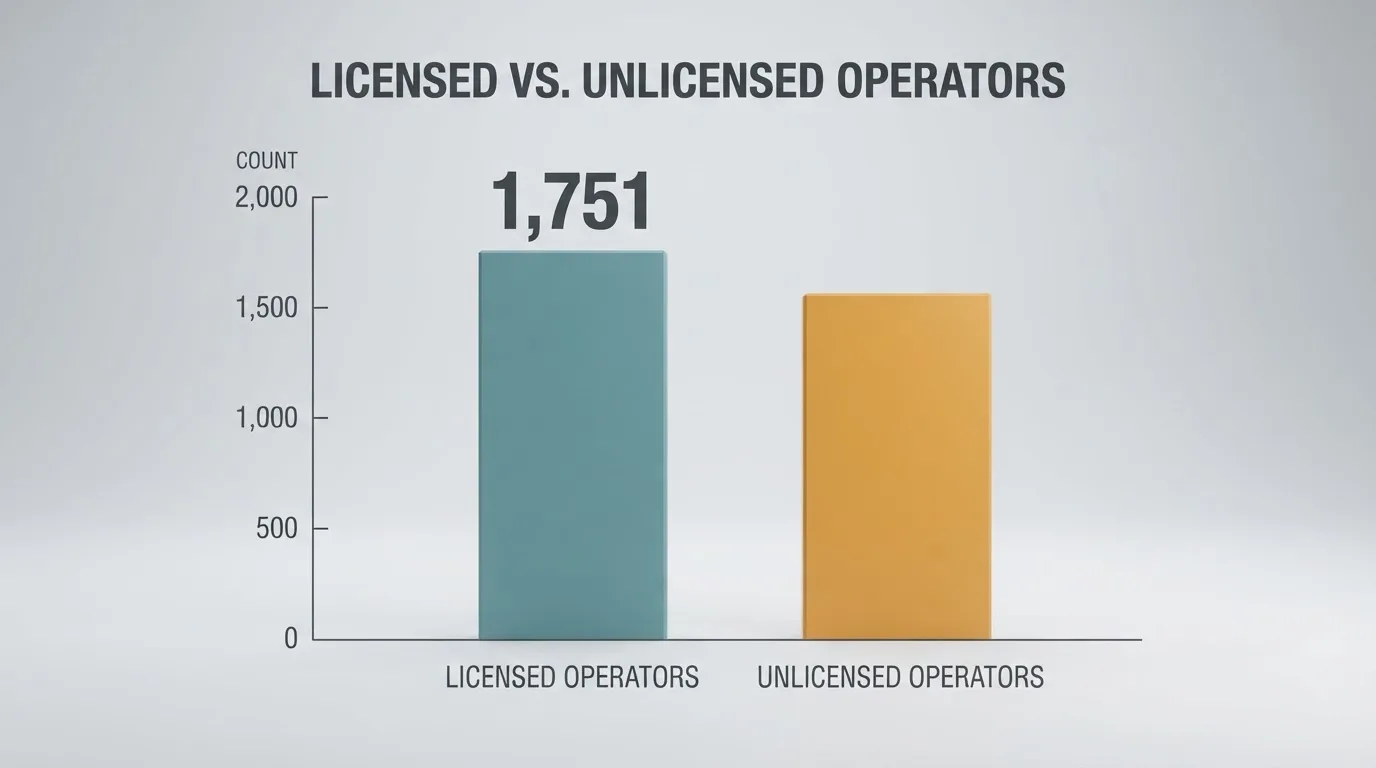
Enforcement sits with the ACMA, which investigates, issues formal warnings and directs internet service providers to block illegal sites. According to the ACMA as reported in June 2026, a total of 1,751 illegal gambling and affiliate marketing websites had been blocked since the first blocking request in November 2019, and more than 230 unlicensed gambling services had left the Australian market since enforcement was strengthened in 2017. In a round reported on 26 June 2026 the ACMA asked Australian internet service providers to block 12 more illegal gambling websites: 7Signs, ChromaBet, Donbet, Duospin, Freshbet, Slots Gem, Jacks Club, Lucky Start, Pointsbetz.com, Spinrise, Vinyl Casino and Wildsino. The blocking pipeline is not theoretical; it is operational, and a balance sitting at a casino cashier when the site is added to a blocking round is a balance that the casino holds, not the player.
H2 Gambling Capital’s 2025 report estimates that Australians lose about A$3.9 billion a year to illegal gambling sites, and that the share of gambling going through legal channels fell from 74% in 2021 to 64%. That figure is the case for the regulator’s enforcement, and it is also the case against a reader treating an offshore casino cashier as an equivalent substitute for the licensed Australian wagering market. The licensed market is restricted to wagering, not casino games, which is the gap the offshore sites fill, and the offshore market is where the prohibition does its work.
The individual player is not prosecuted under the IGA. The Act targets the provider. That fact is real, and it is also where the protection ends. An offshore site gives no Australian consumer protection, no complaints body and no recourse if a withdrawal is refused, and it can be blocked with a balance still on it. The Interactive Gambling Amendment (Gambling Reform) Bill 2026 passed Parliament on 19 August 2026 and adds advertising and inducement measures that commence on 1 January 2027, which is the part of the reform package that operators and affiliates are most affected by, and which is not yet in force on a 2026 page.
Gambling winnings of a recreational player are not assessable income under section 6-5 of the ITAA 1997 and losses are not deductible, unless the person carries on a business of gambling, which is the model rule only. Anyone with a question about their own position needs to check with the ATO, and that sentence is not legal advice. The minimum age is 18 across the country, and that is the one rule that applies uniformly to both the licensed and offshore sides.
How fast the ACMA’s blocking list has grown since November 2019
The blocking pipeline is the one piece of arithmetic that belongs on this page, because it is the part of the legal frame the reader can feel as a number. The first blocking request went out in November 2019, and as of the June 2026 ACMA reporting round, 1,751 illegal gambling and affiliate marketing websites had been blocked. That is the running total across roughly six and a half years, and the rate is the interesting part.
Spreading 1,751 blocks across the 80 months between November 2019 and the end of June 2026 gives a working average of just under 22 blocked sites per month, with the early years lighter and the recent years heavier. Spreading the same total across the 12-month window ending June 2026 gives a different number: 222 blocked sites in the year to June 2026, on the ACMA’s most recent count, which works out to roughly 18 to 19 per month averaged across the year. The two averages tell different stories because the pipeline has not run at a constant rate. The honest band to put on the rate is 18 to 22 sites blocked per month over the past year, with the running total growing unevenly and concentrated in the more recent enforcement rounds.
The 12-site blocking round reported on 26 June 2026 is on the low side relative to that band, and earlier rounds in 2025 and 2026 ran higher. A reader looking at the page in 2026 should read the rate as a band, not a single figure, and as a number that the ACMA itself reports only as a running total rather than a monthly rate.
Choosing between these operators when none of them is licensed in Australia
The comparison block above is a list of eleven brands, not a ranking, and the most useful thing a reader can take from it is a structural observation. The brands cluster around a small number of operators. Dama N.V. alone is responsible for four warnings across three of the brands on this page (Level Up, Woo Casino, Spirit Casino, and the original 2022 Rocketplay cluster), and Consolutetish S.R.L. picks up two more (National Casino and Bizzo Casino). The remaining five warnings sit across five separate operators, each with one warning on the public record. A player who picks one brand on this list is, with non-trivial probability, picking a brand operated by a company the ACMA has already formally told to stop serving Australians.
For a player who has decided to use an offshore site anyway, the operational rules are different from the licensed market. The Interactive Gambling Act 2001 as amended in 2023 makes it an offence for Australian-licensed online wagering services to accept payment by credit card or other credit-related products, a restriction that also constrains gambling use of linked digital wallets. None of the brands above is an Australian-licensed wagering service, so the credit card ban does not bind them in the same way, but the underlying bank still catches credit-card transactions at the merchant category code. The legal deposit routes for licensed Australian wagering are debit card, bank transfer, PayID and Osko and BPAY, and a site asking an Australian for a credit card or a crypto deposit is operating outside the Australian rules in a way that compounds the IGA exposure.
The bank’s gambling block is the structural protection that does not depend on the casino’s cooperation. NAB and ANZ let customers apply a gambling block to their credit and debit cards themselves in their banking apps, without calling or visiting the bank. ANZ’s block, applied through the app, blocks gambling transactions made through a digital wallet on an eligible card, which is the part that catches a Google Pay attempt. Westpac’s block works at card level: it refuses authorisation of transactions registered under the merchant category code “Betting/Casino Gambling” on eligible personal credit and debit cards. Once ANZ’s block is on, removing it requires a 48-hour waiting period, which is the structural feature that makes the block harder to bypass in a moment of weakness than the casino’s own reality checks.
For a player who has decided that the licensed Australian market does not cover what they want, the page’s recommendation is not a brand. It is the bank-side block, set up before the deposit, and the National Gambling Helpline on 1800 858 858 if the casino’s cashier is the place a habit is starting to take hold. The offshore brands on this page are not equivalents of the licensed bookmakers: they are operating under a different legal frame, they are subject to ACMA enforcement on a continuing basis, and a balance on their cashier is a balance an Australian consumer has no statutory way to recover.
Frequently asked questions
Is it legal for an online casino to accept Google Pay from a player in Australia?
No online casino can lawfully offer casino games or online pokies to a person in Australia under the Interactive Gambling Act 2001. The payment method is not the issue; the offering is. Every operator on this page has been the subject of an ACMA formal warning specifically for that prohibited offering, and the ACMA follows warnings with blocking requests to ISPs when the behaviour continues.
What is the smallest deposit a Google Pay casino site usually asks for?
The minimum deposit at offshore casino sites that accept Google Pay typically sits around A$10 to A$20, set by the casino’s own cashier rather than by Google Pay. The wallet does not impose its own minimum; the merchant does. The bank’s own minimum applies on top, and the bank’s gambling block overrides the merchant’s minimum if the card is blocked.
Does a Google Pay withdrawal clear any faster than a card withdrawal at these sites?
No, because the Google Pay withdrawal is a card withdrawal underneath. The wallet tokenises the underlying card, and the casino sends the funds back to the card. The casino’s own manual checks run first, and only after the casino approves the payout does the bank process the card-leg transaction. Where the casino’s checks are slow, no technology on the player’s side accelerates them.
Can Google Pay be used at every offshore pokies-style site, or only some of them?
Only some. Google Pay support is set by each casino’s own cashier, and the ACMA-warned brands on this page do not publish Google Pay confirmation uniformly. Where third-party listings do not confirm the wallet for a specific brand, the brand should be treated as unverified on that point rather than as not supporting it. The legal status of the offering does not change either way: every brand on this page is offering a prohibited interactive gambling service under the IGA.
Does depositing with Google Pay add an extra fee at these casino sites?
No, not from the wallet. Apple Pay and Google Pay do not charge consumers a fee to use the wallet, and any surcharge at the cashier comes from the merchant’s own card-processing fees. That review proposes removing surcharges on eftpos, Mastercard and Visa card transactions, and explicitly leaves American Express outside the scope of the proposed surcharge ban, which is the relevant distinction for any brand routing through Amex rails.
What should a player do if a Google Pay deposit does not appear in a casino account?
Check the bank statement first, because the wallet layer can confirm a transaction that the casino’s cashier has not yet posted. If the bank shows the transaction as authorised but the casino shows nothing, the delay is on the casino’s side and the player needs to contact the casino’s support with the bank reference. If the bank shows the transaction as declined, the most common cause at an Australian bank is the gambling block catching the transaction at the merchant category code, not the wallet failing.