
Apple Pay at Online Casinos Accessible from Australia: What Players Face in 2026
Anyone searching for an Apple Pay casino site and sitting in Australia runs into a wall that the marketing never mentions. The Interactive Gambling Act 2001 makes it an offence to provide online casino games, online pokies or in-play betting to a person physically in Australia. No state or territory licenses any of those products. The licensed wagering on offer is restricted to pre-event race and sport bets, lotteries and keno, and the providers behind those products run on the Northern Territory’s regime, not on a Curaçao or Kahnawake notice plate. What this page covers, then, is the gap between an offshore site’s payment-method list and the legal reality a player faces: which of the offshore brands the ACMA has formally warned still advertise Apple Pay, what a deposit or withdrawal through the wallet actually looks like at those brands, and what the wallet itself does and does not promise.
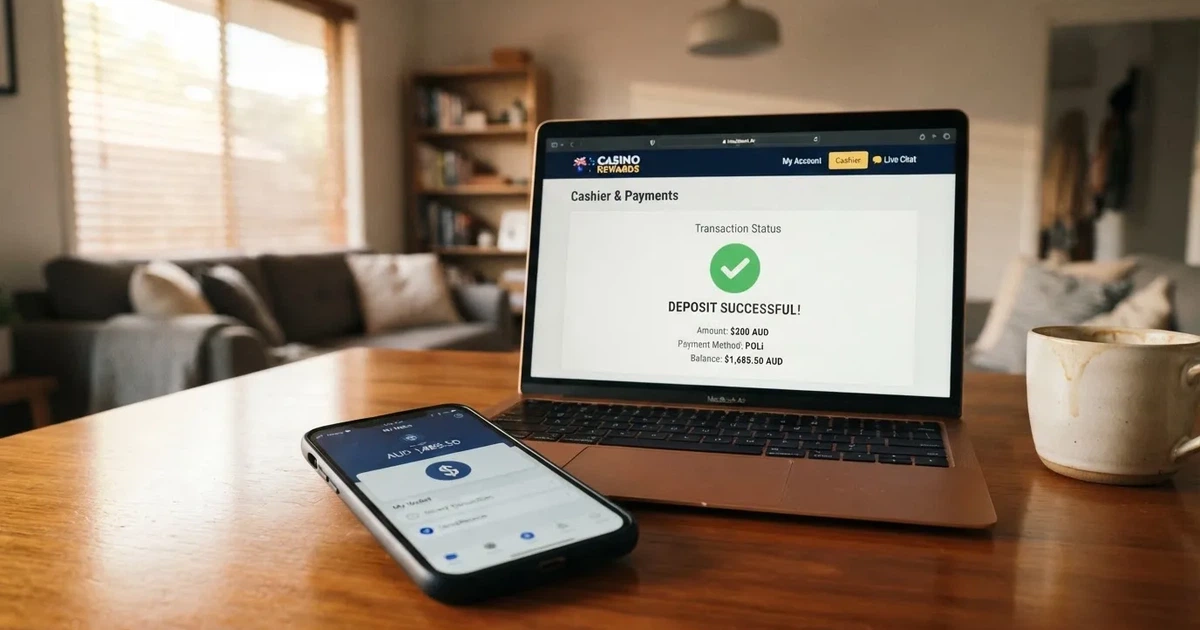
Current as of 6 November 2026. Operator claims verified against the ACMA’s formal-warning register and the Interactive Gambling Act 2001.
Table of Contents
- How Apple Pay Works at a Casino Site (and What It Does Not Do)
- The Legal Position: Why No Site May Lawfully Serve an Australian
- Responsible-Gaming Protections That Do Not Reach an Offshore Site
- Deposit Routes at Offshore Sites: What a Player Sees in the Cashier
- Withdrawal Mechanics: Why Apple Pay Cannot Move Money Back Out
- The Landscape of Offshore Casino Sites the ACMA Has Formally Warned
- Reading the Blocking Rate as a Trend
- Operator Reviews: What Each Brand on the ACMA’s List Actually Looks Like
- What a Player Considering Any of These Sites Should Weigh
- Frequently Asked Questions
How Apple Pay Works at a Casino Site (and What It Does Not Do)
Apple Pay is a wallet, not a card. It stores tokenised versions of the debit, credit or prepaid cards the customer has loaded onto a device, and at the checkout it asks the card network to authorise the merchant’s transaction through the underlying card rather than through Apple itself. Apple states plainly that it does not charge consumers any fee for using Apple Pay in stores, online or in apps. Any surcharge a customer sees on a deposit screen comes from the merchant’s own card-processing fees, not from Apple.
Three things follow from that design, and each one matters at a casino cashier.
First, the transaction is still a card transaction. The merchant sees a card payment; the bank sees a card payment; the card network charges interchange on a card payment. The wallet is a rail, not a substitute for the rail it sits on. A casino that lists Apple Pay is listing a way to charge one of the customer’s underlying cards. If the underlying card is blocked at merchant-category level, Apple Pay is also blocked.
Second, transaction limits and PIN requirements are set by the card issuer and the merchant, not by Apple. Apple’s own support documentation makes this explicit. A casino can set its own minimum deposit at any figure it likes, and a bank can refuse any transaction regardless of which front-end the customer is using to send it.
Third, what Apple Pay cannot do is change the legal status of the product it is paying for. A tokenised debit card paying for an offshore casino deposit is still a debit card paying for an offshore casino deposit. The wallet adds frictionless authorisation at the device; it does not convert a prohibited transaction into a permitted one.
In Australia, mobile wallet transactions have become a routine part of the card market rather than a novelty. By the end of 2025, Apple Pay, Google Pay and Samsung Pay collectively accounted for around 45% of all card payments in Australia by number. That share makes a wallet the default expectation for a customer walking into a checkout, and the absence of Apple Pay on a casino’s deposit screen is now the thing a player notices, not the presence of it. But a 45% share of card payments does not turn the wallets into a separate payment system: the regulatory frame sits behind them, not above them.
The Legal Position: Why No Site May Lawfully Serve an Australian
The Interactive Gambling Act 2001, strengthened by the Interactive Gambling Amendment Act 2017, makes it an offence to provide a prohibited interactive gambling service to a customer physically in Australia. A prohibited interactive gambling service covers online casino games, online pokies and in-play betting. The prohibition sits on the provider, not on the player, and the ACMA, the Australian Communications and Media Authority, is the body that enforces it. A customer is not prosecuted for placing a bet at an offshore site; the offshore site is the target.

What is licensable is wagering on racing and sport placed before the event, lotteries and keno. In practice those services sit under the Northern Territory Racing and Wagering Commission (NTRWC), which regulates 52 of Australia’s online bookmakers. The NTRWC has no full-time staff and meets once a month in Darwin, a structural detail that explains why one regulator handles the majority of the country’s licensed wagering. The minimum age is 18. A brand licensed for pre-event sports betting is not licensed for casino games, pokies or in-play wagering, and adding the latter services to a wagering licence is not available.
Enforcement is what an offshore site most often forgets to mention. The ACMA investigates, issues formal warnings and directs Australian internet service providers to block illegal sites at the domain level. As reported in June 2026, a total of 1,751 illegal gambling and affiliate marketing websites had been blocked since the first blocking request in November 2019, and more than 230 unlicensed gambling services had left the Australian market since enforcement was strengthened in 2017. A round reported on 26 June 2026 alone added 12 more sites to the blocked list: 7Signs, ChromaBet, Donbet, Duospin, Freshbet, Slots Gem, Jacks Club, Lucky Start, Pointsbetz, Spinrise, Vinyl Casino and Wildsino.
The losses involved are large enough that the enforcement effort has a measurable target. H2 Gambling Capital’s 2025 report estimates that Australians lose about A$3.9 billion a year to illegal gambling sites, and that the share of gambling going through legal channels fell from 74% in 2021 to 64%. The legal-channel share has fallen while the ACMA’s blocking tally has grown, which is the inverse of the trend the regulator is trying to produce. The 2026 reform package, the Interactive Gambling Amendment (Gambling Reform) Bill 2026, passed Parliament on 19 August 2026; its advertising and inducement measures commence 1 January 2027. The law is passed, not yet in force, and 2026 is the year the advertising crackdown is on the runway rather than in operation.
Responsible-Gaming Protections That Do Not Reach an Offshore Site
The two public protections Australian players hear about most are BetStop, the National Self-Exclusion Register, and the National Gambling Helpline at 1800 858 858, with chat at Gambling Help Online. Both are real. Both stop at the Australian licence boundary.
BetStop went live in August 2023. It binds every Australian-licensed online and phone wagering service, meaning the licensed sports and race bookmakers operating under the Northern Territory regime and the equivalent state regimes. When a person registers, every licensed operator is required to refuse their account, refuse their deposits and refuse to send them marketing. An offshore casino is not connected to the register. A player who has registered with BetStop and then opens an account at a Curaçao-licensed offshore site finds nothing in the way, because the offshore site has no obligation to query the register and no Australian regulator that can compel it to.
The same boundary applies to the gambling blocks offered by the Australian banks. Westpac’s gambling block operates at card level, refusing authorisation of any transaction registered under the merchant category code for betting and casino gambling on eligible personal credit and debit cards. ANZ’s block works similarly, and it explicitly covers gambling transactions made through a digital wallet such as Apple Pay on an eligible card, not just the physical card. Commonwealth Bank offers a comparable gambling lock in its app. What those blocks do is stop the transaction at the issuer side; what they do not do is override the offshore site’s right to hold a balance, refuse a withdrawal or vanish when the ACMA blocks its domain.
The bank-level blocks carry their own caveats. ANZ warns that once the block is activated, removing it again requires a 48-hour waiting period, and that not all gambling transactions will be blocked and some non-gambling transactions might be blocked in error. The Commonwealth Bank’s product page states it cannot guarantee all gambling-related purchases will be stopped. None of those caveats makes the blocks useless; they make the blocks imperfect, and the imperfection matters in the same way any safety mechanism’s imperfection matters: it is the gap a player falls through when they assumed the mechanism would catch them.
The offshore site’s own responsible-gaming tools, deposit limits, reality checks, cooling-off periods and self-exclusion are designed by the operator and enforced by the operator. The player at an offshore casino has the responsible-gaming tools the offshore casino chooses to provide, and no Australian complaints body has jurisdiction over the operator if a withdrawal is refused or a bonus term is applied in a way the player contests.
Deposit Routes at Offshore Sites: What a Player Sees in the Cashier
The payment methods an Australian player actually encounters at an offshore site break into two groups: card networks the player recognises (Visa, Mastercard, American Express in some cases) and the local-instant payment rails that some sites list to attract Australian traffic (PayID, Osko, BPAY).
Card deposits are the simplest channel. The wallet sits in front of the card, and the authorisation runs against the underlying card. A minimum deposit in the A$10–A$30 range is standard at the sites covered below, with the exact figure varying by brand. The minimum is a brand decision, not a wallet decision; Apple Pay imposes no minimum of its own.
PayID and Osko sit on Australia’s New Payments Platform, which became accessible to the public on 13 February 2018. A PayID resolves to a bank account and shows the name of the account holder before the transfer is sent, which is the safety feature the system advertises most loudly. The operator of the platform, Australian Payments Plus (AP+), warns that being asked to transfer money to a PayID on an illegal gambling site almost certainly means a scam site. Osko transfers between participating banks arrive in under a minute, 24/7 including weekends, whether addressed to a BSB and account number or to a PayID. PayID-based instant transfers are available at over 100 Australian financial institutions, and more than 25 million PayID identifiers had been registered on the platform as of April 2025. AUSTRAC’s threshold-transaction-report rule applies only to physical cash; ordinary electronic bank transfers are not subject to that per-transaction reporting requirement, regardless of the amount.
BPAY is the bill-payment service in online banking: the payer enters the Biller Code and the Customer Reference Number printed on the bill. BPAY has operated since 1997, is available in the online banking of over 140 banks and financial institutions and is offered by over 95,000 businesses. It is run by Australian Payments Plus, the same operator as PayID and Osko, and is owned equally, via parent company Cardlink Services Limited, by Australia’s four major banks. Participants in the New Payments Platform must keep the platform’s monthly outages to no more than two minutes; in 2021 the ACCC authorised merging NPP Australia with BPAY and eftpos into a single company, Australian Payments Plus.
| Payment Method | Characteristic | Speed |
|---|---|---|
| Apple Pay | Digital wallet using card rail | Instant (via card) |
| PayID | Instant bank transfer | Instant |
| Osko | Instant payment rail | Instant |
| BPAY | Bill payment service | 1–3 business days |
Withdrawal Mechanics: Why Apple Pay Cannot Move Money Back Out
The wallet’s design has an asymmetry the marketing copy never acknowledges. Apple Pay can push money in: it authorises a card transaction from the customer’s card to the merchant. It cannot, in any general sense, pull money back. There is no Apple Pay rails for a casino to send a withdrawal to. A withdrawal is a transfer from the casino’s own bank account or card processor to the customer’s bank account or card.
What an offshore site typically does at the withdrawal stage is one of three things. It credits the customer’s underlying Visa or Mastercard through the same card network it accepted at deposit. It runs a bank transfer to the customer’s Australian account via SWIFT or a local equivalent, which can take several business days. It offers a cryptocurrency payout to a wallet the customer controls, with no Australian bank in the loop. The fastest of these is the card-credit path, because the original card scheme still has the customer’s details on file; the slowest is the SWIFT path, which is what the player experiences as a “pending” withdrawal for three to five working days.
The wallet is not in this picture at all. A player who deposited through Apple Pay cannot withdraw through Apple Pay. The casino credits the original card, which the player sees arrive in their card account a few days later. If the casino has its own manual checks, the credit sits in “pending” status while those checks run, and the player has no way to speed them up by switching wallets on their device. A pending withdrawal that is reviewed, rejected or simply never confirmed by an offshore site is one of the standard complaints the ACMA’s enforcement effort exists to head off, and the offshore site’s recourse mechanism is whatever the offshore site’s terms page says it is.
The Landscape of Offshore Casino Sites the ACMA Has Formally Warned
Eleven offshore brands have received formal ACMA warnings over the period covered by this page, and the table below sets out the warning, the operator named on the warning, the date it was issued and whether any source in the consulted set covers the site as an Apple Pay-accepting casino. Two readings of the table matter. The first is that the operator named by the ACMA is rarely the same legal entity as the brand name on the casino’s homepage; the ACMA names the company behind the brand. The second is that the “Apple Pay support” column is a measure of how the consulted external sources describe each brand, not a measure of what the brand’s own cashier currently does.
| Brand | ACMA action and date | Operator named by the ACMA | Apple Pay support |
|---|---|---|---|
| RocketPlay | Formal warning, March 2026 (earlier Dama N.V., May 2022) | Pulsup Ltd | — |
| Level Up Casino | Formal warning, May 2022 | Dama N.V. | listings-only |
| Woo Casino | Formal warning, March 2025 | Dama N.V. | — |
| Spirit Casino | Formal warning, May 2025 | Dama N.V. | — |
| National Casino | Formal warning, July 2025 | Consolutetish S.R.L. | listings-only |
| Bizzo Casino | Formal warning, July 2025 (earlier TechSolutions, 2022) | Consolutetish S.R.L. | — |
| Ignition Casino | Formal warning, July 2025 | Bamboo Media | — |
| Instant Casino | Formal warning, February 2025 | EOD Code SRL | listings-only |
| Jackbit | Formal warning, April 2026 | Ryker B.V. | — |
| Casino Intense | Formal warning, April 2025 | Sterplay Holding Ltd | listings-only |
| Sky Crown | Formal warning, September 2022 | Hollycorn N.V. | — |
The pattern in the operator names is worth a paragraph. Dama N.V. appears three times in the table: Woo Casino, Spirit Casino and Level Up Casino, plus a fourth instance in the 2022 warning that also named Bambet, Dazard, Wild Tornado and Cobra Casinos. Consolutetish S.R.L. appears twice in a single July 2025 round, for National Casino and Bizzo Casino. Hollycorn N.V. took the warning for both Sky Crown and Blue Leo in September 2022, though only Sky Crown appears on the table above because Blue Leo is outside the eleven featured here. The point is structural: one offshore operator group can run several brands under different front-of-house names, which is what an Australian consumer sees as eleven different sites and what the ACMA sees as a small set of repeat offenders.
The “Apple Pay support” column carries an em dash where the consulted set has nothing to report on that brand’s wallet acceptance, and the word “listings-only” where external directories or comparison pages mention the brand alongside Apple Pay, without confirming anything from the brand’s own cashier. In neither case is the column telling a player what the site’s current cashier will show on a given afternoon. A listing in a third-party directory is a marketing artefact, not a payment-method guarantee, and the same warning applies to any deposit screen that says a wallet is accepted: it tells the customer the wallet is available, not that the wallet will work when the customer presses Pay.
Reading the Blocking Rate as a Trend
The figures behind these trends sit in the ACMA’s running record. The first blocking request was issued in November 2019. By the time the June 2026 round reported 12 additional sites, the cumulative count reached 1,751 blocked websites. The time window is roughly six years and seven months; the rate, taken across the whole period, sits between 250 and 280 blocked sites per year on average. The actual rate in 2026 is well above the average: the June 2026 round alone added 12 sites in one announcement, and earlier rounds in the period have run larger. The earlier years of the program ran at lower volumes and the recent years at higher ones, which is what one would expect from an enforcement effort that grew in scope and capability over the period.
Two conditions belong to any number that comes out of that arithmetic. First, the count includes affiliate marketing websites as well as gambling sites, so a straight read of “blocked casinos” overstates the casino-only figure. Second, the count resets only at the blocking event, not at the site’s voluntary departure, so the 230-odd sites that have left the Australian market voluntarily are a separate, overlapping set.
The blocking rate is not the only measure worth tracking. The H2 Gambling Capital estimate that Australians lose about A$3.9 billion a year to illegal gambling sites, with the legal-channel share falling from 74% in 2021 to 64%, is the spend measure. The blocking rate is the supply measure. The two measures move in the same direction: more blocking, more spend redirected. The 2026 reform package’s advertising and inducement measures, commencing 1 January 2027, are intended to constrain the demand side, though the law is not yet in force.
Operator Reviews: What Each Brand on the ACMA’s List Actually Looks Like
Each brand below sits on the ACMA’s formal-warning register. The review is descriptive: what the ACMA said about the brand, what its payment-method claims amount to and what kind of reader, if any, the brand would suit if its legal status were different. No recommendation is offered. The point of the reviews is to give a player comparing offshore sites enough specificity to recognise each one on a deposit screen, not enough confidence to play at any of them.
RocketPlay
The ACMA issued a formal warning to Pulsup Ltd over Rocketplay in March 2026; the same brand name, Rocketplay, had been the subject of an earlier 2022 warning to Dama N.V. Two separate operators on two separate dates signals that the brand has moved between corporate parents in the period covered, and that whoever owns the brand at any moment is the entity the ACMA addresses. The consulted set carries no listing that places Apple Pay on RocketPlay’s cashier, so what the wallet status actually is on the brand’s current site is a matter the player has to verify for themselves. A player drawn to the brand by name recognition should treat the double warning as the relevant fact and treat the wallet status as a question the cashier screen will or will not answer on the day.
Level Up Casino
The May 2022 formal warning to Dama N.V. covered Level Up alongside five other Dama N.V. brands. Dama N.V. is the operator behind three of the brands in the table above, which is what makes Level Up a representative of a group rather than a standalone site. External listings mention the brand in the context of payment options, though without a specific Apple Pay confirmation, so the listing sits in the “listings-only” category: a directory says the brand exists in this space, not that the brand’s cashier will accept the wallet on a given day. The 2022 warning is old enough that a player might reasonably assume enforcement has moved on; the ACMA’s willingness to warn the same operator three times over the period shows that warnings are not always the end of the matter.
Woo Casino
The March 2025 formal warning to Dama N.V. over Woo Casino is the first of Dama N.V.’s two 2025 appearances in the ACMA’s register, with Spirit Casino following in May 2025. A warning in March 2025 is recent enough to belong in the same enforcement window as Spirit Casino, and the short gap between the two warnings tells a player something about the operator’s response: the same group has been told twice in three months. No Apple Pay listing is on record for Woo Casino in the consulted set, which leaves the wallet status a question for the cashier rather than a fact from the directory.
Spirit Casino
The May 2025 formal warning to Dama N.V. over Spirit Casino closes a pair with Woo Casino, three months apart. A player choosing between the two Dama N.V. brands on offer in 2025 cannot rely on recency as a differentiator: both warnings sit in the same year, and the ACMA’s enforcement record over the period shows that a single warning does not necessarily change an operator’s behaviour. The consulted set carries no Apple Pay listing for Spirit Casino. A player who reaches the Spirit Casino cashier expecting the wallet to be present is acting on an assumption that the consulted external directories do not support.
National Casino
The July 2025 formal warning to Consolutetish S.R.L. over National Casino pairs with a parallel warning to the same operator over Bizzo Casino on the same date. Two brands, one operator, one enforcement event. External listings place National Casino in the same directory space as the payment-method conversation without specifying Apple Pay, which is the listings-only position: the brand exists in the space, the wallet’s status at the cashier is not externally confirmed. The July 2025 warning is recent and unpaired with an earlier warning to the same operator, which means Consolutetish S.R.L. is a newer name on the ACMA’s register than Dama N.V. and one whose pattern of behaviour under warning is not yet established.
Bizzo Casino
Consolutetish S.R.L.’s July 2025 warning is the second formal warning tied to Bizzo Casino since 2022, with the earlier one addressed to TechSolutions (CY) Group Limited and TechSolutions Group N.V. Two operators across three years on the same brand is the strongest signal in the table that brand names and operator names move independently. A player reading “Bizzo Casino” on a deposit screen and assuming the corporate behind it is the same corporate that the ACMA warned in 2022 is not necessarily wrong, but is making an assumption about rebranding rather than a reading of the current state. No Apple Pay listing for Bizzo Casino appears in the consulted set, so the wallet’s cashier status is unconfirmed externally.
Ignition Casino
The July 2025 formal warning to Bamboo Media over Ignition Casino is the only entry on the table from that operator, which means the brand is a single-incident ACMA contact rather than a repeat offender in the consulted set. The consulted set carries no Apple Pay listing for Ignition Casino, so the wallet’s presence at the cashier is not externally confirmed. The brand’s Australian audience is limited by the offshore-only structure of the offering: any Australian customer reaching the cashier is reaching it through the offshore site, which is the structure that puts the brand on the ACMA’s register in the first place.
Instant Casino
The February 2025 formal warning to EOD Code SRL over Instant Casino is the only entry on the table from that operator, though external listings place Instant Casino in directories that also mention Apple Pay and PayID in the surrounding context. The wallet status is “listings-only”: a directory says the brand sits in the space, the consulted set does not confirm wallet acceptance from the brand’s own site. The February 2025 warning is recent enough that a player weighing Instant Casino against older-warned brands is choosing between recent enforcement exposure and old enforcement exposure, both of which carry weight.
Jackbit
The April 2026 formal warning to Ryker B.V. over Jackbit pairs with a parallel warning to the same operator over CasinOK, though only Jackbit appears on the table above. Two brands on one warning round is the same pattern as Consolutetish S.R.L.’s July 2025 round: one operator running multiple brands, one enforcement event covering both. The consulted set has no Apple Pay listing for Jackbit, which leaves the wallet’s status a cashier question rather than a directory fact. The April 2026 date makes Jackbit one of the most recent warnings on the table.
Casino Intense
The April 2025 formal warning to Sterplay Holding Ltd over Casino Intense is the only entry from that operator. External listings place Casino Intense in directories that discuss payment methods in general terms, without confirming Apple Pay specifically, which is the listings-only reading. A player approaching Casino Intense as a comparative option has the same currency of evidence the Instant Casino review carries: a directory mention, no confirmed wallet acceptance, a recent ACMA contact.
Sky Crown
The September 2022 formal warning to Hollycorn N.V. covered both Sky Crown and Blue Leo; only Sky Crown appears on the table above, with Blue Leo sitting outside the eleven featured. Hollycorn N.V. is a different operator from Dama N.V., Consolutetish S.R.L. and the other groups on the table, which makes Sky Crown a representative of a separate enforcement target rather than a duplicate of one of the more heavily-warned brands. No Apple Pay listing for Sky Crown appears in the consulted set. The 2022 warning is the oldest on the table, which a player might read as the brand having had the longest run since contact; the same player should note that the ACMA’s enforcement record over the period shows that a single warning does not necessarily close the matter.
What a Player Considering Any of These Sites Should Weigh
Four points sit behind every brand on the table. They are not unique to any one brand, and a player choosing between them is choosing between four versions of the same structure rather than four distinct products.
The legal exposure is on the operator, not on the player. The Interactive Gambling Act 2001 is enforced against the provider, and the ACMA’s enforcement record over the period shows that the regulator acts against operators through formal warnings and domain blocking rather than against individual players. A player at an offshore site is not the regulator’s target, but a player at an offshore site also has no Australian consumer protection if a withdrawal is refused or a bonus term is applied in a way the player contests.
The wallet is a card rail, not a regulatory workaround. Apple Pay authorises a card transaction from the customer’s card to the merchant. The transaction is still a card transaction in the bank’s and the network’s view. If the underlying card is blocked at merchant-category level, the wallet is also blocked. The wallet does not change the legal status of the product it is paying for.
The bank-level gambling blocks are imperfect. ANZ, Westpac and Commonwealth Bank all offer gambling blocks that cover Apple Pay transactions on eligible cards. Each bank’s product page carries an explicit caveat that not all gambling transactions will be blocked and some non-gambling transactions might be blocked in error. The block is the strongest Australian-side protection available, and it is also the one most often defeated by an offshore site that holds a balance the player cannot withdraw.
The offshore site’s responsible-gaming tools are operator-controlled. Deposit limits, reality checks, cooling-off periods and self-exclusion at an offshore site are designed and enforced by the operator. BetStop’s National Self-Exclusion Register does not bind offshore sites. A player who has registered with BetStop and then opened an account at an offshore site has the responsible-gaming tools the offshore site chooses to provide.
Frequently Asked Questions
Is it legal for an online casino to accept Apple Pay from a player in Australia?
No. The Interactive Gambling Act 2001 makes it an offence to provide a prohibited interactive gambling service to a person physically in Australia, and online casino games and online pokies are prohibited services. The offshore sites that list Apple Pay at their cashier are providing those services; the prohibition applies regardless of which payment rail the casino accepts.
What is the smallest deposit an Apple Pay casino site usually asks for?
The minimum deposit varies by brand and is set by the casino, not by Apple Pay. Sites in the offshore space covered here typically list minimums in the A$10–A$30 range. The wallet imposes no minimum of its own, and any figure the player sees on the deposit screen is the casino’s own policy.
Does an Apple Pay withdrawal clear any faster than a card withdrawal at these sites?
Not through Apple Pay itself, because Apple Pay cannot move money back. What the casino does at the withdrawal stage is credit the original card through the same card network it accepted at deposit. The wallet is not in that path; the casino’s own manual checks are. A pending withdrawal that sits in review is pending because the casino’s checks are running, not because the wallet is slow.
Can Apple Pay be used at every offshore pokies-style site, or only some of them?
Only at the sites whose cashier lists it. The consulted set of external directories and listings confirms Apple Pay at a handful of the brands covered here and carries no confirmation for the rest, which is why the table marks the column as listings-only or an em dash. A site’s listing on a directory page is not a guarantee the wallet will work at the cashier on a given afternoon.
Does depositing with Apple Pay add an extra fee at these casino sites?
Apple charges no fee to consumers for using Apple Pay. Any surcharge the player sees on a deposit screen comes from the merchant’s own card-processing fees, and the Reserve Bank of Australia’s July 2025 review proposes removing surcharges only on eftpos, Mastercard and Visa card transactions, explicitly leaving American Express outside the scope of the proposed surcharge ban. A fee on an Apple Pay deposit, if one appears, is the casino passing through a card-processing cost, not an Apple Pay cost.
What should a player do if an Apple Pay deposit does not appear in a casino account?
Start with the card statement, not the casino’s balance page. An Apple Pay transaction that has not appeared at the casino has either not been sent (the device side failed) or has been received and is pending. A pending transaction on the card statement is one the casino has not yet credited; a missing transaction is one that needs to be re-sent from the device. If the casino credits the deposit after a delay, the wallet was working and the cashier was slow; if the casino never credits it, the dispute is with the casino, not with Apple Pay.