
Real money pokies on Android phones in Australia: how the offshore app market actually sits beside the law
Most readers reach this page from the same place: an advert, a search result or a YouTube caption that promises a “real money pokies app” or “free Aristocrat pokies for Android,” and a phone in their hand that says otherwise. The Australian Communications and Media Authority (ACMA) has been warning the operators behind those exact promises for years, and the Interactive Gambling Act 2001 (the IGA) has been making them unlawful to provide ever since. This page works through what that means in practice — what such an app actually is, what it asks of the phone it sits on, who has been warned for offering one, and where a person worried about their own play can turn.

The current evidence used here is 6 November 2026, set against the ACMA’s own register of formal warnings and blocking requests and the IGA as in force on that day.
Table of Contents
- Responsible gambling: the starting point, not the last paragraph
- What a real money pokies Android app is — and why the package shape exists at all
- How this shelf ranks the eleven ACMA-warned operators
- Brand-by-brand notes on the eleven warned operators
- The legal prohibition, and the few product shapes the law leaves inside it
- How enforcement actually feels: blocking, formal warnings, and what they each mean
- State-by-state licensing, and where each one draws the line
- What a careful reader actually checks before trusting an offer
- What the help services look like, when a reader decides to stop
- Frequently asked questions
Responsible gambling: the starting point, not the last paragraph
Pokies do real damage in Australia. The figures are striking enough to put at the front. In 2020–21, Australians wagered close to A$150 billion through gaming machines and lost A$12.18 billion on them — Australia’s 0.3% of the world’s population sits behind roughly 3% of the world’s pub and club poker machines. The machines are legal. The app version of them, on an offshore site, is not. That gap is the reason the ACMA’s enforcement record matters, and it is the reason a page about such apps has to open with the help lines rather than end there.

For a reader already feeling the loss column more than they would like, three doors are open without cost and without any check on immigration status:
- The National Gambling Helpline, 1800 858 858, free and answered around the clock. Online chat runs through Gambling Help Online.
- BetStop, the National Self-Exclusion Register, has been live since August 2023. It binds Australian-licensed online and phone wagering services — the legal ones — to honour an exclusion registered against the caller’s name.
- State-based programs, including New South Wales’ ClubAssist in NSW and similar schemes in Victoria, Queensland and elsewhere, work alongside BetStop rather than as a replacement for it.
A word the rest of the page leans on: an offshore casino is not connected to BetStop. Self-excluding through BetStop does not stop offshore sites from accepting money, because they are not required to query the register. That is one of several reasons a person who has put a self-exclusion on their account should treat an offshore app as still open to them even after BetStop has done its part. None of the help services above will tell a reader that offshore play is “safe.” What they will do is sit with the picture the reader has brought them.
The second reason responsible gambling sits first and not last: the rest of this page describes the market so the reader can understand what an offer is, not so they can chase one. A clear head at the start of a piece on high-loss games is worth more than the same sentence appended to a thousand words of marketing-friendly adjectives.
What a real money pokies Android app is — and why the package shape exists at all
A “pokies app” is, mechanically, the same piece of software as a casino website: a slot-machine engine behind an account, a cashier and an account-balance screen. The app wrapper exists for two reasons. The first is that a tap on a phone home-screen icon is faster and more private than typing a domain into a browser each session — the sort of speed and quiet that suits gambling, which is a thing some readers will recognise about their own behaviour and others will not. The second is that the major app stores police what gets listed, so an app downloaded through Google Play or a phone-manufacturer store carries a whiff of vetting the brand can market around. That second reason is the one to be clear-eyed about: the Australian Google Play storefront does not list real money casino apps for Australians, and no sideload of an APK is going to change the underlying licensing status in the country the phone is sitting in.
Touchscreen play itself is indifferent to the legal question. A pokies reel does not behave differently because the player is tapping rather than clicking. What changes is everything around it — the way the cashier is reached, the way a withdrawal is checked, the way complaints go somewhere. The Australian rules around that surrounding machinery are what an offshore app lies outside.
There is one carve-out readers sometimes notice in passing: free-play apps, the ones that simulate the pokies without taking deposits or paying real money, are a different product and follow different rules. Free Aristocrat-style apps do exist on the storefront for Australians, marketed as entertainment. Some of the apps that market themselves as “free Aristocrat pokies no download” sit on the same shelf as those that quietly ask for a deposit a screen or two later. Distinguishing the two is one of the things a reader needs to do before trusting any single download, and the rest of this section explains how.
An app asks the phone for permissions, and what those permissions mean
A real money pokies APK asks for a specific set of phone permissions when it is installed, and reading them before tapping “allow” tells the reader more about the operator than the marketing page does. Four permissions matter more than the rest.
Storage access is the basic one. The app needs somewhere to keep settings and cached graphics, and storage permission is normal for any non-trivial application. What counts as normal is broad, and an app that asks for storage and nothing else is unremarkable.
Full network access is the second. An app that wagers money needs to talk to a server, and that means an open network socket. Every real money app asks for this. The reader should expect to see it.
Camera or microphone access is the red flag. A pokies engine has no honest reason to record a player or to listen to the room. Any app asking for those permissions is asking the phone to hand over something the player has not agreed to hand over, and a withdrawal of that permission mid-install is the right move.
The next permission category, and the one most often missed, is accessibility-services access. On Android, an “Accessibility” permission is broad: it lets an app read screen content, simulate taps and detect which other app is in the foreground. A real money game does not need that to spin a reel. Some offshore apps request it anyway, on the stated ground of “captcha solving” during sign-up or during a withdrawal. The same permission, in more aggressive hands, is the technical groundwork for reading what the player is doing in other apps — a banking app, a help-line chat, a sign-in screen. An app that asks for accessibility permission should not be installed.
A second tell sits in the install path itself. A Google Play install carries an audit trail of who published it, when it was last updated, and what permissions it asks for at install time. A sideloaded APK has none of that — the publisher is whatever the operator chose to type into the certificate. “Free Aristocrat pokies no download” describes a browser-based game with no sideload at all and no install certificate to misread. “Download pokies games for free Android APK” describes the certificate-optional route. The two should not be treated as the same product, and the marketing copy that flattens them is doing so on purpose.
Browser play versus an installed app, and why the distinction matters
A pokies site that runs in the phone’s browser does not install anything. There is no certificate, no accessibility permission, no permanent foreground service. The drawback is that the browser tab is one or two taps away from being closed by an operating system that sees it as unimportant. The advantage is that nothing the player did not authorise sits on the phone when the session ends.
An installed app is the opposite. It puts an icon on the home screen, prompts the player to come back, and asks for the permissions listed above. Used well it can offer better graphics and smoother play. Used badly it is a persistent invitation in the same drawer as the messages and the banking app.
The market split between these two is partly legal: Google Play’s policy and the Apple App Store’s policy both restrict real money casino apps in many jurisdictions, including Australia, so an operator that wants an Android icon often has to host the APK on its own server and ask the player to sideload it. That requirement costs the operator the implicit trust of the storefront, and the player gets it back only by reading what the install actually asks of them. The legal status of the underlying offer does not change between the two routes; only the wrapper does.
How this shelf ranks the eleven ACMA-warned operators
The eleven names below are not a recommendation set. Every one of them has been the subject of an ACMA formal warning for offering online casino games to Australians — the underlying service is prohibited under the Interactive Gambling Act 2001 and the 2017 amendments that tightened it. They are listed here so a reader who has already seen one of these names in an advert or a search result knows what the ACMA itself has said about it, when, and over which operator entity. The machine token Subject support: in the research is not printed; the corresponding field of the table is left as an em dash where research carries nothing about how a third-party site lists the brand, and reads as a sourced industry listing where it does.
The order is the ACMA record’s own order: most recent formal warnings first, then earlier ones, then a Hollycorn case from 2022 that sits separately because the warning pre-dates the wave.
| Brand | ACMA action and date | Operator named by the ACMA | Subject support |
|---|---|---|---|
| Jackbit | formal warning, April 2026 | Ryker B.V. | — |
| RocketPlay | formal warning, March 2026 | Pulsup Ltd (Rocketplay.com.au) | — |
| Casino Intense | formal warning, April 2025 | Sterplay Holding Ltd | listed (some industry listings) |
| Sky Crown | formal warning, undated (Hollycorn N.V. PDF, September 2022) | Hollycorn N.V. | — |
| Woo Casino | formal warning, March 2025 | Dama N.V. | — |
| Spirit Casino | formal warning, May 2025 | Dama N.V. | — |
| Instant Casino | formal warning, February 2025 | EOD Code SRL | — |
| Ignition Casino | formal warning, July 2025 | Bamboo Media | — |
| National Casino | formal warning, July 2025 | Consolutetish S.R.L. | listed (industry listings) |
| Bizzo Casino | formal warning, July 2025 (earlier 2022 warning to TechSolutions) | Consolutetish S.R.L. | — |
| Level Up Casino | formal warning, May 2022 | Dama N.V. | listed (one software-vendor listing) |
Eleven rows, eleven formal warnings. The table makes a point the prose cannot: the same operator entity has been named more than once (Dama N.V. in May 2022 over Level Up, then again in March and May 2025 over Woo and Spirit; Consolutetish S.R.L. in 2025 over both National and Bizzo). An operator that resurfaces under a new brand name after a warning is the operator the warnings are aimed at, and the ACMA’s record is the public list of those resurfacings.
A reader who arrived at this page from a particular advert can read down the column on the right until their own situation matches, then read the action and date in the column beside it. Readers who arrived here without a brand in mind can read the table for what is missing: a single, properly licensed Australian alternative to the offshore app does not appear in this table, because it does not exist.
Brand-by-brand notes on the eleven warned operators
The block below names what the ACMA record says about each operator and one or two facts the page can stand behind. The verdict sentence at the end of each block is the page’s own take, and it answers the question that block’s material raises — not “would we recommend this brand” but “what does the record say a reader is looking at.”
Jackbit
The ACMA issued a formal warning to Ryker B.V. in April 2026 covering both Jackbit and a sister brand, CasinOK. Ryker B.V. is a Curaçao-incorporated entity; Curaçao is a common hosting jurisdiction for offshore casino sites, not an Australian one. The warning treats both brands as offering prohibited interactive gambling services to Australians, which is what the ACMA’s standard template covers.
Verdict: an offshore brand the ACMA has named this year for offering exactly the category of product the subject of this page describes. The recentness of the action is itself the most useful fact for a reader weighing whether to install.
RocketPlay
RocketPlay has had two formal warnings on the ACMA’s record. Dama N.V. was warned in May 2022 over six brands including RocketPlay; Pulsup Ltd was warned in March 2026 over Rocketplay.com.au specifically. Two warnings, two operators, the same brand surface — a textbook example of an entity reincorporating or rebrokering after enforcement attention.
Verdict: the same product, retendered under a different parent company, with the same Australian prohibition behind it. A reader who recognises the name from an advert is looking at the second of two ACMA cases, not the first.
Casino Intense
Sterplay Holding Ltd was the named operator when the ACMA issued its formal warning in April 2025. Casino Intense sits within a cluster of offshore brands that share back-office infrastructure with several of the other names in this table. Some industry listings do carry the brand as a Pokies venue in the loose sense of the term — that the listing exists says nothing about the operator’s Australian status.
Verdict: an offshore brand the ACMA called out specifically in 2025, sitting on the same shelf as the November blocking rounds below. The “intense” half of the name is the marketing word to puncture with the date in the second column.
Sky Crown and Blue Leo
Hollycorn N.V.’s formal warning is the oldest item in this table — it pre-dates the 2025 wave and runs to a Hollycorn PDF from September 2022 covering Sky Crown and Blue Leo together. Hollycorn N.V. is a Curaçao entity, and the ACMA’s template applies in the usual way.
Verdict: a brand whose ACMA record is now four years old, but whose Australian-facing offer has not changed in any of the ways the warning required. The absence of a more recent action is not the same as a licence appearing.
Woo Casino
Dama N.V.’s March 2025 warning covered six brands, and Woo Casino was one of them. The brand is also tied into the broader Dama cluster of operators that has surfaced repeatedly on the ACMA’s list. The warning is the most recent formal action on Woo Casino and was issued in the same window as the Spirit Casino and Instant Casino cases.
Verdict: a brand to read alongside the rest of the Dama cluster. One warning does not make Woo Casino an outlier; several operators with the same parent are saying the same thing, and the ACMA is treating them the same way.
Spirit Casino
Dama N.V. again, this time in May 2025. The two-month gap between the Woo Casino warning and this one is not an accident — Dama was warned at the operator level for the conduct the brands share. Spirit Casino’s marketing surfaces usually describe a Curaçao parent and an offshore licence that means nothing in Australia.
Verdict: the Spirit Casino warning is the clearest example of the ACMA escalating at parent level. The brand surface is fresh, the prohibition is not.
Instant Casino
EOD Code SRL received its formal warning in February 2025 over Instant Casino. The EOD Code parent is the named entity in the ACMA’s template; Instant Casino is the consumer-facing surface that advertises to Australians. The instant-withdrawal marketing — which the brand name implies and which the affiliate pages promote — has no Australian consumer protection sitting behind it, because no Australian body regulates it.
Verdict: the marketing word and the regulator’s record are pulling in opposite directions. The February 2025 action is what the reader should weigh against the speed claim.
Ignition Casino
Bamboo Media was the ACMA’s named operator in the July 2025 warning. Ignition Casino sits in a different back-office cluster from the Dama and Consolutetish cases, and the ACMA’s action is its own data point rather than a continuation of the older cases. The “ignition” half of the name is the marketing word — turning the reader’s “starting now” impulse into a tap.
Verdict: a brand whose name is engineered to feel like a beginning, paired with the fact that the ACMA has called its offer prohibited.
National Casino
Consolutetish S.R.L. was named in the July 2025 warning, alongside Bizzo Casino below. National Casino also appears in some third-party industry listings as a venue that offers pokies games, in the loose catalogue sense. The listing tells a reader something about how the industry catalogues the brand, not about whether the brand is licensed in Australia.
Verdict: a brand whose third-party catalogue presence says nothing about its Australian status. The ACMA’s recent action does.
Bizzo Casino
Consolutetish S.R.L., July 2025, and a second appearance — TechSolutions (CY) Group Limited and TechSolutions Group N.V. were named in a 2022 warning over the same brand. Two warnings, two operators, the same brand surface, in three years.
Verdict: a brand that has been warned, re-formed and warned again. The 2022 action is the older half of a two-step pattern the rest of the table does not need to repeat in detail; it is what the July 2025 entry is a continuation of.
Level Up Casino
Dama N.V., May 2022 — the oldest single-brand entry in the table. The brand is also the only one in this list that appears in at least one software-vendor catalogue as a venue carrying BGaming content. The catalogue mention is again about catalogue mechanics, not Australian licensing.
Verdict: a brand on a 2022 warning whose latest operator-side conduct the more recent Dama cases are still addressing. The catalogue listing does not soften the action.
The legal prohibition, and the few product shapes the law leaves inside it
The product itself is what is illegal, not the channel it is offered through. The Interactive Gambling Act 2001, as tightened by the Interactive Gambling Amendment Act 2017, makes it an offence to provide online casino games — including real money pokies — to a person in Australia. No state or territory of Australia issues the licence that would authorise such a service. The Northern Territory Racing and Wagering Commission (NTRWC) licences wagering on sport and racing (and was the subject of an April 2026 ABC story noting the Commission regulates 52 online bookmakers including Sportsbet, Bet365 and Ladbrokes, has no full-time staff, and meets monthly in Darwin), but a wagering licence does not extend to casino games. The legal products Australians can bet on through an Australian-licensed online channel sit in three boxes: pre-event wagering on racing and sport, lotteries, and keno.
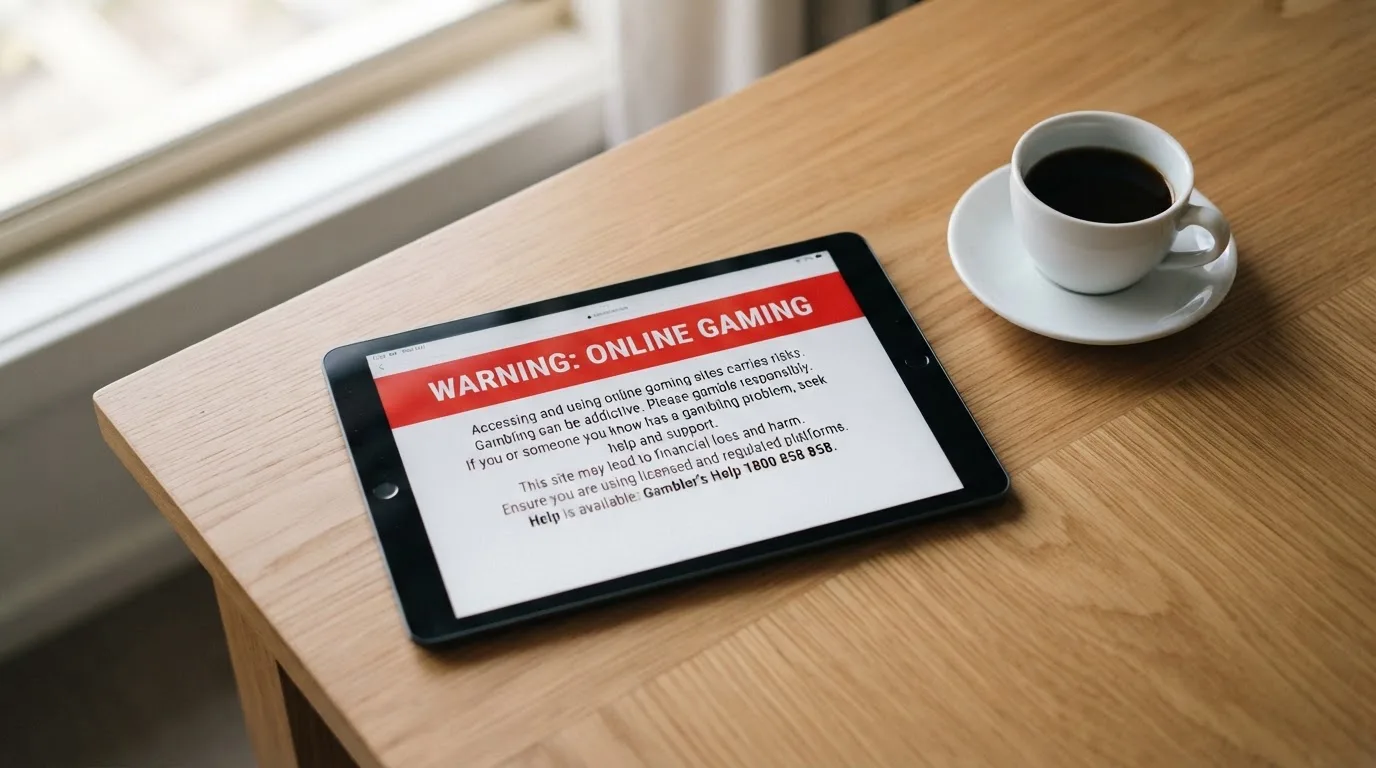
The minimum age for any of these is 18. The 2017 amendments made it an offence for the provider rather than the player — Australians using an offshore site are not personally prosecuted, but they also have no Australian consumer protection behind them. There is no Australian complaints body with jurisdiction over a Curaçao-incorporated operator. If a withdrawal is refused, the practical recourse is the operator’s own internal process, which the operator controls.
Two recent rule changes tighten the legal frame further. First, since 11 June 2024, credit cards, credit-related products and digital currency are banned as payment instruments for any Australian-licensed online wagering; the maximum penalty for an operator accepting them is A$247,500 per breach. The legal deposit routes for licensed wagering are debit cards, bank transfers, PayID, Osko and BPAY. An Australian player who is asked for a credit card or a crypto wallet address is being asked by an operator that is not running on Australian rules. Second, the Interactive Gambling Amendment (Gambling Reform) Bill 2026 passed Parliament on 19 August 2026; its advertising and inducement measures commence on 1 January 2027. That is law with a start date, not yet in force on a 2026 page, and the page treats it as a date the reader has heard about rather than a rule the reader is currently inside.
The 2017 amendments also extend beyond the consumer-facing offer. They created a prohibition on in-play online betting during a sporting event, a prohibition on click-to-pay odds on race and sport, and restrictions on the advertising of in-play betting. The Interactive Gambling Amendment (Gambling Reform) Bill 2026 builds on that frame for the same consumer-protection reasons.
How enforcement actually feels: blocking, formal warnings, and what they each mean
The ACMA has two distinct enforcement tools, and they are not interchangeable. A formal warning is a written notice under the Interactive Gambling Act that says the named operator is providing a prohibited service to Australians; it is published, named-operator specific and dated. A blocking request is a directive to Australian internet service providers to make a named domain unreachable from an Australian IP address. Both tools have been used repeatedly.
By the end of the reporting window cited in June 2026, the ACMA’s enforcement record stood at 1,751 illegal gambling and affiliate marketing websites blocked since the first blocking request in November 2019, with more than 230 unlicensed gambling services having left the Australian market altogether since enforcement was strengthened in 2017. The 26 June 2026 round added 12 more domains to the blocking list: 7Signs, ChromaBet, Donbet, Duospin, Freshbet, Slots Gem, Jacks Club, Lucky Start, Pointsbetz.com, Spinrise, Vinyl Casino and Wildsino. The blocking tool names the domain, not the operator; the operator identity is what a formal warning carries.
Several thousand Australians still try to reach these domains every week. A block is not a permanent close: domain mirroring, alternate routing and mirror front-ends mean a blocked site can reappear under a different address within days. The blocking record is a list, not a wall. What it gives the reader is a clear sense of the ACMA’s appetite for enforcement and a recent list of names to look out for in a search result or an advert.
The H2 Gambling Capital 2025 estimate puts the share of Australian gambling going through legal channels at 64%, down from 74% in 2021; the same report estimates annual Australian losses to illegal gambling sites at around A$3.9 billion. The illegal-channel share rising while the legal-channel share falls is the underlying trend a blocking record sits on top of, and it is the trend a reader should weigh before treating the ACMA’s record as a solved problem.
The blocking rate the ACMA has built up
A running total of 1,751 blocked domains since November 2019 divides, against the calendar, to a recent average of several hundred domains added per year — unevenly distributed across rounds that ask ISPs to block a dozen or more at once rather than one at a time. The 26 June 2026 round is one of those rounds, and the April and June rounds through 2026 have run in the same batched pattern. The arithmetic the page can offer from this material is not a single number: it is a range, conditional on which window the reader looks at. Across the full window of roughly 80 months, the average works out to about 22 domains a month, but a single 12-domain round can double a year’s count and a quiet stretch can drop it to zero — so the honest summary is a steady, batched blocking pace that has produced, in aggregate, a list of more than seventeen hundred sites. The condition the band carries is “since November 2019, in batched rounds.” That is also why the table above is constructed as it is: a reader looking at a single round sees 12 names; a reader looking at the cumulative record sees a five-figure list with eleven named operators at the top.
Formal warnings and the operator-level record
The formal-warning tool has its own logic. The ACMA names the legal entity behind a brand, on a date, over a specific prohibited service. If the brand resurfaces under a different parent, the warning has to be reissued against the new parent. The repeated appearances of Dama N.V. in the table above — May 2022 over Level Up, then March and May 2025 over Woo Casino and Spirit Casino — are the clearest example of this. The behaviour is what the ACMA is targeting; the legal entity is the lever.
A reader looking at a brand name in an advert and finding it in the ACMA’s register has the public part of the answer already: the named operator is on the warning list. What the register does not tell the reader is what the operator has done internally to address the warning. The IGA does not require a public closure notice. The audit trail a reader can build is one of dates and entity names, and the absence of a post-warning compliance note is not the same as compliance.
State-by-state licensing, and where each one draws the line
Australia’s poker-machine policy is set state by state, and a reader’s state affects what is and is not available at a venue as much as their wallet does. Each state separately regulates the design and operation of electronic gaming machines.
New South Wales had 87,298 gaming machines outside casinos across 2,195 venues at June 2023, with player losses of A$8.18 billion over 2022–23. The minimum legal return-to-player in NSW is 85%. Queensland had 21,122 gaming machines in 351 venues at October 2023; its minimum RTP is also 85%. Victoria operates about 26,380 machines outside Crown Melbourne across 488 venues under a 30,000-machine statewide cap; the standard minimum RTP is 85% but Crown Melbourne is set at 87%. Western Australia banned poker machines in pubs and clubs when Crown Perth opened in 1985, leaving the state machine-free outside that one casino; the minimum RTP is 90%, the most generous in the country, but the universe of legal machines is far smaller. The Australian Capital Territory and Tasmania both set a 87% floor, with the ACT’s minimum-return machines being the most common in their state-level player base. South Australia sits at 87.5%. Tasmania also passed legislation in November 2021 ending the Federal Group’s monopoly on poker machines, with oversight moving to the Tasmanian Liquor and Gaming Commission; planned mandatory pre-commitment cards were pushed back to a late 2025 launch.
The minimum-RTP figures are the legal floor for a land-based machine; an online pokies engine has no analogous floor because there is no Australian-licensed online pokies product. The figures matter here because a reader comparing an offshore app’s RTP claim to a familiar Australian number should know that the Australian number sits on the side of the regulated machines, not the offshore ones.
The NSW regulator’s casino-games regime is also relevant to one corner of the market. Section 66 of the NSW Casino Control Act 1992 requires that a casino operator may only offer a game such as baccarat (or any other table game) under rules approved by the regulator, and must make the approved rules available on request. Victoria has had a similar regime under the VGCCC since 1 July 2022. The relevance to this page is narrow: regulated table games in a casino are approved games; an unapproved offshore game is something else entirely, even when the marketing uses the same word.
What a careful reader actually checks before trusting an offer
Six questions sit behind the table. They are not a checklist that turns a blocked offer into a safe one — there is no checklist that does that — but they are the questions a reader can answer with the ACMA record in front of them, and that is more than most adverts invite.
- Is the operator named in any of the ACMA’s formal warnings? The brand-by-brand table above is current; the ACMA’s own register is more recent.
- Is the offer a prohibited interactive gambling service? Online pokies, online casino games and in-play betting are prohibited; pre-event wagering on sport and racing, lotteries and keno are not.
- What is the payment route the cashier asks for? A debit card, a bank transfer, PayID, Osko or BPAY is consistent with Australian-licensed wagering. Credit card or crypto is a strong signal of an offshore channel.
- Is the offer available through Google Play, the Apple App Store or Samsung Galaxy Store in Australia? Real money casino apps are not listed in the Australian storefronts, so an offer that turns up in those stores under the Australian flag is almost certainly free-play, not real money.
- Is the offer connected to BetStop? A licensed Australian operator is connected; an offshore operator is not. Self-exclusion runs only as far as the legal frame.
- Is the user over 18? The legal age is 18 across every Australian state and territory.
The above is what the regulation is. What it does not do, and is not designed to do, is make a prohibited product safe.
The page’s prescribed calculation, asked of the blocking-rate material, lands in the band “several hundred domains blocked per year on average across the full November 2019 to date window, with individual rounds naming a dozen at a time.” That is the band; the condition is “in batched rounds since November 2019.”
What the help services look like, when a reader decides to stop
The reason this page opens with the help services — and repeats them in a single paragraph below — is that a reader who has just read about the offshore side of this market, and who has decided to step away from it, has a small but real set of doors to walk through. None of them is a website the reader has to find on a Google result. The number 1800 858 858 is the line. Gambling Help Online is the chat. BetStop is the registered self-exclusion that binds Australian-licensed operators; if the reader is using an offshore site, BetStop does not bind it, and the right next step is a helpline call rather than a fresh install.
There is no version of this page that ends with a recommendation that an Australian download a real money pokies app. The product is prohibited in this country by primary legislation, and the ACMA’s record is the public part of how that prohibition is enforced. The reading the page asks of its reader is the reading the law has been asking of the offshore side of this market for years.
Frequently asked questions
The questions below are the ones the ACMA record and the IGA most often produce, written in a reader’s own words and answered in the terms the rest of the page has used.
Can a real money pokies app actually be downloaded through the Google Play Store in Australia?
No. The Google Play storefront for an Australian Google account does not list real money casino apps, including pokies apps. An app that shows up in that storefront with “real money” in its description is either a free-play app or an app the reader has found outside the storefront; the storefront policy is the same either way.
Is sideloading a real money pokies APK onto an Android phone something Australians can legally do?
The legal status sits with the offer rather than the install method. Offering real money pokies to a person in Australia is prohibited under the Interactive Gambling Act 2001, no matter how the underlying software reaches the phone. An APK sideload does not make the offer legal.
How does a free Aristocrat-style pokies app differ from one that claims real-money play?
A free app simulates pokies for entertainment and does not accept deposits or pay out real winnings; an Aristocrat-style free app is, in plain terms, a slot-machine game. A real money app opens a cashier, takes a deposit and offers to pay real cash. The two should not be treated as the same product, and the marketing copy that flattens them is doing so on purpose.
What permissions does a real money pokies app typically ask for on an Android phone?
Storage, network and the like are normal. Camera, microphone and Android Accessibility-services access are not normal for a pokies engine and should be a reason to uninstall at the point of permission request, regardless of what the install screen says about why the permission is needed.
Why would an app be advertised as “download for Android” rather than just playable in a browser?
App-store policies restrict real money casino listings in Australia, so an operator that wants a phone-screen icon has to host the APK outside the storefront and ask the player to sideload it. The install path costs the operator the storefront’s implicit vetting; the player gets back the equivalent trust only by reading the certificate and the permission list themselves.
What should someone check before trusting an app’s claim to pay real money on Android?
The Australian-acquirer question is the central one: is the operator named in any of the ACMA’s formal warnings, and is the offer a prohibited interactive gambling service? A debit card on an Australian-licensed wagering product is a yes; a crypto wallet on an offshore casino is a no. The help services and the legal age of 18 are the rest of the answer.