
Best new online casino sites Australia 2026: what the ACMA record says, and what readers are really paying for
New online casino sites pitched at Australian readers in 2026 share one feature regardless of the bonus they advertise: every one of them is operating against Australian law. The Interactive Gambling Act 2001 prohibits the supply of online casino games — slots, table games, live dealer rooms — to anyone physically in Australia. No state or territory licenses that product. The only things an Australian-licensed operator can sell online are pre-event sports and race wagering, lotteries and keno. So a “new casino” page written from inside Australia is not a shortlist; it is a careful description of what the offshore brands are doing, the regulators who have noticed, and the practical mechanics — deposits, withdrawals, blocks, self-exclusion — that meet a reader who lands on one of them.

Data current as of 9 November 2026, cross-checked against the ACMA register, AUSTRAC guidance, the Reserve Bank of Australia’s card-payments review and the operator terms pages of Westpac, ANZ and Commonwealth Bank.
Table of Contents
- Games, providers and live tables: what the catalogues actually carry
- New casinos: what “new” actually means, and what it costs
- Brands targeted by ACMA actions
- The Australian legal landscape
- Player protection in a market that doesn’t license the product
- Crypto and the route the rules don’t reach
- Payments and payout speed: the mechanics that meet an Australian reader
- Bonuses and the turnover that comes attached
- Mobile and the app question
- What an Australian reader actually has
- Frequently asked questions
- What the ACMA record closes
Games, providers and live tables: what the catalogues actually carry
The shape of a new casino lobby
The catalogues behind these brands are not experiments. They are the same library of roughly 100 to 200 studios, refreshed every few weeks, with a small group of providers — Pragmatic Play, Evolution, NetEnt, BGaming, Nolimit City — supplying most of what a player will see. A site that launched last month and a site that launched in 2023 share most of their floor. What differs is the welcome wrapper, the seasonal promo calendar and, occasionally, one exclusive title that the operator funded directly. None of that changes the math of any single spin.

Slots, jackpots and the RTP that matters
A slot’s return-to-player figure is set by the studio, not the operator. The same Pragmatic Play “Sweet Bonanza” runs at the same 96.5% RTP at every brand that stocks it. The house edge is in the game; the brand is the storefront. When a lobby highlights a “new release” with a 97% figure, the player is looking at a slot the rest of the industry also released that week, on terms the studio wrote. Where research names an exact RTP, it is named for a specific title and that title only — copying the number onto a neighbour in the lobby is the kind of mistake a fact sheet quietly invites.
Live dealer and table games
Live casino rooms are dominated by Evolution, Pragmatic Play Live and a handful of smaller studios. The game types — roulette, blackjack, baccarat, game-show products — are not new, and the bet limits are set by the studio’s contract with the operator. “New live casino” in 2026 usually means a fresh Evolution studio opening, not a new game mechanic. For an Australian reader the practical point is that the live-dealer experience is identical across the brands in any ACMA warning round, because the studios are the same.
Why this shelf comes first
The catalog is what a player sees on the second screen, after the bonus pitch. Putting it ahead of the legal framing is a deliberate choice: a reader who lands here expecting a game review needs to know, before the catalogue does its work, that the storefront itself is what carries the risk. The slots are not in dispute; the operator is.
New casinos: what “new” actually means, and what it costs
How new is new
A “new casino” brand can be three different things, and a reader should know which one is sitting in front of them. The first is a genuinely fresh launch — a new domain, a new operating company, often no visible licence or a licence from Curaçae or Anjouan that was issued weeks before the site went live. The second is a rebrand: Dama N.V.’s catalogue includes Rocketplay, Level Up, Woo Casino, Wild Tornado, Cobra and Dazard, and ACMA warnings over individual names land in clusters because the operator’s pipeline, not the player-facing brand, is the unit of enforcement. The third is a so-called “white-label” skin, where the same platform is rented to a marketing team that owns only the domain and the welcome email. All three look new to a first-time visitor.
The cost of newness
A freshly launched offshore brand has not yet built the trail that an older one carries. There is no long payout history to check, no record of how it handled a complaint, no forum thread about a delayed withdrawal. That is not a deal-breaker, but it is information. The warning history the ACMA publishes is, in practice, the only public audit trail many of these brands ever receive — and it runs in the opposite direction. In March 2026 the ACMA warned Pulsup Ltd over Rocketplay.com.au. In April 2026 it warned Ryker B.V. over Jackbit and CasinOK. The pace has not slowed.
Newness as a marketing hook
The word “new” carries weight in this market because the casino business is saturated and a fresh domain can buy itself a slot on affiliate lists and a bonus rate the older operators cannot match. A 200% match plus free spins, on a brand launched four weeks ago, with no payout history and a Curaçae licence number that was registered the month before the welcome email went out — that is the profile a reader is being asked to take on faith. The operator’s pitch is that they are hungry for customers; the ACMA’s record is that they are also fresh enough not to have been warned yet.
Brands targeted by ACMA actions
How the list was assembled
The list below is not a recommendation. Every brand on it was named in a formal ACMA warning for offering prohibited interactive gambling services to Australians. The list is the ACMA’s own record, in the order research gives it. Where research carries no support data for the brand, no support claim is made here — the table leaves the cell empty rather than carrying a half-formed claim.
The eleven brands in the ACMA record
| Brand | ACMA action and date | Operator named by the ACMA | Subject support |
|---|---|---|---|
| RocketPlay | March 2026 | Pulsup Ltd (Rocketplay.com.au); earlier Dama N.V., May 2022 | Gamblinginsider listings |
| Level Up Casino | May 2022 | Dama N.V. | Westpac listings |
| Woo Casino | March 2025 | Dama N.V. | — |
| Spirit Casino | May 2025 | Dama N.V. | — |
| National Casino | July 2025 | Consolutetish S.R.L. | ACMA register; AUSTRAC; BetStop listings |
| Bizzo Casino | July 2025 | Consolutetish S.R.L.; earlier TechSolutions, 2022 | Gamblinginsider listings |
| Ignition Casino | July 2025 | Bamboo Media | — |
| Instant Casino | February 2025 | EOD Code SRL | EcoPayz and PayID listings |
| Jackbit | April 2026 | Ryker B.V. | — |
| Casino Intense | April 2025 | Sterplay Holding Ltd | AUSTRAC; BetStop; Gamblinginsider listings |
| Sky Crown | September 2022 | Hollycorn N.V. | — |
Eleven brands, eleven warnings, and the operators behind them cluster the way enforcement clusters: Dama N.V. accounts for four of them. Consolutetish S.R.L. for two. The table is what the ACMA has done. It is also what the licensed Australian wagering market has nothing to say to, because none of these brands sits inside its perimeter.
How to read the table
The “Subject support” column is the only column where a negative is meaningful. A dash means research found no listing that ties the brand to that payment method, support line or self-exclusion register. Where a name appears, the listing is what gamblinginsider, an operator terms page, the ACMA register itself or a payment provider’s merchant directory carries — never the casino’s own claim, and never a recommendation. A reader using the table to choose where to play is reading the wrong document. A reader using it to see what regulators and payment providers have noticed is reading it the right way.
The Australian legal landscape
The Interactive Gambling Act 2001 in plain language
The Interactive Gambling Act 2001 (IGA) makes it an offence to provide a “prohibited interactive gambling service” to a person in Australia. The 2017 amendment closed the loophole that had let overseas operators offer in-play betting to Australians. Online casino games — slots, blackjack, roulette and their live-dealer variants — are the clearest case of a prohibited service. Pre-event wagering on sport and racing, lotteries and keno are licensed and legal. The line between them is not about how the games look; it is about the licence that authorises them.
The Northern Territory’s narrow role
Australia’s online bookmakers — Sportsbet, Bet365, Ladbrokes, among 52 others — are licensed by the Northern Territory Racing and Wagering Commission. The commission has no full-time staff and meets once a month in Darwin. The Northern Territory licences are wagering licences, not casino licences; no Australian jurisdiction issues one. The arrangement is fiscal: the Territory collects the licence fees. A reader who sees “Australian licensed” on a casino brand’s footer is being shown one of two things — a wagering licence held by a sister company for sports betting, or a licence that does not exist.
Credit cards, crypto and the June 2024 ban
Since 11 June 2024, Australian-licensed online wagering services cannot accept credit cards, credit-related products or digital currency as payment. The penalty for an operator that does is up to A$247,500. The rule covers digital wallets linked to a credit account — Apple Pay on a credit card, for example, is not a route around the ban. The licensed deposit channels that remain are debit cards, bank transfer, PayID/Osko and BPAY. An offshore casino asking an Australian for a credit card number or a USDT wallet address is operating outside the Australian rules; the player using one is not committing an offence, but is using a payment route the regulator has explicitly closed.
What the 2026 reform bill changes
The Interactive Gambling Amendment (Gambling Reform) Bill 2026 passed Parliament on 19 August 2026. Its advertising and inducement measures commence on 1 January 2027. The bill is law with a start date; it is not in force on a 2026 page. Its effect, once commenced, is to tighten what Australian-licensed operators — wagering operators — can say in their promotions. It does not change the underlying prohibition on offshore casino supply; that part of the law is the IGA itself, and it has been in force since 2001.
Player protection in a market that doesn’t license the product
BetStop’s limit, stated plainly
BetStop — the National Self-Exclusion Register, live since August 2023 — is the only Australian consumer-protection register of its kind. A punter who signs up excludes themselves from every Australian-licensed online and phone wagering service. It does not bind an offshore casino. An Australian who has registered with BetStop and then opens an account at one of the brands in the ACMA table above is registering with nothing that connects to that brand. The exclusion is a domestic tool for a domestic product, and the gap is the point.
The 48-hour window at ANZ
ANZ’s gambling block, activated inside the ANZ app, blocks gambling transactions at card level — including transactions made through Apple Pay on the same card. Removing the block again requires a 48-hour waiting period. The bank warns that not all gambling transactions will be blocked and that some non-gambling transactions might be blocked in error. That caveat matters for anyone who relies on a bank block as a backstop: it is a partial filter at the merchant-category-code level, not a guarantee.
Westpac and Commonwealth Bank’s parallel tools
Westpac’s gambling block works the same way: it refuses authorisation of transactions registered under the merchant category code for betting and casino gambling on eligible personal credit and debit cards. Commonwealth Bank lets customers apply a gambling lock to eligible cards via the CommBank app, with the same partial-coverage caveat. Three of the four major banks, three card-level blocks, all working off the same MCC code, none of them able to stop a transaction that is miscoded by the merchant. A reader who treats a bank block as a substitute for self-exclusion is using it as a backstop, not a fence.
Where help is reachable
The National Gambling Helpline — 1800 858 858 — is free, 24/7, and runs chat at Gambling Help Online. Both services are reachable from inside Australia regardless of where a person plays. The 1800 number does not bind to a specific operator; it is a public service that takes calls from anyone whose gambling has become a problem, offshore brand or licensed bookmaker alike.
Crypto and the route the rules don’t reach
Why a crypto-only new casino is a familiar pitch
A new casino that takes only Bitcoin, USDT or a handful of altcoins is solving two problems at once. The first is the credit-card ban: the June 2024 prohibition on credit-related products does not, in practice, reach an unhosted crypto wallet, because the transaction has no Australian issuer and no merchant acquiring bank. The second is the KYC problem: a wallet address and a deposit amount, in principle, let a player move money without the kind of identity check that a licensed Australian wagering operator runs. In practice, the larger operators do verify — they ask for source-of-funds documents, they flag large deposits, and they reserve the right to freeze withdrawals until the documents are in.
The Australian rule, applied to crypto
The ban on digital currency as a payment method for licensed wagering is part of the same 2024 amendments that banned credit cards. It applies to operators, not to players; an Australian punter is not committing an offence by sending Bitcoin to an offshore casino wallet. The casino that accepts it is, however, operating outside the Australian framework. A reader who values the privacy angle of crypto should know that the operator is using that same privacy to keep itself out of ACMA reach.
Stablecoins and the cash-out problem
A withdrawal from a crypto-only casino into an Australian bank account is the moment the privacy ends. The receiving bank will ask where the funds came from; a major exchange will run the same source-of-funds checks. Tether and other stablecoins can be redeemed through Australian exchanges, but the redemption trail is auditable. A reader who sees “instant withdrawals in BTC” on a brand’s homepage is being shown the start of a chain that ends with a bank statement and a tax record.
Payments and payout speed: the mechanics that meet an Australian reader
The PayID and Osko picture
PayID lets a customer address a transfer to a phone number, email or ABN, with the receiving account holder’s name shown before the transfer is sent. Australian Payments Plus warns that being asked to transfer money to a PayID on an illegal gambling site almost certainly means a scam site. Osko, running on the New Payments Platform, gets a bank-to-bank transfer between participating institutions to the recipient in under a minute, around the clock, addressed either to a PayID or to a BSB and account number. Over 100 Australian financial institutions take PayID; more than 25 million PayID identifiers were registered as of April 2025. The infrastructure for instant domestic transfers is mature, but it is also where a regulator expects a licensed operator to be sitting. An offshore casino asking for PayID is asking for the same rails, without the licence that makes their use lawful.
Credit card surcharging and what it means here
The Reserve Bank of Australia’s July 2025 review proposes removing surcharges only on eftpos, Mastercard and Visa card transactions. American Express is explicitly left out of the proposed ban. The reason matters: Amex runs a three-party scheme — issuer and acquirer in one — and the surcharge reflects that. For an Australian punter using a debit card at a licensed wagering operator, the RBA’s proposal would mean no extra fee on top. For an offshore casino, the fee structure is whatever the merchant’s acquiring bank charges, and that is rarely disclosed on the deposit page.
Apple Pay, Google Pay, and the merchant-category-code block
By the end of 2025, Apple Pay, Google Pay and Samsung Pay together accounted for around 45% of all card payments in Australia by number. The transaction limits and PIN requirements for Apple Pay are set by the card issuer and the merchant, not by Apple; Apple itself charges no consumer fee. The catch sits one level down: the ANZ gambling block, activated inside the app, blocks Apple Pay gambling transactions on eligible cards at the same MCC level as it blocks the physical card. The wallet is not a side door. It is a label on top of the same plastic.
AUSTRAC’s A$10,000 threshold
AUSTRAC’s threshold-transaction-report rule applies to physical cash transfers of A$10,000 or more. Ordinary electronic bank transfers are not subject to the per-transaction reporting rule, regardless of the amount. A reader who worries about the size of a withdrawal flagging it for the regulator is reading the wrong rule. The reporting layer that matters for online gambling is the bank’s own source-of-funds process, not the AUSTRAC threshold.
BPAY and what it is
BPAY has run in Australia since 1997 and is available in the online banking of more than 140 banks and financial institutions, used by more than 95,000 businesses. It is a bill-payment service: the payer enters the Biller Code and the Customer Reference Number printed on the bill. BPAY is owned, via parent Cardlink Services Limited, equally by ANZ, Commonwealth Bank, National Australia Bank and Westpac, and is now run by Australian Payments Plus, the same operator as PayID and Osko. It is not a payment route for offshore casinos. It is a payment route for licensed Australian utilities and wagering operators, and the fact that it sits in the same menu is what makes the offshore pitch harder to spot.
Bonuses and the turnover that comes attached
The shape of a “new casino” welcome
A new offshore casino’s welcome package is typically a multi-deposit match — 100% on the first deposit, 50% on the second, 25% on the third — bundled with a free-spin allocation on a specific slot. The headline figure can run from A$1,500 to A$5,000 in bonus money plus several hundred free spins. The number is the marketing number. The cost of clearing it sits in the wagering requirement and the game weighting.
Bonus requirements and weighting
| Bonus Factor | Typical Weighting | Requirement Note |
|---|---|---|
| Slots | 100% | Full contribution to turnover |
| Table Games | 10%–20% | Reduced contribution |
| Live Dealer | 0% | Typically excluded |
The arithmetic above is the cost of the offer. A 40x wagering requirement on a A$1,000 bonus is A$40,000 of qualifying bets, or roughly 55.6 hours of continuous play at A$1 per spin. Any game weighting reduction, such as the 10% applied to table games, raises that turnover floor further.
The game weighting that hides in the small print
Slots almost always count 100% toward wagering. Table games, where a player’s edge against the house is closer, are weighted at 10% to 20%. Live dealer games are commonly excluded from bonus play entirely. The 40x headline on a slot-friendly welcome is, in effect, closer to 200x on a blackjack habit. A reader who treats the welcome as a free bet is treating it as a marketing line, not as a contract.
Free spins and the winnings cap
Free-spin allocations are pinned to a specific slot, with a per-spin value set in the bonus terms — typically the slot’s minimum bet. Winnings from those spins usually carry their own wagering requirement and almost always carry a maximum cashout cap, often in the A$100 to A$200 range. A 200-spin allocation that returns A$400 of bonus money can convert to A$100 of withdrawable cash. That is the value of the gift, after the rules have finished with it.
Why this shelf is here
The bonus shelf is the part of a “new casino” page that does the actual selling. Putting it after the legal framing is the point: a reader who has already read that the storefront itself is what carries the risk will see the bonus arithmetic for what it is. The arithmetic is not a recommendation to take or refuse. It is a price tag.
Mobile and the app question
The mobile experience is the same
A new casino’s mobile offering in 2026 is, in almost every case, a responsive web app delivered through the phone’s browser. A small minority ship native iOS or Android apps; the apps are usually sideloaded as APKs rather than distributed through Google Play, because Google Play’s real-money-gambling policy is country-specific and an offshore casino does not clear it for Australia. The product on the phone is the same catalogue as on desktop, the same bonus terms, and the same deposit flow.
Why a “new mobile casino app” is hard to verify
The “new mobile casino” pitch arrives in two shapes. The first is a brand-new operator that has launched a web app alongside its desktop site. The second is an existing operator that has wrapped its web app in a downloadable shell and rebranded it as “our new app”. Both look the same on a phone screen. A reader who wants to verify the operator before downloading can run the ACMA’s name against its register of formal warnings; a clean name is not an endorsement, but a name already on the register is information. The Play Store and App Store country restrictions, on their own, are not a verification — they are a distribution gate.
The data and battery cost
A live-dealer stream is roughly 2 to 4 MB a minute, sustained. A session of two hours over mobile data is a meaningful chunk of a monthly plan; over a hotel or café Wi-Fi it is, in 2026, an exposure to whatever the public network is. The mobile experience is not unsafe in any technical sense, but it is the same experience as on desktop, with a different network and a smaller screen.
What an Australian reader actually has
The licensed route
A reader who wants to gamble online in Australia has three lawful options. The first is a licensed sports or racing bookmaker — a Sportsbet, a Ladbrokes, a Bet365 — licensed by the Northern Territory Racing and Wagering Commission. The second is a lottery product, run by a state lottery operator. The third is keno, available in clubs and pubs in some jurisdictions. None of these is a casino. A reader who wants the casino product — slots, blackjack, roulette, live dealer — is being pointed at the offshore market by the marketing, regardless of the law.
The self-exclusion and help route
BetStop is for the licensed route. The 1800 858 858 helpline is for anyone. Both are reachable from inside Australia regardless of where the gambling happens. A reader who has self-excluded from licensed wagering and is still gambling offshore has a problem BetStop cannot solve. A reader who is gambling offshore and is reaching for the helpline is reaching for the same service.
The blocking-rate calculation
The ACMA, as of June 2026, has blocked 1,751 illegal gambling and affiliate marketing websites since the first blocking request in November 2019 — roughly 81.8 months. That is an average of about 21.4 blocking requests per month, on a single linear reading. The pace is not linear: enforcement rounds bunch when operators share infrastructure, and quiet periods follow when the regulator is moving against the next cluster. The band is wide enough to fit both readings. It is enough to say that the rate has not slowed, and that a brand not yet on the register is, in the ACMA’s own evidence, a brand whose turn may not have come.
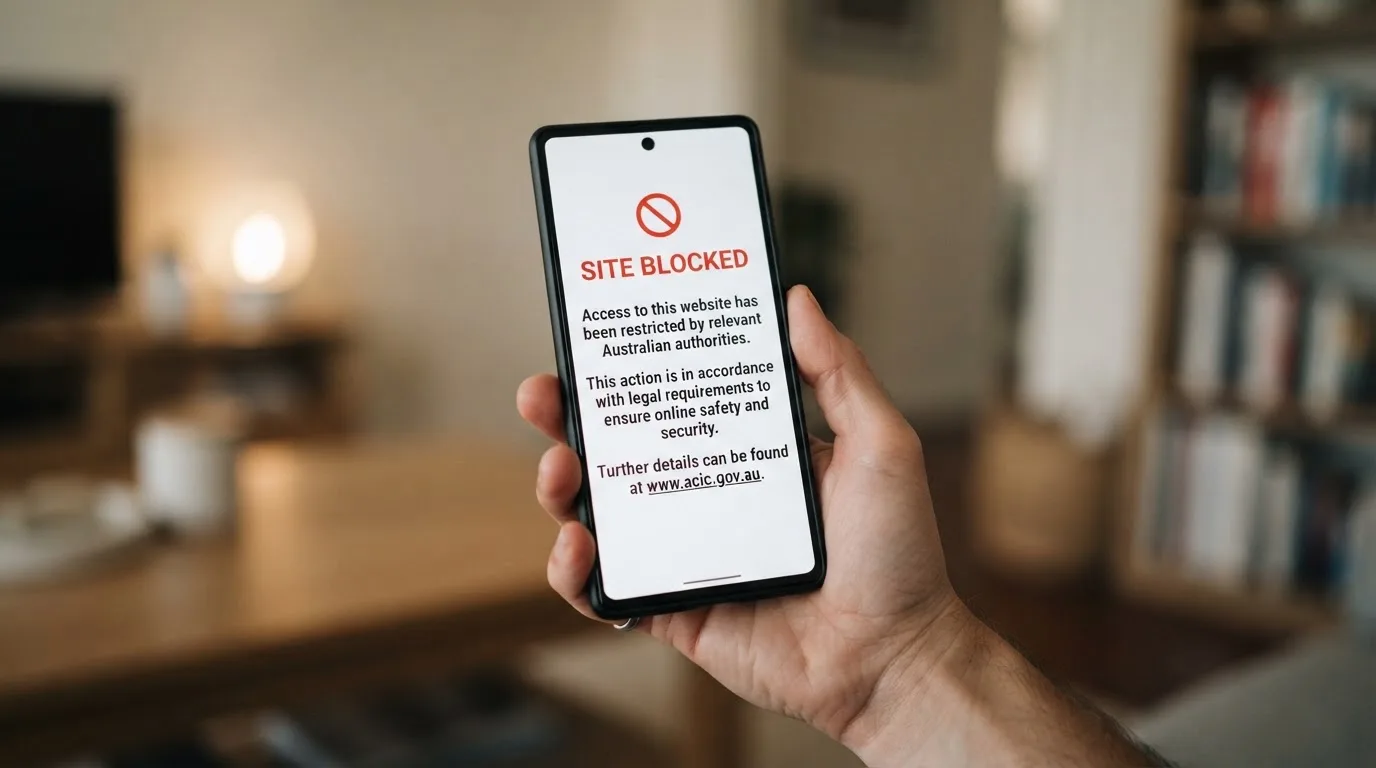
The first blocking request was November 2019. The latest count is June 2026. From November 2019 to June 2026 is 81 months. 1,751 sites divided by 81 months is about 21.6 sites a month, on average. The number that matters is not the average; it is that the count goes up, not down, and that 12 more were added in the most recent round alone.
Reading the offshore market with care
A reader who has decided to use an offshore brand is using a product the regulator has decided not to license. The bank blocks are partial. The self-exclusion register does not reach the brand. The brand’s licence, if it carries one, is from Curaçae or Anjouan, with a complaint channel that runs through the licence issuer and resolves slowly. The bonus carries a wagering requirement that converts a marketing figure into a multi-day play commitment. The crypto route removes some friction at the deposit and adds friction at the cash-out. None of this is a verdict against the reader’s choice; it is the rest of the choice.
Frequently asked questions
How can someone tell how new an online casino site actually is?
A “new casino” brand is, in 2026, more often a new marketing layer on an existing operator’s pipeline than a genuinely fresh launch. Dama N.V., Consolutetish S.R.L. and Hollycorn N.V. all run multiple brands under one corporate roof, and each new domain can be set up in a few weeks. The age of the operating company behind a brand is rarely shown on the homepage; the launch date of the domain is what the marketing copy usually points to, and that is the shallower of the two dates. A reader who wants the deeper answer has to look at the licence holder, not the brand.
Do brand-new casino sites carry more risk than established ones?
A fresh launch carries no payout track record, no complaint history, and no public audit trail of how the operator handled a disputed withdrawal. The warning record the ACMA publishes is, in many cases, the only public trail the brand ever receives — and the ACMA’s list is the part of that trail that runs against the brand. The risk is not a deal-breaker; it is information that an older brand would otherwise generate for free.
Is it legal for a newly launched online casino to accept Australian players?
No. The Interactive Gambling Act 2001 prohibits the supply of online casino games to anyone in Australia. The brand may display a Curaçae or Anjouan licence, but no Australian jurisdiction issues one for casino games, and a foreign licence does not make the supply lawful here. The individual player is not prosecuted; the operator is.
What should someone check before trusting a casino site that only just launched?
The starting point is the ACMA’s register of formal warnings. A brand already on the list is a brand the regulator has noticed. Beyond that: the operating company behind the brand, the licence issuer and licence number, the address of any complaints body named in the terms, and the payment route being asked for. Credit cards and crypto are out of scope for licensed Australian wagering since June 2024; a site asking for either is operating outside the Australian framework.
Do new casino sites typically offer a welcome bonus to attract players?
Yes, and the headline number is the marketing number, not the cost. A A$1,000 bonus at a 40x wagering factor is A$40,000 of qualifying bets, or about 55.6 hours of continuous play at A$1 a spin. Game weighting — slots at 100%, table games at 10% to 20%, live dealer commonly excluded — can lift the figure further. Free-spin winnings usually carry their own cap, often A$100 to A$200. The arithmetic is the value of the offer, after the rules have finished with it.
Can a new mobile casino app be verified as genuine before downloading it?
Partly. The ACMA register is the only Australian register that covers these brands. An app distributed as a sideloaded APK, rather than through Google Play or the App Store, is harder to verify because it has not passed a store’s review. The brand’s operating company, the licence issuer and the deposit route are the same checks as on desktop. A clean name on the ACMA register is not an endorsement; a name already on the register is information.
What the ACMA record closes
The ACMA’s June 2026 count is 1,751 blocked websites since November 2019. The 12 added in that round are 7Signs, ChromaBet, Donbet, Duospin, Freshbet, Slots Gem, Jacks Club, Lucky Start, Pointsbetz.com, Spinrise, Vinyl Casino and Wildsino. None of those names is being added here as a recommendation. They are the latest chapter in a record that began in 2017 with the IGA amendments, has not slowed in 2026, and is the closest thing to a public audit trail the offshore casino market in Australia has.
The legal position has not changed. The bank blocks are partial. The self-exclusion register does not reach offshore brands. The bonus arithmetic does not soften. A reader who reads the page to the end and decides an offshore brand is still where they want to be has decided that with the picture in front of them, not with the marketing line.