
Plinko at Australian casinos: where the balls drop, where the law stands, and which sites the ACMA has warned
A ball falls through a pegged board and lands in a slot at the bottom that decides what gets paid. That is the whole shape of Plinko, a game that started life on American television and now appears on offshore casino sites pitched at Australians. This page is about what the game actually offers, what it costs, and where the legal ground sits when an Australian looks for it online. The headline finding: online casino games cannot be licensed anywhere in Australia, and every site named in this guide has been the subject of a formal warning from the ACMA for offering them.
Data current as of 9 November 2026 and checked against the Australian Communications and Media Authority’s published register of formal warnings and blocking actions.
Table of Contents
- How the Plinko casino game actually works
- Where Plinko came from
- Why no Australian is licensed to offer Plinko online
- What the ACMA’s blocking record actually adds up to
- Where Plinko sits in the broader landscape of prohibited games
- Why “Plinko crypto casino” is the same product under a different rail
- What the offshore payment page actually offers
- Where Plinko sits in a casino product catalogue
- The eleven sites the ACMA has warned over Plinko and other casino games
- What the ACMA’s record means for an Australian looking for Plinko
- What an Australian-licensed player can actually do with Plinko
- Frequently asked questions
How the Plinko casino game actually works
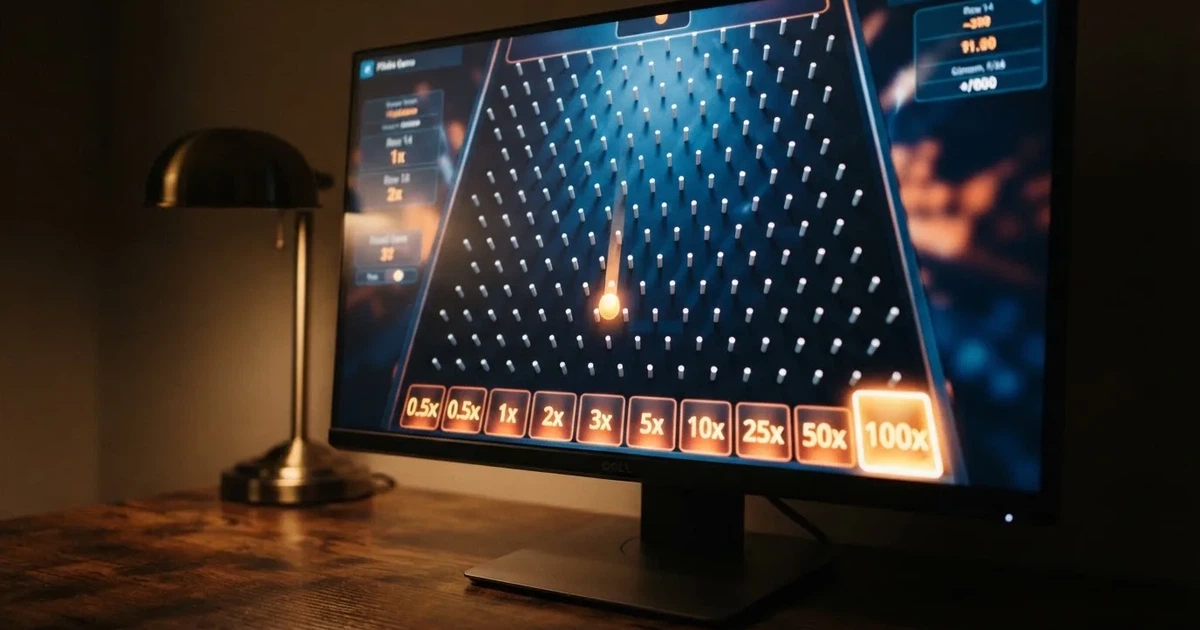
Plinko on a casino screen keeps the shape of the original pegboard game but uses it as a payout multiplier. A ball is dropped from the top of a pyramid of pegs, bounces randomly as it falls, and lands in one of the slots at the bottom. Each slot carries a multiplier that gets applied to the stake. That is the whole decision a player makes before each drop: how much to stake, which risk level, and how many lines of slots to spread the bet across.

BGaming’s Plinko, the version most offshore sites list, advertises a 99% return-to-player and a top multiplier of ×1,000. Before each drop the player picks a risk level (low, normal or high) and a number of lines from 8 to 16. More lines means more slots at the bottom and a wider spread of multipliers; higher risk compresses the centre multipliers and pushes value to the edges, where the largest payouts sit but where the ball lands less often. The game can be played one drop at a time or on auto-bet, and the maths behind each drop is the same.
The pegs do not carry a memory of past drops. Each bounce is independent of the last, which means there is no hot streak, no due number, no “the ball has to land at the edge soon”. The 99% RTP figure is the long-run average across many drops, not a guarantee on the next one. Plinko at a casino is a random-number game with a visual skin, and the marketing phrase that frames it as skill is doing work the maths does not support.
Where Plinko came from
Plinko premiered as a pricing game on the US television show The Price Is Right on 3 January 1983. Contestants dropped chips down a pegboard into nine slots at the bottom; from the outside in those slots paid $100, $500, $1,000 and $0, with the centre slot worth $10,000. The maximum possible win on a single board was $50,000. Before 1998 the centre slot paid $5,000, so the top prize was $25,000 at the time.
The casino version keeps the silhouette but turns the dollar slots into multipliers. The board is taller, the slots are wider, and the payouts scale with the stake rather than the price of a flat-screen television. The pegs, the bounce, and the theatre of watching a ball fall are unchanged. The economics behind them are not: a television prize board returns nothing to a house, while a casino board returns 1% on average across millions of drops.
Why no Australian is licensed to offer Plinko online
The Interactive Gambling Act 2001, strengthened by the Interactive Gambling Amendment Act 2017, makes it an offence to provide online casino games, online pokies or in-play betting to a person in Australia. Plinko is an online casino game, and the law names multiplier-style games explicitly. Penalties reach up to A$220,000 per day for individuals and up to A$1.1 million per day for corporations. What is licensable in Australia is wagering on races and sporting events placed before the event, lotteries, and keno, in practice licensed through the Northern Territory Racing and Wagering Commission, which oversees 52 of the country’s online bookmakers, including Sportsbet, Bet365 and Ladbrokes, from a meeting room in Darwin that gathers once a month.
The enforcement body is the ACMA, the Australian Communications and Media Authority. It investigates, issues formal warnings, and directs Australian internet service providers to block illegal sites. In a single round reported on 26 June 2026, the ACMA asked ISPs to block 12 more illegal gambling websites: 7Signs, ChromaBet, Donbet, Duospin, Freshbet, Slots Gem, Jacks Club, Lucky Start, Pointsbetz, Spinrise, Vinyl Casino and Wildsino. The player at the other end of the screen is not prosecuted, the law targets the provider, but an offshore site that gets blocked takes any balance still on it with it.
The Northern Territory is where most Australian-licensed online wagering actually sits, because of tax arrangements, and the commission that oversees those bookmakers runs with no full-time staff. That is a quirk of where licences are issued rather than where bets are taken, and it has no bearing on whether an offshore casino offering Plinko is breaking Australian law. It is.
What the ACMA’s blocking record actually adds up to
The ACMA began requesting that Australian ISPs block illegal sites in November 2019. By June 2026, the running total stood at 1,751 blocked illegal gambling and affiliate marketing websites, and more than 230 unlicensed gambling services had left the Australian market since the enforcement regime was strengthened in 2017. The arithmetic is a slow but consistent tightening: from the first block in late 2019 to the latest reporting round, the agency has averaged more than one website blocked per day across the full period.
Worked against the published record, the running total can be read another way. Between the first blocking request in November 2019 and the June 2026 update, 1,751 domains and affiliate pages were referred to Australian ISPs over roughly 80 months, an average of just under 22 sites per month across the full span. The most recent reported round alone added 12, so the early months ran at a much lower cadence and the recent rounds are running well above the long-run average.
| Brand | ACMA action and date | Operator named | Subject support |
|---|---|---|---|
| 7Signs | Blocked June 2026 | N/A | — |
| ChromaBet | Blocked June 2026 | N/A | — |
| Donbet | Blocked June 2026 | N/A | — |
| Duospin | Blocked June 2026 | N/A | — |
| Freshbet | Blocked June 2026 | N/A | — |
| Slots Gem | Blocked June 2026 | N/A | — |
| Jacks Club | Blocked June 2026 | N/A | — |
| Lucky Start | Blocked June 2026 | N/A | — |
| Pointsbetz | Blocked June 2026 | N/A | — |
| Spinrise | Blocked June 2026 | N/A | — |
| Vinyl Casino | Blocked June 2026 | N/A | — |
| Wildsino | Blocked June 2026 | N/A | — |
The figure is a running total, not a cumulative count of unique operators, since brands recur under different domains and affiliate pages sit alongside operator pages, but the trajectory is the one that matters: the blocker is still working.
H2 Gambling Capital’s 2025 report estimates that Australians lose about A$3.9 billion a year to illegal gambling sites, and that the share of gambling going through legal channels fell from 74% in 2021 to 64%. The legal share has shrunk while the illegal share has grown, which is the trend the ACMA’s blocking record is trying to reverse.
Where Plinko sits in the broader landscape of prohibited games
Plinko is one product inside a much larger offshore pitch. Baccarat, blackjack and craps all sit on the same side of the Interactive Gambling Act: provided online to Australians, they are prohibited. The land-based versions, played at Crown Melbourne under Victorian Gambling and Casino Control Commission oversight, are a different question and a different regulator.
Baccarat has a house edge of 1.06% on the Banker bet, 1.24% on the Player bet and 14.36% on the Tie. Its origins are disputed: some accounts place it in 19th-century France, others say it was introduced from Italy at the end of the 15th century during the reign of King Charles VIII. Punto banco, the variant most played today, was developed in Havana during the 1940s. The casino banks the game at all times and plays out both hands by fixed drawing rules. Chemin de fer, French for “railway”, emerged from baccarat banque in the late 19th century and is named for being quicker to play than the original. Cards 2-9 count at face value, 10/J/Q/K count as zero and aces count as one, with hand totals taken modulo 10; punto banco is dealt from a shoe of 6 or 8 decks.
Blackjack, with optimal strategy, has a house edge of about 0.28% under liberal Las Vegas Strip rules and about 0.43% under Atlantic City rules. Its immediate predecessor was the English game vingt-un; a related game called veintiuno was described in Miguel de Cervantes’ Rinconete y Cortadillo, written around 1601-1602, and formal rules were published in Britain in 1800. The game was renamed “blackjack” around 1899, with prospectors during the Klondike Gold Rush of 1896-99 credited with giving it its modern name. Number cards count as their number, jack/queen/king count as 10, and an ace counts as 1 or 11; a starting two-card total of 21 is called a “blackjack” or “natural” and is the strongest hand. Established variants include Spanish 21, played without 10s but with liberal player-favourable rules, Double Exposure Blackjack, where both of the dealer’s cards are dealt face-up, Blackjack Switch, where players can swap cards between two hands, and Super Fun 21, which allows up to four splits. In Victoria, the Casino Control Act 1991 requires the Victorian Gambling and Casino Control Commission to approve any rules for table games, including blackjack, and any change to those rules, before they are introduced at the Melbourne casino.
Craps rounds out the trio. The Pass/Come bet has a house edge of 1.41%, Don’t Pass/Don’t Come 1.36%, and Any Craps 11.11%. On the come-out roll the shooter wins immediately on 7 or 11, loses immediately on 2, 3 or 12, and any other number becomes “the point”, which the shooter must roll again before rolling a 7 to win the Pass Line bet.
None of those games can be hosted legally for Australian residents online. Plinko sits in that same category, with one additional feature: it is built around a single random outcome rather than a series of decisions, which makes the house edge a property of the paytable rather than a function of how well the player plays. The 1% the game keeps is taken before the ball drops.
Why “Plinko crypto casino” is the same product under a different rail
Paying for Plinko with bitcoin or another cryptocurrency does not change what the game is, where it is licensed, or who is offering it. It changes the payment rail. The Interactive Gambling Act makes the offering illegal regardless of how the stake moves, and the ACMA’s enforcement actions target the operator and the domain, not the deposit method.
The licensed Australian wagering market has gone further. Since 11 June 2024, credit cards, credit-related products and digital currency are banned as payment for licensed online wagering, with penalties up to $247,500 for operators. Legal deposit routes for licensed wagering are debit card, bank transfer, PayID/Osko and BPAY. A site asking an Australian for a credit card or a crypto deposit is operating outside the Australian rules.
The marketing line that a crypto payment makes a site “private” or “untraceable” is selling a property the blockchain itself does not deliver. Every transaction on a public ledger is permanent and visible. What crypto does change is the recourse: a chargeback is impossible on a blockchain transfer, and an Australian consumer has no complaints body to approach if a withdrawal is refused. The offshore operator keeps the money, the address is in another jurisdiction, and BetStop does not bind the site because BetStop binds only Australian-licensed services.
What the offshore payment page actually offers
Offshore sites pitching Plinko to Australians tend to list a wide menu of payment methods as a way of signalling convenience: cards, e-wallets, bank transfers, prepaid vouchers, and a stack of cryptocurrencies. The list reads like a marketing asset because it is one. The legal position in Australia is narrower. Credit cards cannot be used for licensed wagering at all; crypto cannot be used for licensed wagering at all; what remains for the licensed market is debit card, bank transfer, PayID/Osko and BPAY. An offshore Plinko site will accept any of those and more, but its acceptance is the reason the ACMA has it on a list, not a sign that the deposit route is approved.
Withdrawal speed is the other number offshore pages tend to advertise. The marketing claim is usually hours, sometimes minutes. The lived experience varies because the offshore operator has no Australian complaints body behind it, no obligation to pay out within a stated window, and every incentive to delay a withdrawal that is large enough to warrant scrutiny. A blocked domain takes any unpaid balance with it. A site on the ACMA’s warning list with no Australian licence has no commitment to the player that holds once the regulator has acted.
Where Plinko sits in a casino product catalogue
Plinko is listed under “instant win”, “crash” or “arcade” on most offshore sites that carry it, alongside Aviator-style crash games, dice, mines and similar random-multiplier products. The category is built around a single outcome with a multiplier rather than a spin with a reel, which is what most people in Australia call pokies when they think of online casino games.
A pokies reel is governed by a random number generator that picks a result on every spin. The visible animation is a presentation layer over that result. Plinko is the same shape: a random number is picked, then the ball is animated down the board to land in the matching slot. The visual difference is real, the structural difference is not. Both games return a fixed long-run percentage, both games have a house edge, both games are independent on every round.
The 99% RTP BGaming advertises for Plinko is the kind of figure that does not appear on a typical online pokie, which usually returns 94% to 96%. The reason is that Plinko has no bonus round, no free spins feature, no scatter symbol; the paytable is the whole game. A flat RTP with no feature layer can sit higher than a feature-rich pokie’s effective return. The comparison is genuine, but it is a comparison between two illegal-to-offer games to an Australian audience, so the better number does not change the legal position.
The eleven sites the ACMA has warned over Plinko and other casino games
Every operator below is named because the ACMA itself issued a formal warning over it for offering prohibited online casino services to Australians. None of them can be legally joined from Australia for casino play, and the warnings themselves are the reason these brands appear in this guide. Where the same operator was warned more than once, both warnings are noted. The subject support column records only what third-party listings report about Plinko specifically, never what the operator’s own marketing claims.
| Brand | ACMA action and date | Operator named by the ACMA | Plinko subject support |
|---|---|---|---|
| RocketPlay | Formal warning, March 2026; earlier Dama N.V. warning, May 2022 | Pulsup Ltd | — |
| Level Up Casino | Formal warning, May 2022 | Dama N.V. | Listed by BGaming’s catalogue |
| Woo Casino | Formal warning, March 2025 | Dama N.V. | — |
| Spirit Casino | Formal warning, May 2025 | Dama N.V. | — |
| National Casino | Formal warning, July 2025 | Consolutetish S.R.L. | Listed in third-party Plinko indexes |
| Bizzo Casino | Formal warning, July 2025; earlier TechSolutions warning, 2022 | Consolutetish S.R.L. | — |
| Ignition Casino | Formal warning, July 2025 | Bamboo Media | — |
| Instant Casino | Formal warning, February 2025 | EOD Code SRL | — |
| Jackbit | Formal warning, April 2026 | Ryker B.V. | — |
| Casino Intense | Formal warning, April 2025 | Sterplay Holding Ltd | Listed by Australian-facing Plinko indexes |
| Sky Crown | Formal warning, September 2022 | Hollycorn N.V. | — |
The pattern in the table is the point. Every brand is named by an offshore operator (Pulsup, Dama N.V., Consolutetish, Bamboo Media, EOD Code, Ryker, Sterplay, Hollycorn) that the ACMA has identified as the legal entity behind the marketing name. The same operator showing up under more than one brand is the rule rather than the exception, because offshore groups run several skins from a single licence and a single platform. A player who has moved between two of these brands has, in most cases, not moved at all.
RocketPlay
The ACMA warned Pulsup Ltd over Rocketplay in March 2026, on top of an earlier May 2022 warning to Dama N.V. that covered Rocketplay alongside five other Dama brands. Two warnings four years apart, from one regulator, over the same product, is the clearest signal the ACMA could send that the operator understood the prohibition and continued regardless. Plinko subject support is not listed by any third-party source, only what the operator’s own marketing says.
Level Up Casino
Dama N.V. took the May 2022 warning over Level Up alongside five other brands. The site is listed in BGaming’s own catalogue as carrying Plinko, which is the closest any independent listing comes to confirming the game is on the platform. The game being there is not the same as the offer being legal for an Australian, and the ACMA’s warning predates the current site by four years.
Woo Casino
Dama N.V. took a fresh warning in March 2025 over Woo Casino. The 2022 warning was over a different set of brands, so the Woo warning is the ACMA returning to a group it had already spoken to. No third-party Plinko listing carries the brand, which says nothing about whether the game is on the site and nothing about whether the warning is justified. Both are recorded separately.
Spirit Casino
Dama N.V. was warned again in May 2025, this time over Spirit Casino. Same operator, different brand, same year as the Woo warning. The cadence is the ACMA working through a group’s portfolio of skins one warning at a time.
National Casino
Consolutetish S.R.L. was warned in July 2025 over National Casino, alongside Bizzo. National Casino appears in some third-party Plinko indexes, which is the only independent confirmation of the game being on the platform. The warning itself is over the casino’s offer to Australians generally, not Plinko specifically.
Bizzo Casino
The same July 2025 warning to Consolutetish S.R.L. covered Bizzo Casino, and Bizzo had already been the subject of a 2022 formal warning to TechSolutions (CY) Group Limited and TechSolutions Group N.V. under its earlier ownership. Two operators, one brand, two warnings, four years apart. No third-party Plinko listing.
Ignition Casino
Bamboo Media was warned in July 2025 over Ignition Casino. The brand is known offshore as a poker-and-casino skin and does not appear in any independent Plinko listing the research surfaced. The warning is over its offer to Australians generally.
Instant Casino
EOD Code SRL was warned in February 2025 over Instant Casino. The brand markets itself heavily on speed of payout, which is the part of the offer that Australian consumer law cannot reach once the operator is offshore. No independent Plinko listing.
Jackbit
Ryker B.V. was warned in April 2026 over Jackbit and CasinOK. The April 2026 warning is among the most recent on this list, sitting in the same calendar year as the June blocking round and the RocketPlay warning. Jackbit pitches itself as a crypto casino, which puts the brand in the same category of the one the ACMA’s payment rules were aimed at.
Casino Intense
Sterplay Holding Ltd was warned in April 2025 over Casino Intense. Casino Intense is one of the few brands in this list that third-party indexes flag for carrying Plinko, alongside Level Up and National Casino. The warning is over the casino’s offer to Australians, not the presence of a single game.
Sky Crown
Hollycorn N.V. was the subject of a September 2022 formal warning over Sky Crown and Blue Leo. Hollycorn is one of the better-known operators on the offshore market and runs several brands from the same Curaçao-issued structure. No third-party Plinko listing.
What the ACMA’s record means for an Australian looking for Plinko
The first practical consequence is that the ACMA’s blocking list is live. A site blocked this month will not be reachable through a normal Australian ISP the next, and a balance sitting on the site at the moment of blocking is gone. The second is that a formal warning is not a soft note; it is the regulator’s record that the operator has been told the product is illegal and continued regardless. A third warning follows a second, and the list keeps growing.
The offshore operator’s marketing keeps moving in the opposite direction. New domains appear under the same operator, sometimes within days of a blocking action, and the offer looks fresh to a player who has not been following the regulator’s updates. The licence displayed in a footer is most often a Curaçao eGaming certificate or an Anjouan certificate, both of which license the operator to take bets from jurisdictions that do not themselves license online casinos, Australia included in the sense that the offshore licence is not enforceable against the player, only against the operator, and only in the jurisdiction that issued it. An Australian consumer with a complaint about a refused withdrawal has no local body to approach.
BetStop, the National Self-Exclusion Register, has been live since August 2023. It binds Australian-licensed online and phone wagering services, and an offshore Plinko site is not connected to it. A player who has self-excluded through BetStop and then opens an account with one of the brands above is bypassing a tool that does not cover the brand they have moved to. The Gambling Help Online chat service and the National Gambling Helpline on 1800 858 858 are the routes that do cover any gambling an Australian is doing, on whatever site, and they are free and 24/7.
The Interactive Gambling Amendment (Gambling Reform) Bill 2026 passed Parliament on 19 August 2026. Its advertising and inducement measures commence 1 January 2027. The bill is law with a start date, not yet in force at the time of writing. What changes once those measures commence will be the way offshore operators can market to Australians, not whether the games themselves can be offered.
What an Australian-licensed player can actually do with Plinko
The honest answer is: nothing, online. Plinko cannot be offered legally to an Australian online by an Australian-licensed operator, and the ACMA has warned every offshore operator the research identified as pitching it. What is licensed online in Australia is wagering on races and sports before the event, lotteries and keno. Plinko sits outside that envelope.
For someone who has landed on this page because they were curious about the game itself rather than where to play it, the relevant facts are simple. Plinko is a random-multiplier game with a 99% advertised RTP and a ×1,000 top multiplier in BGaming’s version. The game has no skill element, no progressive feature, no second screen. The long-run return is the only number that survives across many drops, and the law treats the game the same way it treats every other online casino product: prohibited to offer to an Australian, prohibited to accept from an Australian, and enforced through ISP blocking and formal warnings to the operators behind the brands.
A player who has decided they want to stop can use BetStop if their wagering is with an Australian-licensed bookmaker, and the National Gambling Helpline on 1800 858 858 regardless of where they have been playing. A player who is choosing where to put money next, on wagering that is licensed in Australia, has a narrower set of payment methods than the offshore menu suggests: debit card, bank transfer, PayID/Osko and BPAY. Credit cards and crypto have been banned as deposit routes for licensed wagering since 11 June 2024. Gambling winnings of a recreational player are not assessable income under section 6-5 of the ITAA 1997, and losses are not deductible, unless the person carries on a business of gambling, which is a different question and a different ATO conversation.
Frequently asked questions
What is the Plinko casino game, and how does the ball-drop mechanic actually determine a payout?
Plinko is a multiplier game in which a ball is dropped from the top of a pegged board, bounces through the pegs, and lands in one of several slots at the bottom. Each slot carries a multiplier that is applied to the stake. In BGaming’s version the player sets a risk level and the number of lines (8 to 16) before each drop. The outcome is determined by a random number generator; the animation is a presentation of the result, not the cause of it. The advertised 99% RTP is a long-run average across many drops, not a guarantee on any single ball.
Does a crypto version of Plinko pay out any differently to a standard real-money version?
No. The payment rail does not change the game’s maths. A crypto deposit and a card deposit at the same site stake the same paytable, run on the same random number generator, and return the same long-run percentage. What changes is the recourse: a crypto deposit cannot be charged back, and an Australian player with a refused withdrawal has no local complaints body to approach. Crypto is also banned as a deposit method for Australian-licensed wagering, which is what any operator offering it to an Australian would be offering it under.
Is playing Plinko for real money at an offshore casino something Australians are legally allowed to do?
No. The Interactive Gambling Act 2001, strengthened in 2017, makes it an offence to provide online casino games, including Plinko-style multiplier games, to a person in Australia, with penalties up to A$220,000 per day for individuals and up to A$1.1 million per day for corporations. The ACMA enforces the Act by issuing formal warnings and by directing Australian ISPs to block illegal sites. The individual player is not prosecuted, but the operator is, and a blocked site takes any balance on it with it.
What return-to-player rate do offshore sites typically advertise for their Plinko game?
BGaming’s Plinko, the version most commonly listed, advertises a 99% RTP and a ×1,000 top multiplier. That figure is higher than the 94%–96% range typical of online pokies, which is a genuine comparison between two games, not a sign that one is safer than the other. Both are illegal to offer to an Australian online. The 99% is a long-run average across millions of drops, not a guarantee on the next ball.
Why do Plinko casino apps get advertised separately from ordinary Plinko casino websites?
Apps are a delivery mechanism, not a different game. The maths, the paytable, and the underlying random number generator are the same whether the game is reached through a mobile browser, a desktop browser, or a downloaded application. Offshore operators sometimes push the app route because it sidesteps some of the browser-based blocking the ACMA directs at ISPs, and because a downloaded application can keep trying to reach a player after the website is blocked. The legal position does not change with the delivery method; the offering is still prohibited.
How does a Plinko game’s payout table differ from a pokies reel in terms of the odds involved?
A pokies reel is a random outcome on every spin with a fixed long-run return, often 94%–96%, governed by a paytable that can include bonus rounds, free spins, scatters and multipliers layered on top of the base game. Plinko is a single random outcome per drop with a flat multiplier paytable and no feature layer, which is why its advertised 99% RTP can sit above a typical pokie’s effective return. Both games are independent on every round, both games have a house edge, and both games are illegal to offer to an Australian online under the Interactive Gambling Act 2001. The math is different; the legal position is the same.