
Gambling casino sites, online slots and the Australian legal line
9 November 2026 · Checked against the ACMA register and the Interactive Gambling Act 2001 as administered in Australia.
The Australian market runs on a single bright line. Land-based casinos, licensed pokies in clubs and pubs, and online wagering on races and sport placed before the event are all legal. Online casino games — slots, table games, live dealer rooms — are not. The Interactive Gambling Act 2001, tightened by the Interactive Gambling Amendment Act 2017, makes it an offence to provide those products to a person physically in Australia, and no state or territory issues a licence that would cover them. Every site this page reviews falls on the wrong side of that line. The point of looking at them is not to recommend one but to be honest about what an Australian player is choosing between when one of these tabs opens anyway.
Table of Contents
- The legal frame: prohibited product, offshore providers
- Enforcement in 2026: the blocking rate
- Responsible play: the limits that actually apply
- Crypto-funded play: the same slots, a different rail
- Slots, pokies and the games themselves
- The offshore brands the ACMA has acted against
- How the legal and the offshore channels line up
- Frequently asked questions
The legal frame: prohibited product, offshore providers
The Interactive Gambling Act 2001 distinguishes a wagering service from a prohibited interactive gambling service. A wagering service covers betting on racing, on sporting events before they start, and lotteries and keno run under state or territory authority. A prohibited interactive gambling service covers online casino games, online pokies and in-play betting. Only the first category is licensable, and the licence does not bleed into the second. The Northern Territory Racing and Wagering Commission regulates 52 of Australia’s online bookmakers — Sportsbet, Bet365 and Ladbrokes among them — for tax reasons, and the commission has no full-time staff and meets once a month in Darwin. None of that machinery covers a slots catalogue.
The provider is the one who breaks the law, not the punter. The Australian Communications and Media Authority investigates complaints, issues formal warnings and can direct Australian internet service providers to block offending sites. The June 2026 round alone added 12 sites to the block list — 7Signs, ChromaBet, Donbet, Duospin, Freshbet, Slots Gem, Jacks Club, Lucky Start, Pointsbetz, Spinrise, Vinyl Casino and Wildsino — bringing the running total to 1,751 illegal gambling and affiliate marketing websites blocked since the first blocking request in November 2019. More than 230 unlicensed services have left the Australian market since enforcement was strengthened in 2017.
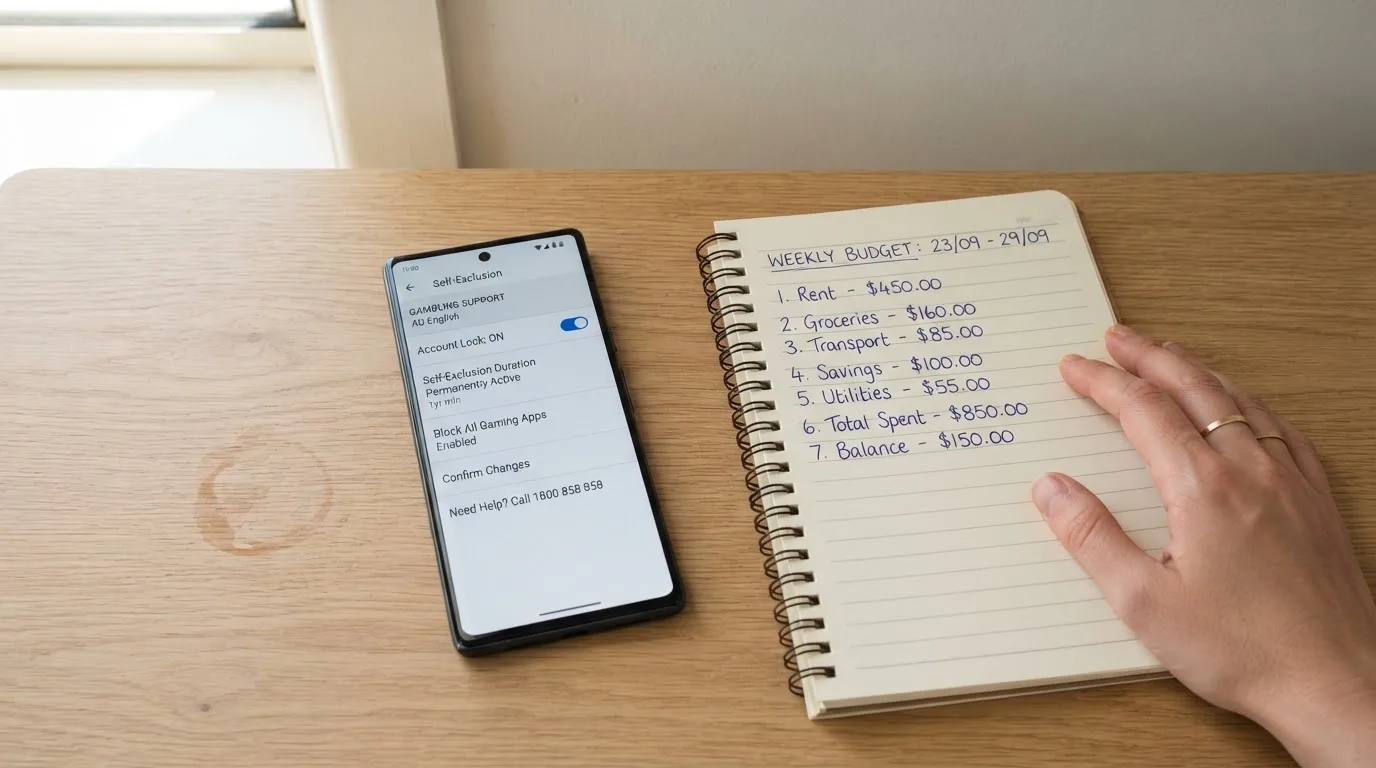
Player protection sits inside that same frame. BetStop, the National Self-Exclusion Register, has been live since August 2023 and binds Australian-licensed online and phone wagering services — offshore casinos are not connected to it, so a self-exclusion lodged with BetStop does not stop an offshore site from accepting a deposit. The National Gambling Helpline (1800 858 858) is free, runs 24/7 and offers chat through Gambling Help Online. None of this reaches a Curaçao-registered site that has never agreed to Australian rules.
What an offshore casino does not give a player is the Australian safety net: no dispute resolution through a domestic regulator, no automatic blocking on self-exclusion, no obligation to honour a withdrawal. If the offshore operator decides a withdrawal is a bonus-abuse case and closes the account, the only recourse is the operator itself. That is the structural cost of choosing one.
Where pokies are legal, and where they are not
The pokies landscape outside online casinos is heavily concentrated in the south-east. New South Wales counted 87,298 pokies-style machines outside casinos in June 2023, with Victoria at 26,380 in 2021–22, Queensland at 21,122 in October 2023, South Australia at 11,672 in September 2023 and the ACT at 3,587 in November 2023. By 2010 Australia operated an estimated 97,103 gaming machines outside casinos — a per-capita rate about five times that of the United States. These are pub, club and casino machines, governed by state-level regulators and harm-minimisation measures such as mandatory pre-commitment in some jurisdictions. They are not the subject of this page. They matter here only because every “real money online pokies Australia” search result is a step sideways into the prohibited product.
What the ACMA has actually acted against
The Authority does not chase affiliates in the abstract; it issues a formal warning when a named operator has been offering prohibited services to Australian customers, and it publishes the warning with the operator name and the brand. Repeated warnings are public. The dossier of operators the ACMA has acted against is the practical list of what the regulator considers to be in scope. This page works through that dossier in order. Every brand below has been the subject of a published ACMA formal warning; every brand below operates from outside Australia; every brand below is, by definition, prohibited.
Enforcement in 2026: the blocking rate
The arithmetic that matters is simple and damning. The ACMA made its first blocking request in November 2019. By June 2026, the cumulative total stood at 1,751 websites blocked and more than 230 services having exited the market since 2017. That is the underlying rate.
| Period | Blocked sites added (cumulative) | Years elapsed | Effective rate |
|---|---|---|---|
| Nov 2019 – Jun 2026 | 1,751 | 6.6 | ≈265 sites per year blocked |
The condition behind the figure: it counts unique websites and affiliate pages, not legal cases. A single operator group can produce several blocked URLs, and an affiliate marketing page is counted alongside the casino it points to. The number also stops where the ACMA’s published record stops — sites that have not yet come to its attention are not in it. The headline number says one thing and only one thing: enforcement is constant, the pipeline of new blocked URLs is not drying up, and the rate at which offending sites appear continues to outpace the rate at which they leave the market voluntarily.
The H2 Gambling Capital 2025 estimate is the other half of the picture: Australians lose about A$3.9 billion a year to illegal gambling sites, and the share of gambling going through legal channels has fallen from 74% in 2021 to 64%. That is not a legal-channel problem — it is a prohibited-channel problem, and it is growing faster than enforcement can answer it.
What a formal warning actually does
A formal warning under the Interactive Gambling Act 2001 is a written notice naming the operator, the brand and the conduct. It is published on the ACMA website and stays there. It does not by itself block the site, but it is the documented step before a blocking request to ISPs and often the trigger for civil penalty proceedings. Repeated warnings to the same operator group — Dama N.V. over Woo Casino in March 2025 and over Spirit Casino in May 2025, or the warning to Consolutetish S.R.L. over National Casino and Bizzo Casino in July 2025, the second formal warning tied to Bizzo Casino since 2022 — are how the regulator signals that the next step is a block or a penalty. A player who cares about where a site sits in that process can check the ACMA register.
Responsible play: the limits that actually apply
A site calling itself “trusted” or “safe” online gambling is making that claim about itself. Independent limits and self-exclusion tools matter more than the marketing, because they sit outside the operator’s control. The Australian-licensed wagering side has a real framework: BetStop covers licensed online and phone wagering, debit card or bank transfer or PayID or BPAY is the legal funding route, and credit cards and crypto have been banned for licensed wagering since 11 June 2024, with penalties up to A$247,500 for operators that take them. An offshore casino is bound by none of this.
What an Australian player actually has, regardless of where the site is licensed, is a set of personal decisions. Pre-commitment — a hard cap on deposits and time spent before the session starts — works better than a limit set inside a casino app the player can toggle off. The 24/7 National Gambling Helpline at 1800 858 858 is free and confidential. Gambling Help Online offers live chat. A punter who plays offshore because the licensed options do not include slots is still playing offshore: the harm-minimisation conversation that the licensed sector is being pushed into does not follow the money there.
Age, identity and the offshore gap
Minimum age for any gambling activity in Australia is 18. Licensed operators verify identity before the first deposit and link the account to BetStop if a self-exclusion match comes back. Offshore sites vary: some run light KYC at withdrawal and treat deposit-time checks as a checkbox. The Interactive Gambling Act 2001 prohibits providing the service, not playing it — a player is not prosecuted — but a site that does not verify age is not the place to take a problem gambler’s complaint if a child has used a parent’s card. The licensed side is the side with an audit trail.
What an offshore dispute looks like
The simplest version: a player deposits in Bitcoin or via card, plays, requests a withdrawal, and the operator freezes the account pending a “bonus abuse” review. The review concludes weeks later with the balance forfeited. The player has no Australian complaints body to write to, no local court with cheap jurisdiction over a Curaçao or Anjouan-registered company, and no automatic recourse. That is the consequence of choosing a prohibited product: the law does not protect the customer on the prohibited side. A licensed bookmaker has obligations to the regulator; an offshore casino does not.
Crypto-funded play: the same slots, a different rail
Crypto gambling casinos run the same slot titles as card-funded sites — the same reels, the same bonus features, the same return-to-player settings — with a blockchain wallet swapped in for a bank card. Bitcoin, Litecoin and a small set of altcoins are the typical deposits. The slot software on the back end is the same library: BGaming, Pragmatic Play, Evolution for live tables, and the rest of the usual catalogue. The difference is not the game; it is the funding rail and the regulatory geography.
What changes is the legal treatment. From 11 June 2024, digital currency is a banned payment method for Australian-licensed wagering, alongside credit cards and credit-related products. A licensed Australian bookmaker cannot lawfully accept Bitcoin. An offshore casino is not subject to that rule, so crypto is one of its easier routes in. For a player who would not fund a gambling site with a credit card and would not use PayID because of the trace it leaves, crypto is the path the offshore side has kept open. That path is exactly what the 2024 ban was aimed at closing on the legal side; on the prohibited side, the ban does not bite.
The Bitcoin gambling site and the card-funded site play the same slots for the same house edge. The bonus offers on the welcome page often look the same in headline number, but the conditions — the wagering multiple, the maximum cashout, the games that count toward clearing — are different in detail across brands, and the details are what make one offer costlier than another. A 35x turnover on a A$500 bonus at A$1 per spin is 17,500 spins of commitment, not a gift.
Slots, pokies and the games themselves
Online slots and pokies-style titles differ mainly in reel count, paylines and bonus features rather than in how outcomes are decided. The mechanics are the same: a random number generator produces a result on every spin, and that result maps to a symbol combination and a payout according to the game’s published pay table. Modern video slots can run five or more reels with 50 or more symbols per reel, producing odds as high as 300 million to one against a top combination, against a classic three-reel machine with about 10 symbols per reel offering roughly 1,000 possible combinations. The maths is in the pay table, not in the player’s eye.
Charles Fey of San Francisco developed the first automatic slot mechanism in the late 19th century — a three-reel machine with five symbols (horseshoes, diamonds, spades, hearts and the Liberty Bell), where three bells in a row paid the top prize of ten nickels. Bally’s “Money Honey” in 1963 was the first slot with a bottomless hopper and automatic payout of up to 500 coins without an attendant. The first video slot was developed in 1976 by Fortune Coin Co. in Kearny Mesa, California. The Australian pokies machine is a direct descendant of that lineage, with state-level regulation layered on top. NSW legalised slot machines in 1956; the local market has been growing in density since.
A note on the numbers behind the screen. The house edge on a slot is the inverse of the return to player: a 96% RTP slot returns A$96 over a long series of spins for every A$100 wagered, and the house keeps A$4. State-level regulation in the United States sets minimum payout percentages that vary — Nevada at least 75%, Mississippi at least 80%, New Jersey at least 83% — but Australian online slots are not regulated to that minimum, because the sites offering them are not licensed here. A “96% RTP” stamped on a game page is the provider’s own number, not a regulator’s audit.
Table games at licensed venues: a short reference
Table games at Australian casinos are regulated by state authorities and not the focus of this page, but they show what approved play looks like. Crown Melbourne offers three baccarat variants — Traditional Baccarat, Crown Baccarat and 2 to 1 Baccarat — approved by the Victorian Gambling and Casino Control Commission, which replaced the VCGLR as Victoria’s casino regulator on 1 July 2022. Baccarat’s house edge is 1.06% on the Banker bet, 1.24% on the Player bet and 14.36% on the Tie; cards 2-9 count at face value, 10/J/Q/K count as zero and aces count as one, with hand totals taken modulo 10, dealt from a shoe of 6 or 8 decks. Punto banco, the variant most played today, was developed in Havana in the 1940s; the casino banks the game at all times and plays out both hands by fixed drawing rules. Under section 66 of the NSW Casino Control Act 1992, a casino operator must not permit a game such as baccarat to be played unless the game and its rules are approved by the regulator and a copy of the approved rules is made available to patrons on request. Blackjack, played under liberal Las Vegas Strip rules, carries a house edge of about 0.28% with optimal strategy. Craps is 1.41% on Pass/Come, 1.36% on Don’t Pass/Don’t Come. These are the numbers that a state-regulated casino publishes. An offshore slots site publishes what it chooses.
The offshore brands the ACMA has acted against
Every brand in this section is a prohibited interactive gambling service. None can be licensed in Australia. Each is named here because the ACMA itself has issued a formal warning over it for offering prohibited services to Australian customers, and the operator and date are exactly as the ACMA has published them. The order is the order of the ACMA dossier, not a ranking.
| Brand | ACMA action and date | Operator named by the ACMA | Subject support |
|---|---|---|---|
| RocketPlay | March 2026 | Pulsup Ltd | — |
| Level Up Casino | May 2022 | Dama N.V. | listings-only (BGaming) |
| Woo Casino | March 2025 | Dama N.V. | — |
| Spirit Casino | May 2025 | Dama N.V. | — |
| National Casino | July 2025 | Consolutetish S.R.L. | listings-only (en.wikipedia.org) |
| Bizzo Casino | July 2025; earlier 2022 | Consolutetish S.R.L. (2025); TechSolutions (2022) | — |
| Ignition Casino | July 2025 | Bamboo Media | — |
| Instant Casino | February 2025 | EOD Code SRL | — |
| Jackbit | April 2026 | Ryker B.V. | — |
| Casino Intense | April 2025 | Sterplay Holding Ltd | listings-only (Abc.net.au; acma.gov.au; Crown Melbourne) |
| Sky Crown | September 2022 | Hollycorn N.V. | — |
The table tells one story in four columns: every brand has been the subject of an ACMA formal warning; the operators are registered in Curaçao, Cyprus, Romania or similar offshore jurisdictions; the “subject support” column is mostly empty because the ACMA’s records cover these brands as defendants, not as payment-method or game-provider subjects, and the cross-reference material that exists is sourced to third-party listings pages rather than to the operator itself. The substance is uniform — every brand here is in the same legal position — and the variation across rows is administrative: who the ACMA named, and when.
RocketPlay
RocketPlay was the subject of a formal warning to Pulsup Ltd in March 2026. Dama N.V. had been warned earlier, in May 2022, over the same brand under its previous operator structure. A site that changes the company name on its footer without changing the games, the bonus offers or the customer base is not a new entrant to the regulator’s attention; it is the same business under a different letterhead. RocketPlay offers the standard prohibited product — online slots, live tables — to Australian customers via an offshore registration. The ACMA’s repeated engagement with the brand is the clearest signal that the operator has been told, in writing, on more than one occasion, that the service is prohibited.
Level Up Casino
Dama N.V. was warned over Level Up Casino in May 2022 as part of a six-brand batch that also covered Bambet, Dazard, Rocketplay, Wild Tornado and Cobra Casinos. Level Up is the BGaming-friendly face of that group — the slots library and the provably fair branding line up with BGaming’s catalogue listings on third-party sites, though the operator itself does not publish a payments or providers list in a form the regulator cross-checks. The Australian position is the same as for the rest of the group: the service is prohibited, the warning is on the ACMA register, and any Australian-facing page that opens is one the ACMA can ask ISPs to block.
Woo Casino
Dama N.V. was warned again in March 2025, this time over Woo Casino. Two years separates the 2022 batch and the 2025 Woo warning, which is itself a data point: a single operator group can rack up multiple formal warnings without the underlying conduct changing. Woo’s catalogue is the standard mix — slots, live tables, jackpot games — funded by card and crypto, with no Australian licence. The brand is a useful reminder that “Dama N.V. was warned in 2022” is not the same as “Dama N.V. left the market.” It did not.
Spirit Casino
The May 2025 warning to Dama N.V. over Spirit Casino closes the loop with the March 2025 warning over Woo Casino: two formal warnings to the same operator group, two months apart, over two different brands. Spirit runs on the same template as Woo — slots library, bonus offers, crypto on the deposit rail — and the regulatory outcome is the same. A reader looking at one brand and not the other is looking at the same operator twice; the only difference is the brand name on the homepage.
National Casino
Consolutetish S.R.L. was warned in July 2025 over National Casino. National’s catalogue appears on third-party listings pages (en.wikipedia.org), and its bonus structure follows the offshore pattern. The Consolutetish S.R.L. name is a recent one in the ACMA’s register; the 2022 history belongs to different companies over different brands. The point is that the corporate name behind the brand is what the regulator names, and that name changes more often than the underlying service.
Bizzo Casino
Bizzo Casino has been warned twice: Consolutetish S.R.L. in July 2025, and TechSolutions (CY) Group Limited and TechSolutions Group N.V. in 2022. Two operator names, three years apart, one brand. A brand that changes the operating company twice in three years is one to be cautious about on a withdrawal dispute, since the corporate counterparty the player is dealing with is not a constant. The slot catalogue and bonus terms are the same as the rest of the offshore market.
Ignition Casino
Bamboo Media was warned in July 2025 over Ignition Casino. Ignition has a longer history than most on this list — its roots are in the offshore poker and casino market of the early 2010s — and the warning is a sign that the ACMA’s net has widened beyond the European-registered operators to the broader offshore field. The brand is well-known; the legal position is the same as for every other brand here.
Instant Casino
EOD Code SRL was warned in February 2025 over Instant Casino. Instant Casino markets itself heavily on speed of withdrawal — a frequent emphasis in the offshore market, where “fast payout” is the pitch that replaces the regulatory trust signal that licensed operators offer. The pitch works only if the operator decides to honour it; the legal structure around an offshore operator does not compel a payout the way a licensed regulator does.
Jackbit
Ryker B.V. was warned in April 2026 over Jackbit and CasinOK. Jackbit is the more crypto-native of the two — Bitcoin, Ethereum, Litecoin and a wider altcoin list on the deposit rail, with a slots-heavy catalogue and minimal fiat on-ramp. The crypto-native positioning is exactly the gap the 11 June 2024 ban on digital currency for licensed wagering was aimed at closing; on the prohibited side, the gap is the entire product.
Casino Intense
Sterplay Holding Ltd was warned in April 2025 over Casino Intense. Casino Intense sits on the third-party listings pages — Abc.net.au and the ACMA register are the Australian-side references, with Crown Melbourne’s site appearing as a state-regulated contrast point in listings that compare offshore and licensed venues. The brand is small relative to the others on the list; the legal position is the same.
Sky Crown
Hollycorn N.V. was warned over Sky Crown and Blue Leo, with the formal warning published in September 2022. Hollycorn is a long-running operator group in the offshore space, and the September 2022 warning is among the earlier entries on the ACMA’s register of formal warnings. The brand is a useful reminder that the ACMA’s enforcement has been continuous since the 2017 amendments, not a sudden crackdown in 2025.
How the legal and the offshore channels line up
A reader looking at this page is choosing between two channels: the legal one — land-based casinos, licensed pokies, online wagering on races and sport — and the offshore one, which is what the ACMA has been warning and blocking since 2017. The legal channel offers regulated play, real dispute resolution, BetStop-linked self-exclusion and a tax position the ATO has published. The offshore channel offers a wider slots catalogue, crypto funding and bonuses that look generous on the welcome page; the same channel offers no Australian regulator, no dispute body and no recourse on a withdrawal dispute.
For a punter who wants to play online slots, the choice is not between two licensed options; it is between a legal product that does not include what the punter wants and a prohibited product that does. The honest reading of that choice is what this page has tried to give. The marketing word — “trusted”, “safe”, “real money”, “best” — is on the offshore side, and it is the marketing word that has to do the work of the regulator that the offshore side does not have.
What changes in 2026 and after
The Interactive Gambling Amendment (Gambling Reform) Bill 2026 passed Parliament on 19 August 2026. Its advertising and inducement measures commence on 1 January 2027. It is law with a start date; it is not in force on this page. The direction of travel is clear: the legal side is being tightened around marketing and inducements, and the offshore side is not being legalised. A punter choosing an offshore site in 2026 is choosing a prohibited product that is becoming more, not less, regulated against.
What an Australian player actually has
A licensed bookmaker’s account, a BetStop registration if the punter wants one, a hard pre-commitment on deposit and time, the National Gambling Helpline (1800 858 858) on speed dial, and a clear-eyed view of what an offshore slot site is and is not. The licensed wagering side covers racing and sport before the event. It does not cover online slots. The choice the punter makes between the two is theirs, and the legal frame around both is what this page is built to make visible.
Frequently asked questions
Is real-money online casino gambling legal for someone based in Australia?
No. Online casino games and online pokies are prohibited interactive gambling services under the Interactive Gambling Act 2001. No state or territory issues a licence that covers them. The provider is the one the law targets, not the player, but an offshore site gives no Australian consumer protection, no complaints body and no recourse if a withdrawal is refused.
How does a slot machine’s random number generator decide the result of a spin?
A random number generator produces a result on every spin, independent of the previous spin and independent of the player’s history. That result maps to a symbol combination according to the game’s pay table. Modern video slots can run five or more reels with 50 or more symbols per reel, producing odds as high as 300 million to one against a top combination.
Do crypto gambling casinos use the same slot software as card-funded sites?
Yes. Bitcoin and other crypto deposits at offshore casinos run the same slot titles and the same library as card-funded sites — the same reels, the same bonus features, the same RTP settings. The difference is the funding rail and the regulatory geography, not the games on the back end.
What is the difference between an online slot and a pub or club pokies machine?
The mechanics are the same: a random number generator decides each spin’s outcome, mapped to a symbol combination and a payout. An online slot is a video game with no physical machine, while a pub or club pokies machine is a regulated physical device in a licensed Australian venue. The legal status is the key difference — pub pokies are state-regulated and legal; online offshore slots are prohibited.
Does a site calling itself trusted or safe mean it has been independently checked?
No. The claim is the operator’s own. Independent checks on the legal side come from the ACMA, state regulators and a BetStop-linked self-exclusion register. On the offshore side, the operator is making the marketing claim and the player has no Australian body to verify it against.
What tools can help someone track and limit time spent playing online slots?
BetStop, the National Self-Exclusion Register, covers Australian-licensed online and phone wagering services. The National Gambling Helpline (1800 858 858) is free, 24/7 and offers chat through Gambling Help Online. A hard personal pre-commitment on deposits and session time, set before play begins, is the most reliable limit — and it is the player’s, not the operator’s.