
Best RTP Pokies Australia: Where Return-to-Player Meets the Offshore Question
The phrase “best RTP pokies Australia” pulls two different things into one search. On one side sits the genuine question — which pokies machines, in clubs, pubs and casinos, return the highest theoretical percentage to the player, and how that figure gets set, audited and disclosed. On the other sits a market the question doesn’t quite ask about but cannot avoid: the offshore online casinos that advertise Australian-friendly sign-up screens, claim high-RTP game libraries, and operate outside every Australian regulator’s reach. Both sides deserve an honest answer, and the honest answer to the second is that the product on offer there is prohibited.
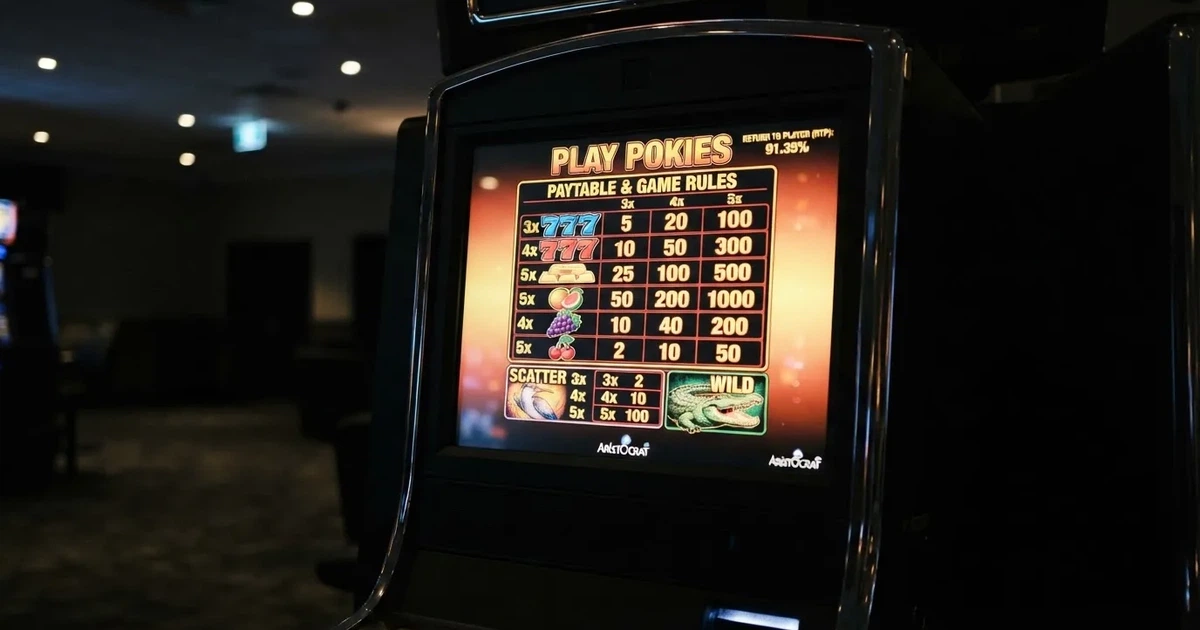
This page works through what return-to-player means on the machines Australians can actually sit down at, what a “high” figure looks like once the state-by-state minimums are accounted for, and how the ACMA’s enforcement record has reshaped the offshore side. Current as of 31 October 2026, cross-checked against the ACMA register and state gaming commission publications.
Table of Contents
- Help Comes First: Where a Player in Australia Stops, Limits, and Talks
- What RTP Actually Means on an Australian Pokies Machine
- The Mechanics: What Makes a Pokies Machine Tick
- How a Shortlist of High-RTP Pokies Gets Built
- The Comparison: Eleven Names the ACMA Has Acted Against
- The Landscape: How Many Machines Sit Where, and Why the Numbers Differ
- The Legal Frame: Why Online Pokies Are Not on Offer to Australians
- Onshore Game-Side Notes Worth Carrying Forward
- The Responsible-Gaming Recap, in One Place
- Frequently Asked Questions
Help Comes First: Where a Player in Australia Stops, Limits, and Talks
A page about high-RTP pokies belongs to a reader who may be weighing a session ahead of them, and the responsible-gambling support network belongs to that reader too. It belongs at the top because everything below it is read by someone whose circumstances the page cannot see.

Gambling Help Online runs the National Gambling Helpline on 1800 858 858 — free, twenty-four hours a day, with web chat available. The service is funded nationally and operates independently of any operator named on this page. It is the first call a player should make if a session has run longer than intended, if chasing losses has become a pattern, or if a family member has raised the question.
BetStop, the National Self-Exclusion Register, went live in August 2023 and binds every Australian-licensed online and phone wagering service. A person registered with BetStop cannot open a new account with a licensed Australian bookmaker, and existing accounts are closed. The register covers licensed wagering only — sports and racing — and does not bind an offshore casino. An offshore operator is not on the system, will not see a BetStop registration, and offers no equivalent exclusion. That gap is one of the structural reasons offshore sites carry different risks to the licensed side.
State-level self-exclusion and patron-screening schemes sit alongside BetStop. New South Wales, Victoria, Queensland, South Australia, Western Australia, Tasmania, the ACT and the Northern Territory each operate their own venue-level exclusion arrangements, applied at clubs, hotels and casinos. The details vary — a Western Australian ban applies only at Crown Perth because that is the only venue in the state operating machines under section 5 of the Casino Control Act 1984, while a Victorian scheme spans the state’s licensed venues — and the responsible-gambling page for each jurisdiction gives the registration route. A multi-state exclusion is not a single form; it is a form per jurisdiction, and an exclusion in one does not travel.
For a player reading this page because a high-RTP figure has tempted a longer session than planned: the figure is a long-run average across many spins and tells the reader nothing about the next spin. A machine set to return 90 cents in the dollar will, on any given minute, return nothing, or a small win, or a feature hit. The arithmetic that produces the published figure is not a prediction. Gambling Help Online and BetStop exist for the cases where that distinction has stopped being obvious.
What RTP Actually Means on an Australian Pokies Machine
Return-to-player is a theoretical average, not a guarantee, and the distinction matters more than the figure itself.
The number is calculated across an enormous number of simulated spins — published figures come from regulator-approved testing houses running millions to billions of cycles against the game’s mathematical model. What comes out is the percentage of money wagered that the machine is designed to return, averaged across that simulation. A machine with a 92% RTP will, over enough spins, return $92 for every $100 put in. Over a hundred spins, the same machine will almost certainly do something else.
On Australian pokies, the figure sits between two constraints. The lower bound is a statutory minimum, set by the state or territory that licenses the venue. The upper bound is whatever the manufacturer has built into the game’s mathematics, provided the game clears the lower bound and the testing regime of the regulator that approved it. The range between the two is where the meaningful variation lives.
The State-by-State Minimum RTP Floor
Every Australian jurisdiction that allows poker machines sets a minimum return-to-player below which no machine may be set. The floors are not uniform — they reflect different policy choices about the role of gaming revenue in funding community services, different assessments of harm, and different histories with the machines.
| Jurisdiction | Minimum RTP | Notes |
|---|---|---|
| New South Wales | 85% | Pub, club and casino machines under state framework |
| Northern Territory | 85% | Same floor as NSW; territory licenses online bookmakers but not casino games |
| Queensland | 85% | Pub, club and casino machines |
| Victoria | 85% generally, 87% at Crown Melbourne | Higher casino floor reflects separate approval regime |
| Australian Capital Territory | 87% | Higher than the 85% cluster |
| Tasmania | 87% | Set during the monopoly-era framework |
| South Australia | 87.5% | Marginal increase over the 87% cluster |
| Western Australia | 90% | Highest minimum; reflects restricted-venue policy |
The 85%–90% band is the range Australian venues operate in. A machine returning 90% is not “high RTP” in the marketing sense — it sits at the regulatory ceiling of one jurisdiction, and a New South Wales pub machine set to 87% sits four points below the Western Australian minimum. The figures are not comparable across borders without translation.
What Counts as a High Figure in Practice
“High RTP” is a marketing phrase, not a regulatory category. Within the 85%–90% statutory band, a venue has limited room to differentiate a particular machine — most machines sit at or a point or two above the floor. The headline-grabbing high-RTP machines tend to be found in casino floors where multiple approved denominations and feature configurations give operators more headroom than a pub or club machine provides. Crown Melbourne, for example, operates under a separate approval regime that allows a higher floor and a wider range of approved game settings than the state’s broader hotel and club trade.
Online, the framing shifts. An offshore site advertising a 96% or 97% RTP slot is advertising a figure the Australian regulatory framework does not apply to. The Interactive Gambling Act 2001 prohibits offering online casino games to people in Australia, so no Australian regulator tests, audits or approves that figure. The number on the game’s information screen is supplied by the operator and, in practice, by the software provider. The testing that backs it may be real — the major studios do subject their games to independent labs — but the certification does not travel through an Australian authority and does not give an Australian player a complaints path if a withdrawal is refused or a balance disputed.
A figure disclosed under an Australian state framework is, by contrast, regulator-tested, regulator-approved and venue-monitored. The audit log of the machine, including its actual return over time, sits with the state regulator or with an approved monitoring house. A pub player in Queensland who suspects a machine is operating outside its approved settings has a venue inspector and a state regulator to raise the matter with. An offshore player has the operator’s own customer support and whatever alternative-dispute-resolution service the offshore licence references — usually in Curaçao or another jurisdiction with limited enforcement reach over an Australian customer.
Where the Figure Has to Be Disclosed
Disclosure rules vary by jurisdiction, and the level of detail a player can see on-machine differs accordingly.
In New South Wales, the player information display on a gaming machine is required to show the credit value, the amount bet on the current game and the amount won on the last game played, but the RTP figure itself is not mandated to be visible on the machine’s screen. Players who want the figure ask venue staff, who can look it up from the machine’s game information menu, or they consult the state regulator’s published register of approved games. A similar pattern applies in Queensland and Victoria — the on-machine disclosure covers session-level information, not the underlying return-to-player percentage.
In Western Australia, where the only legal venue is Crown Perth, the published game list and the Gaming and Wagering Commission’s approvals provide the figures. Tasmania’s framework, with its monopoly-era hangover and the move to oversight by the Tasmanian Liquor and Gaming Commission, makes machine information available through the venue and on request.
The point is that high-RTP claims in Australian venues are not a marketing surface a player reads off a paytable screen. They are a regulator-maintained figure, accessible but not always front-of-machine. A venue that will not produce the figure on request is one a player has a right to ask harder questions of.
The Mechanics: What Makes a Pokies Machine Tick
The Australian pokies machine is the same basic engine that drives most modern video slots worldwide — a Random Number Generator at the back, a reel-and-paytable display at the front, and a volatility profile in between that the player cannot see directly but feels across a session.
A Random Number Generator (RNG) is a software module that produces a new number every millisecond, whether or not a spin is in progress. The number generated at the moment the spin button is pressed determines the outcome of that spin. The machine does not “remember” previous spins, does not “owe” a win after a long dry patch, and does not “tighten up” after a big payout. Each spin is independent. The RTP figure describes the distribution of outcomes across all those independent spins.
The visible reel display is a representation layer. Modern Australian pokies use five-reel video formats with anywhere from a dozen to several hundred paylines, scatter pays, free-spin features and bonus rounds. The reel symbols and paytable are part of the approved game configuration — the regulator approves the configuration as a whole, including the symbol set, the weighting of each reel stop, and the feature triggers.
Volatility is the missing variable in most player-facing descriptions of RTP. Two machines can both return 92% on paper and behave very differently across a session: one pays out small amounts frequently, the other holds back and pays larger amounts rarely. The first produces a long, undulating session with the balance drifting gradually downward. The second produces a quieter session punctuated by occasional larger wins — or by long stretches where the balance moves only downward. The RTP figure does not distinguish between them; only the game’s design and the player’s experience do.
A machine’s volatility profile is built into its mathematical model. The regulator approves the profile as part of the game’s approval, but the figure is not generally published on-machine. A player who wants to understand the volatility of a particular machine has limited options — observation across a session, asking venue staff, or consulting the published game information where the venue or regulator makes it available.
Feature Mechanics and How They Sit Within the RTP
Bonus rounds, free spins and feature buys are where most of the volatility in modern pokies lives. A base game might return 70% of wagers on its own, with the remaining 22 percentage points sitting inside the feature, where wins are larger but rarer. A player who triggers the feature once every forty spins and wins small amounts most times and a large amount once will hit the published figure across enough spins; a player who hits the feature three times in a row will exceed it on the session, and a player who plays two hundred spins without triggering it will fall well short.
The feature-buy option, available on some machines and on most offshore online slots, lets a player pay a multiple of the stake to trigger the feature directly. The buy price is set so that, on average across many triggers, the feature pays back its cost plus the base game’s contribution to the overall RTP. In practice, a feature buy collapses the variance: a player pays a known cost and gets a known-volatility feature, with the long-term expectation already baked into the price. Whether that collapses the session into something the player enjoys or just makes the loss more efficient is a different question.
Side Games, Multi-Link Jackpots and the Hyperlink Mystery
Many Australian pub and club machines are linked into multi-site jackpot networks. A small percentage of every spin on every machine in the network feeds a central jackpot pool, and the pool pays out when a rare combination of symbols lands on a participating machine. The jackpot tier — minor, mini, major and grand — is displayed on the machine’s attract screen, and the prize amounts climb visibly.
The jackpot feed is part of the machine’s RTP, not an addition on top of it. A machine with a 90% RTP and a linked jackpot contributes a slice of its 90% to the prize pool, and the player receives the balance back through the base game and feature. The headline jackpot figure is therefore paid for by every spin on every machine in the network, not by the operator’s generosity.
A player who treats the jackpot as a separate bet is misreading the structure. The probability of landing the trigger combination is set by the game’s mathematics and is the same on every spin regardless of the current pool size. A larger pool does not make the trigger more likely. It makes the prize larger when the trigger does land.
How a Shortlist of High-RTP Pokies Gets Built
The page’s central comparison question — which pokies machines are “the best” on RTP — has a more honest answer than a ranked list. There is no canonical list, because the figures are set machine-by-machine and venue-by-venue under state-specific approval regimes. What a shortlist can do is identify the categories of machine most likely to sit near the top of the band, and the regulatory and venue factors that push a particular machine up or down.
The criteria a reasonable shortlist uses:
- Statutory floor. Machines approved in jurisdictions with higher minimum RTPs start with a higher floor. A 90% minimum caps the floor at the highest point, and a venue choosing machines has to clear that floor. Crown Perth, operating under the 90% Western Australian floor, has the highest regulatory starting point of any Australian venue.
- Volatility profile. A machine can be high RTP and low volatility, or high RTP and high volatility. A shortlist that ignores volatility pairs high-frequency small-win machines with rare-large-win machines on equal terms and tells the player nothing about session feel.
- Feature design. A machine that concentrates most of its return inside a bonus round behaves differently from one that pays steadily. The same RTP figure can hide very different session shapes.
- Denomination range. A machine approved for a wide denomination range may be set differently at each denomination, and the RTP can vary by stake level. A pub machine set at 1c spins and a casino machine set at $1 spins can both return 90% but carry different variance profiles.
- Venue and operator. A Crown Melbourne machine operates under the Victorian Gambling and Casino Control Commission’s separate approval regime, which permits higher returns than the broader pub and club trade in the same state. A Western Australian venue sits at the top of the state-by-state floor range.
What separates one option from another in practice is rarely the published RTP figure alone. The session profile — how often small wins land, how big features run, how long a bankroll typically lasts at a given stake — is what the player feels, and it is the harder of the two to find on a paytable.
What the Comparison Cannot Settle
The honest comparison on Australian high-RTP pokies does not deliver a single best machine. It delivers:
- A clearer sense of what the regulatory floors allow in each jurisdiction, so the reader knows the ceiling they are working under;
- A clearer sense of how RTP and volatility interact, so the reader can choose between a low-variance session that drifts slowly and a high-variance session that punctuates;
- A clearer sense of where the licensed machines end and the offshore side begins, so the reader is not surprised to find that the product they were comparing is not actually on offer to them through any Australian-licensed channel.
The thing the comparison cannot settle is whether a player should be on a machine at all. The RTP figure describes an average. A reader’s session is one data point, not many.
The Comparison: Eleven Names the ACMA Has Acted Against
The eleven operators below are not a recommended list. They are a record. Each is named because the Australian Communications and Media Authority has issued a formal warning under the Interactive Gambling Act 2001 over that brand for offering prohibited interactive gambling services to people in Australia. The fact that the ACMA has acted is the criterion for inclusion. The list is what an honest comparison of “RTP pokies Australia” has to put on the table: the names that appear in advertising for offshore pokies, the regulator’s response to each, and the gap between what those sites claim about RTP and what an Australian player can actually claim through them.
The product on offer at every one of these sites — online casino games, including online pokies — cannot be licensed anywhere in Australia. The licence displayed on the site is held in another jurisdiction, typically Curaçao, and gives the operator authority to operate in that jurisdiction. It does not give the operator authority to offer online casino games to a person in Australia. No offshore licence extends that authority.
The table below names the brand, the ACMA action and the operator behind it. The dates are the publication dates on the ACMA register.
| Brand | ACMA action and date | Operator named by the ACMA | Subject support |
|---|---|---|---|
| RocketPlay | Formal warning — March 2026 | Pulsup Ltd (Rocketplay.com.au); earlier Dama N.V., May 2022 | — |
| Level Up Casino | Formal warning — May 2022 | Dama N.V. | — |
| Woo Casino | Formal warning — March 2025 | Dama N.V. | — |
| Spirit Casino | Formal warning — May 2025 | Dama N.V. | — |
| National Casino | Formal warning — July 2025 | Consolutetish S.R.L. | — |
| Bizzo Casino | Formal warning — July 2025 | Consolutetish S.R.L.; earlier TechSolutions, 2022 | — |
| Ignition Casino | Formal warning — July 2025 | Bamboo Media | — |
| Instant Casino | Formal warning — February 2025 | EOD Code SRL | — |
| Jackbit | Formal warning — April 2026 | Ryker B.V. | — |
| Casino Intense | Formal warning — April 2025 | Sterplay Holding Ltd | — |
| Sky Crown | Formal warning — September 2022 | Hollycorn N.V. | — |
What the table says, plainly, is that the ACMA’s enforcement has touched a familiar roster of brand names at familiar operator companies. Dama N.V. alone has been warned at least four times across the brands listed — Level Up, Woo, Spirit and an earlier Rocketplay action in 2022 — and the operator company has had time, across those warnings, to change the corporate wrapper rather than the underlying product. The same pattern shows at Consolutetish S.R.L. and at TechSolutions, with National Casino and Bizzo Casino linked through both.
What the ACMA’s Blocking Record Looks Like in Numbers
The arithmetic that puts this comparison in context is the ACMA’s blocking record.
The first blocking request under the Interactive Gambling Act went out in November 2019. The cumulative total, as reported in the most recent ACMA round (June 2026), is 1,751 illegal gambling and affiliate marketing websites blocked. In a single round in June 2026 the ACMA directed Australian internet service providers to block a further twelve sites — 7Signs, ChromaBet, Donbet, Duospin, Freshbet, Slots Gem, Jacks Club, Lucky Start, Pointsbetz.com, Spinrise, Vinyl Casino and Wildsino — taking the running total to that figure. The blocking rate is roughly 240 sites per year across the period since the first request, but the spread is uneven: some years carry much higher numbers of enforcement actions than others, and the year’s count depends on the pace at which the ACMA moves investigations through to a blocking direction. The right way to read the figure is as a band: somewhere between 200 and 300 sites blocked per year on the current trajectory, with significant month-to-month variation.
The arithmetic matters because it puts a number behind a list that, presented as a sequence of warnings, can look static. The eleven operators named above are a small slice of a much larger enforcement picture. The figure of 1,751 blocked sites and 230 unlicensed services that have left the Australian market is the scale the warnings sit inside. A reader choosing an offshore pokies site because of an advertised high-RTP library is choosing, in most cases, from a set the ACMA has been working through for years.
What the Brands Are, in Their Own Right
The honest description of these eleven brands, without recommending any of them, is short.
RocketPlay is the most recently warned brand on the list. The ACMA’s March 2026 warning over Rocketplay.com.au is to Pulsup Ltd, and it sits on top of an earlier 2022 warning to Dama N.V. over the same brand name. The site is a typical offshore casino layout — pokies, table games, live dealer rooms — and the warning identifies the operator behind the .com.au landing page rather than the broader Dama N.V. group. A reader who has heard the name RocketPlay from an affiliate site is reading the same name the ACMA has now named twice.
Level Up Casino was warned in May 2022 as part of the same Dama N.V. round that named six brands at once. It has continued to operate as a brand name since, with the corporate operator changing hands or restating itself at different points. The brand has been one of the more persistent in the offshore Australian-targeted market over the period.
Woo Casino and Spirit Casino are both Dama N.V. brands the ACMA returned to in 2025, a year after the 2022 round that first named Dama N.V. across six properties. The pattern — one operator, multiple brand names, repeated warnings — is what makes the ACMA’s enforcement record dense. The same operator company generates fresh warnings because the corporate surface keeps moving.
National Casino and Bizzo Casino are paired in the same way under Consolutetish S.R.L., warned together in July 2025. Bizzo’s history is longer — it was the subject of an earlier 2022 warning to TechSolutions (CY) Group Limited and TechSolutions Group N.V. The two warnings over the same brand, years apart, against different operators, illustrate the regulatory difficulty of pinning a brand to a corporate entity that itself changes.
Ignition Casino, warned in July 2025, is operated by Bamboo Media. The brand has been a familiar name in offshore poker and casino markets for some years.
Instant Casino was warned in February 2025 over EOD Code SRL. The name suggests an immediate-play product, and the brand has been prominent in affiliate marketing for Australian-facing casino traffic.
Jackbit was warned in April 2026 over Ryker B.V. The brand sits at the recent end of the ACMA’s published actions and, with CasinOK, was named in the same round.
Casino Intense was warned in April 2025 over Sterplay Holding Ltd. The brand has had one of the longer arcs among the names on the list, with the ACMA’s April 2025 action adding to a longer history of marketing activity targeting Australian customers.
Sky Crown is one of two Hollycorn N.V. brands the ACMA has named, the other being Blue Leo. The September 2022 warning is one of the older entries on this list and the brand has remained visible in affiliate channels since.
What the Comparison Decides, and What It Doesn’t
What this comparison decides: the offshore brands advertising “best RTP pokies Australia” are not an unregulated fringe. They are a known set, named by an Australian regulator, repeatedly. A reader choosing one of them is choosing a product the regulator has had on file.
What it does not decide: that any particular offshore brand is safer than another because the ACMA has not warned it as recently. Enforcement is procedural and depends on the ACMA’s investigative queue, not on the order in which sites appear in advertising. A site not yet on the table has simply not been through that queue.
What it does not decide: that the sites’ RTP figures are false. They may be accurate to the games they advertise. What is missing is not the figure itself but the Australian regulatory authority that would test it, the venue staff who would monitor the machine, and the complaints body that would hear a player who disputes a payout.
The Landscape: How Many Machines Sit Where, and Why the Numbers Differ
The numbers behind Australian pokies vary widely by state, and the variation is policy-driven rather than market-driven.
New South Wales, the largest market by some distance, had 87,298 gaming machines outside casinos spread across 2,195 venues as of June 2023, with player losses of A$8.18 billion in the 2022–23 financial year. Queensland had 21,122 machines across 351 venues in October 2023. Victoria operates under a 30,000-machine statewide cap, with 26,380 machines outside Crown Casino spread across 488 venues in 2021–22. Western Australia, with the highest statutory RTP minimum and the only legal machine venue at Crown Perth, has a machine count concentrated in one location. Tasmania’s machine count sits under the Tasmanian Liquor and Gaming Commission’s framework, with the legacy Federal Group monopoly ended by legislation passed in November 2021.
The variation is not just headcount. New South Wales operates a pub-and-club trade at the 85% minimum, while Western Australia operates a single-venue trade at 90%. The average machine in NSW returns 85% by law; the average machine in WA returns at least 90% by law. The two figures describe two different policy choices about what gaming machine revenue funds and at what return to the player.
The Offshore Side, by the Numbers That Exist
The licensed side has the headcount. The offshore side has the spend.
H2 Gambling Capital’s 2025 report estimates that Australians lose about A$3.9 billion a year to illegal gambling sites. The share of gambling going through legal channels fell from 74% in 2021 to 64% in 2024, by the same estimate. The decline in the legal share is the working figure for the offshore market’s growth. The A$3.9 billion is the working figure for what that growth costs Australian players.
The 1,751 blocked sites and the 230 services that have left the market are the enforcement response. The figure does not capture the spend leaving the country, and the spend figure does not capture the volume of new sites appearing to replace the blocked ones. Both are working estimates, and both sit behind the offshore brand list above.
What the Numbers Don’t Tell
The numbers don’t tell the reader which offshore site is safer to use, because none of them is licensed for Australian players. The numbers don’t tell the reader which Australian jurisdiction has the “best” machines, because the 85%–90% floor band reflects policy choices that aren’t reducible to a single ranking. The numbers do tell the reader that the licensed side is large, regulated, machine-counted and loss-tracked, while the offshore side is large, prohibited, spend-estimated and enforcement-active. Those are different shapes of oversight, and the difference is the page’s working point.
The Legal Frame: Why Online Pokies Are Not on Offer to Australians
The reason offshore pokies sites cannot be licensed for Australian customers sits in the Interactive Gambling Act 2001, strengthened by the Interactive Gambling Amendment Act 2017. The IGA makes it an offence to provide online casino games, online pokies or in-play betting to a person in Australia. No state or territory licenses the activity. What is licensed in Australia is wagering on races and sport placed before the event, lotteries and keno — in practice licensed by the Northern Territory through the Northern Territory Racing and Wagering Commission.
The IGA targets the provider, not the player. An individual Australian who plays at an offshore site does not face prosecution under the Act. What they do not have is recourse: an offshore operator gives no Australian consumer protection, no Australian complaints body, and no Australian venue for a dispute. A withdrawal refused, a bonus term disputed, a balance held against a player — these are matters for the operator’s own customer service and whatever alternative-dispute-resolution service the offshore licence references, typically in Curaçao, where enforcement reach over an Australian customer is limited.
The IGA also gives the ACMA its enforcement powers. The ACMA investigates complaints, issues formal warnings, and directs Australian internet service providers to block illegal services. A blocked site can still hold a player’s balance; the block stops new account creation in Australia but does not unfreeze funds already deposited. That asymmetry is part of the offshore risk a player takes on.
What Changed in 2026
The Interactive Gambling Amendment (Gambling Reform) Bill 2026 passed Parliament on 19 August 2026. Its advertising and inducement measures commence on 1 January 2027 — law with a start date, not yet in force on a 2026 page. The bill’s effect on the offshore pokies landscape depends on its implementing rules and on the ACMA’s enforcement priorities once those rules apply. The headline change is to the inducement regime — bonus offers and sign-up incentives — that have been the main channel for offshore sites to acquire Australian customers. The structural prohibition on the product itself is unchanged.
What the Northern Territory Does License
The Northern Territory licenses 52 of Australia’s online bookmakers, including Sportsbet, Bet365 and Ladbrokes, and the Northern Territory Racing and Wagering Commission administers those licences. The commission has no full-time staff and meets once a month in Darwin, an arrangement that has drawn parliamentary attention — an ABC report from April 2026 covered an NT bill to reform what it called “the de facto gambling regulator” for the country’s wagering sector. The point for this page is that the NT licences are wagering licences, not casino-game licences. A Northern Territory licence on a bookmaker does not extend to online pokies or online table games. The territory does not license what the IGA prohibits.
Payment Rails and What They Reveal
The licensed wagering side operates under a separate payments regime. Since 11 June 2024, credit cards, credit-related products and digital currency have been banned as payment for licensed online wagering, with penalties up to A$247,500 for operators. The legal deposit routes are debit card, bank transfer, PayID/Osko and BPAY. A site asking an Australian player for a credit card or a crypto deposit is, by that single signal, operating outside the Australian rules. The rule does not make the game illegal for the player; it makes the operator’s payment rail inconsistent with a licensed Australian wagering service, and a player who sees it should treat the rest of the site’s claims with the same scepticism.
Tax Treatment
Gambling winnings of a recreational player are not assessable income in Australia, under section 6-5 of the ITAA 1997. Losses are not deductible unless the person carries on a business of gambling. The rule is a model: a player whose activity is recreational, who plays for entertainment rather than as a livelihood, does not declare winnings and cannot claim losses. A player whose gambling is a business — professional card counters, advantage-play operators at the edge of legality, sports bettors running a model as a business — sits in a different tax treatment and the Australian Taxation Office’s guidance is the right place to start.
Onshore Game-Side Notes Worth Carrying Forward
A reader comparing “best RTP pokies” will sometimes encounter game-side claims drawn from the broader casino market rather than the Australian pub/club/casino trade. Two carry-overs are worth noting because they shape the language.
Baccarat, when described in RTP terms, carries a house edge of 1.06% on the Banker bet, 1.24% on the Player bet and 14.36% on the Tie. The game is offered at Crown Melbourne under three approved variants — Traditional Baccarat, Crown Baccarat and 2 to 1 Baccarat — regulated by the Victorian Gambling and Casino Control Commission, which replaced the VCGLR as Victoria’s casino regulator on 1 July 2022. Under section 66 of the NSW Casino Control Act 1992, a casino operator must not permit a game such as baccarat to be played unless the game and its rules are approved by the regulator, and the operator must make a copy of the approved rules available to patrons on request. The game’s history sits across 19th-century France and a 15th-century Italian introduction during the reign of King Charles VIII; punto banco, the variant most played today, was developed in Havana during the 1940s and runs from a six- or eight-deck shoe with the casino banking both hands.
Blackjack, with optimal strategy under liberal Las Vegas Strip rules — dealer stands on soft 17, double on any two cards, double after split, resplit aces, late surrender — carries a house edge of about 0.28%. Atlantic City rules lift that to about 0.43%. The game’s 21 on a starting two-card hand is the strongest position and the dealer’s rule of drawing to 17 sets the house edge structure. Established variants — Spanish 21 without 10s, Double Exposure with both dealer cards face-up, Blackjack Switch with hand-swapping, Super Fun 21 with up to four splits — push the rules in different directions and change the figure.
Neither game’s house edge translates cleanly into the pokies context — both are table games, not machines — but they are the comparison points a reader will meet in any broader casino-RTP discussion, and the figures are worth carrying forward because they set the band that a pokies machine has to be measured against. A pokies machine at 90% RTP is performing against a 1%–1.5% house-edge benchmark that table games hit and a 5%–15% gap that the pokies floor does not.
The Responsible-Gaming Recap, in One Place
A reader who has reached this section from any of the above has the same options regardless of the path. They are restated once, here, because they belong to every part of the page rather than to the responsible-gaming section alone:
- Gambling Help Online: 1800 858 858, free, 24/7, with web chat. The line is for the reader, a family member, or anyone who has raised the question.
- BetStop, the National Self-Exclusion Register, binds Australian-licensed online and phone wagering. Offshore casinos are not on the register.
- State-level exclusion schemes apply to Australian venues. They are jurisdiction-specific and do not transfer across state borders.
- A high-RTP figure is an average, not a prediction. The next spin is not informed by the previous one.
Frequently Asked Questions
What counts as a “high” RTP figure on an Australian pokies machine?
The phrase has no regulatory meaning. The statutory floors across Australian jurisdictions sit between 85% and 90%, so any figure above 90% is operating at or beyond the highest minimum in the country. A venue machine set to 87% sits mid-band in NSW but well above the floor in any 85% jurisdiction. “High” depends on the comparison being made and the regulator’s floor being applied.
Is RTP the same thing as the chance of winning on any single spin?
No. RTP is a theoretical average across a very large number of spins. On any single spin the machine either pays a prize or it does not, and the probability is set by the game’s design rather than the published average. A 92% RTP machine pays back $92 across many spins; it does not pay 92 cents on the next dollar wagered, and the next spin carries no memory of the previous one.
Where is a pokies machine’s RTP figure legally required to be disclosed in Australia?
Disclosure requirements vary by state. On-machine displays in NSW and Queensland are required to show credit value, bet amount and last-game winnings, but the RTP percentage itself is not always mandated on the screen. The figure sits with the regulator’s approved game register, and venue staff can look it up from the machine’s information menu on request. State regulators publish approved game lists, and those are the authoritative source.
Can a venue change a machine’s RTP setting after it’s installed?
No. The approved game configuration is set at approval and is not adjustable by the venue. Any change to the game’s mathematics — including the return-to-player percentage — requires re-approval by the relevant state or territory regulator. A venue cannot legally tighten or loosen a machine’s RTP without going back through the regulator, and the regulator maintains records of approved configurations.
Does a high RTP figure mean smaller or larger individual wins?
It means neither, on its own. RTP and volatility are independent dimensions of a game’s design. A high-RTP machine can be low-volatility — paying small amounts frequently — or high-volatility, paying larger amounts rarely. The RTP figure describes the long-run return across many spins, not the size or frequency of individual wins. Two machines at 92% RTP can feel very different across a session depending on which way the volatility leans.