
Best progressive jackpot slots in 2026: how the pool grows, where it sits offshore, and what the ACMA has done about it
A prize pool that climbs with every losing wager, then resets and starts again — that is the progressive jackpot in one sentence. The headline numbers around it, the seven-figure Mega Moolah payouts and the multimillion-dollar Megabucks wins, are the easy half of the story. The harder half is that an Australian punter looking for one online is being pointed at sites the regulator has been warning and blocking for years. This page works through the mechanics, the legal frame, and the brands the ACMA has named, so the choice is made with the picture complete rather than half-painted.
Data current as of 30 October 2026 and cross-checked against the ACMA’s published list of formal warnings and blocking actions.
Table of Contents
- Responsible gambling around progressive jackpot slots
- Games, providers, and the paytable behind a progressive
- How this shortlist is put together
- Overview: what is licensed, and what is not
- The legal frame: the IGA, payments, and what is in force in 2026
- The ACMA’s published list of formal warnings
- How to read the blocking rate
- Frequently asked questions
Responsible gambling around progressive jackpot slots
A progressive jackpot is built to keep a player at the machine longer than a flat-prize game would, because every spin that does not win feeds the pool rather than vanishing into the house’s take. That is the design, and the design works. It also produces the one shape of session a player is least likely to budget for: long, low-return, with the prize at the end standing well above the cost of getting there. A few safeguards sit underneath that.

BetStop, the National Self-Exclusion Register, has been live since August 2023. It binds Australian-licensed online and phone wagering services, which is the only product Australian law actually licenses — wagering on races and sport placed before the event, lotteries, keno. An offshore casino offering pokies is not on the register, because the operator has never applied to be. Self-excluding through BetStop covers the licensed wagering side of a person’s account, and that is the entire licensed side.
The National Gambling Helpline (1800 858 858) is free, around the clock, with web chat at Gambling Help Online. The service is independent of the casino and independent of the regulator — it is a first call for anyone who feels a session has gone past what was planned, whatever brand the session was on.
A useful rule of thumb before playing any progressive: decide the ceiling before the first spin, not after the fifteenth. The pool grows because the math lets it grow; the player’s session costs the math does not stop simply because a seven-figure number is in view.
Games, providers, and the paytable behind a progressive
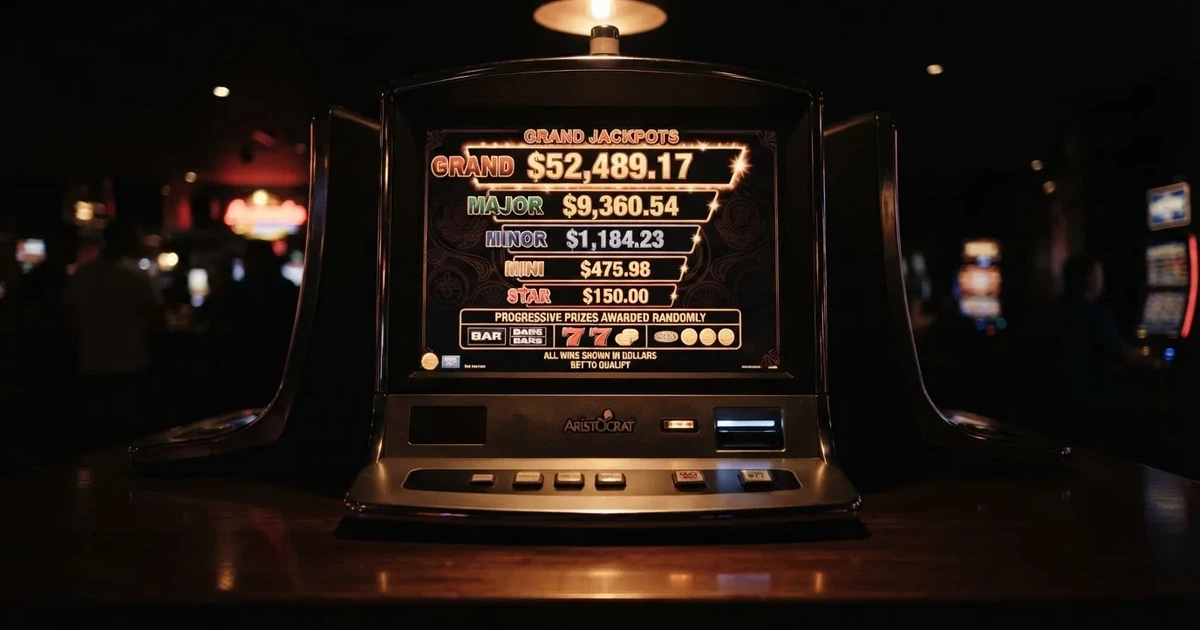
A progressive jackpot slot is not a different machine from a fixed-jackpot slot. It is a fixed-jackpot slot with a second, separately-funded prize attached. That prize grows with each wager that does not win it, then resets to a preset minimum once it pays out, and starts climbing again. The mechanism is older than most readers expect: progressive jackpots were first introduced in large casinos in 1986, and the inaugural Megabucks payout, on International Game Technology’s machine, was US$4,988,842.17 on 1 February 1987.

Three shapes of progressive matter, and they pay differently.
A standalone progressive lives on one machine, in one venue or one site. The pool rises and falls on its own. A network, or wide-area, progressive links many machines in many venues, sometimes across borders — the Mega Moolah network being the textbook example, distributed today by Games Global (the business formerly known as Microgaming). The wider the network, the faster the pool climbs, because more losing wagers are feeding it. A “must-hit-by” progressive is a mystery variant where a random number generator picks the exact payout figure at the moment the previous jackpot is won, within a preset band — winning it does not require a specific symbol combination, only a trigger the machine’s own RNG decides on.
The record online slot payout sits at €19,430,723.60, won on 27 April 2021 by a Belgian player at Napoleon Sports & Casino on Mega Moolah’s “Absolootly Mad: Mega Moolah”. Games Global has since reported further wins on the same network at £11.5 million and £13.5 million. That record is verified through the operator and through the game’s distributor rather than through a third-party audit of every spin — and the verification chain matters, because the headline number is the only figure a player ever remembers.
The paytable, where the casino’s own terms meet the player, has a few lines that repay a careful read. Most progressive slots carry a lower base return-to-player than their fixed-jackpot cousins, because a slice of every wager is diverted into the growing pool rather than into the ordinary line wins. In a few video poker and Caribbean Stud variants the pool has grown large enough that the game’s theoretical return crosses 100%, turning the bet into a positive-expectation proposition; that break-even point is straightforward to compute for a video poker paytable, much harder for a slot because the reel layouts are not published. The trade-off is the same in either case: lower returns in the ordinary course of play, in exchange for a long-tail shot at a prize large enough to flip the math.
How this shortlist is put together
A ranking of progressive jackpot slots is unusual in one respect: there is no Australian-licensed product to rank, because online casino games and online pokies cannot be licensed anywhere in Australia. The set this page works with is the brands the ACMA itself has acted against, and the criteria are the regulator’s criteria, not a comparison of payouts or game libraries.
The full set, in the ACMA’s published order, runs to eleven brands: RocketPlay, Level Up Casino, Woo Casino, Spirit Casino, National Casino, Bizzo Casino, Ignition Casino, Instant Casino, Jackbit, Casino Intense and Sky Crown. Each appears here because the ACMA issued a formal warning under the Interactive Gambling Act 2001 over that brand for offering prohibited services to people in Australia. The dates and the operators the regulator named are listed in the comparison below.
What the comparison cannot do, because the inputs do not back it: rank these brands against each other on game count, payout speed, or bonus terms. Affiliate marketing pages carry those figures, and an affiliate page is not an independent source. The page carries the ACMA’s own record and stops there.
Overview: what is licensed, and what is not
Australia splits the gambling market cleanly. Licensed onshore are wagering on races and sport placed before the event, lotteries and keno. Wagering is regulated mostly through the Northern Territory, where the Racing and Wagering Commission oversees 52 of Australia’s online bookmakers — Sportsbet, Bet365 and Ladbrokes among them — licensed in the Territory for tax reasons. The commission runs without full-time staff and meets once a month in Darwin. That is the licensed layer.
Not licensed, anywhere in Australia, are online casino games and online pokies. The Interactive Gambling Act 2001, tightened by the Interactive Gambling Amendment Act 2017, makes it an offence to provide those products to a person physically in Australia. The IGA targets the provider, not the player. The player does not face prosecution for opening an offshore site, but the offshore site gives no Australian consumer protection, no local complaints body, and no recourse if a withdrawal is refused. A balance sitting on a blocked site is a balance with no path back.
What the ACMA has done, in cumulative terms: by June 2026 the authority had directed Australian internet service providers to block 1,751 illegal gambling and affiliate marketing websites since the first blocking request in November 2019, and more than 230 unlicensed gambling services had left the Australian market since enforcement was strengthened in 2017. A blocking round reported on 26 June 2026 added twelve more: 7Signs, ChromaBet, Donbet, Duospin, Freshbet, Slots Gem, Jacks Club, Lucky Start, Pointsbetz.com, Spinrise, Vinyl Casino and Wildsino.
The loss picture is the scale of the gap. H2 Gambling Capital’s 2025 estimate puts Australian losses to illegal gambling sites at roughly A$3.9 billion a year, and the share of gambling flowing through legal channels has fallen from 74% in 2021 to 64%. The two figures sit beside each other because they describe the same drift: the licensed layer is losing ground to the offshore layer, and the offshore layer is the one the regulator is acting against.
The legal frame: the IGA, payments, and what is in force in 2026
The IGA’s product ban covers online casino games, online pokies, and in-play betting — wagering placed after an event has started. What is licensable is wagering on races and sport placed before the event, lotteries and keno. State and territory regimes add detail — Crown Melbourne, for instance, operates baccarat, blackjack and pokies under approvals from the Victorian Gambling and Casino Control Commission, which took over from the VCGLR on 1 July 2022 — but the IGA’s online casino prohibition sits above the state layer, and no state licence opens that door.
Minimum age for any licensed product is 18. A person under 18 is on the wrong side of every line on this page, and an offshore site will not enforce that line.
On payments: credit cards, credit-related products, and digital currency have been banned as payment for licensed online wagering since 11 June 2024. Penalties for operators run up to A$247,500. The legal deposit routes for licensed wagering are debit card, bank transfer, PayID/Osko, and BPAY. A site asking an Australian player for a credit card or a crypto deposit is operating outside the Australian payment rules, on top of being outside the Australian product rules. A bank can decline those transactions; many do.
A 2026 reform sits in the frame. The Interactive Gambling Amendment (Gambling Reform) Bill 2026 passed Parliament on 19 August 2026; its advertising and inducement measures commence 1 January 2027 — law passed and signed, but not yet in force on this page. The boundary in 2026 is the one the 2017 amendment drew, with payments tightened in 2024 and enforcement running against the offshore side throughout.
Tax: gambling winnings for a recreational player are not assessable income and losses are not deductible, unless the person carries on a business of gambling. A casual punter is on the simpler side of that line; a professional one is on the ATO’s side.
The ACMA’s published list of formal warnings
The comparison below carries what the ACMA itself has published about each brand in the set, and nothing the brand’s own marketing claims. Each row’s “ACMA action” column names the warning, its date as published, and the operator the regulator addressed. The “subject support” column reflects what independent listings say about the brand’s progressive jackpot catalogue; where no listing covers it, the cell stays empty rather than carrying a guess.
| Brand | ACMA action and date | Operator named by the ACMA | Subject support |
|---|---|---|---|
| RocketPlay | Formal warning, March 2026 (earlier May 2022) | Pulsup Ltd (Rocketplay.com.au); Dama N.V. | — |
| Level Up Casino | Formal warning, May 2022 | Dama N.V. | Listed in BGaming’s catalogue |
| Woo Casino | Formal warning, March 2025 | Dama N.V. | — |
| Spirit Casino | Formal warning, May 2025 | Dama N.V. | — |
| National Casino | Formal warning, July 2025 | Consolutetish S.R.L. | Listed in Wikipedia’s coverage of online casino brands |
| Bizzo Casino | Formal warning, July 2025 (earlier 2022) | Consolutetish S.R.L.; TechSolutions | — |
| Ignition Casino | Formal warning, July 2025 | Bamboo Media | — |
| Instant Casino | Formal warning, February 2025 | EOD Code SRL | — |
| Jackbit | Formal warning, April 2026 | Ryker B.V. | — |
| Casino Intense | Formal warning, April 2025 | Sterplay Holding Ltd | Listed in ABC News and the ACMA’s published notices |
| Sky Crown | Formal warning, September 2022 | Hollycorn N.V. | — |
Two things the table is not. It is not a ranking — none of the warnings supersedes another in severity, and the ACMA publishes them as a record of action rather than a leaderboard. It is also not a verdict on whether any one brand is worse to play than another; the regulator’s standard for issuing a warning is that the operator offered a prohibited service to Australians, and that standard has been met by all eleven.
RocketPlay
Two warnings sit on the one brand, separated by four years. The earlier was addressed to Dama N.V. in May 2022, alongside five other Dama brands; the most recent, in March 2026, is addressed to Pulsup Ltd over Rocketplay.com.au. A re-warning under the IGA, after an earlier formal warning, is the regulator telling the public that the conduct has not stopped. Online casino games cannot be licensed anywhere in Australia, whatever licence the site displays — Curaçao, Anjouan, or otherwise — and the brand’s subject support for progressive jackpots is not independently listed.
Level Up Casino
One of the six Dama N.V. brands warned in May 2022. The brand is listed in BGaming’s catalogue of distributor partners, which is an affiliate-side listing rather than an independent audit, and that is the extent of what independent sources carry about its progressive jackpot content. The ACMA’s record is the part that matters here, and that record is unchanged.
Woo Casino
Warned under Dama N.V. in March 2025, alongside other Dama brands addressed that month and the following. The brand’s progressive jackpot catalogue is not covered in independent listings, so there is no source on which to base a comment about what its lobby actually carries. The warning stands on its own.
Spirit Casino
Also warned under Dama N.V. in May 2025 — the second of the Dama warnings that month and the second pair of warnings against the same operator in 2025, the first having covered Woo Casino in March. The pattern is the regulator acting against a single operator for a portfolio of brands rather than against one brand at a time.
National Casino
Addressed to Consolutetish S.R.L. in July 2025, alongside Bizzo Casino, which the regulator had warned separately in 2022. National Casino is listed in Wikipedia’s coverage of online casino brands — a directory entry rather than a review, and not a comment on the operator’s practices. The ACMA’s record on the brand is the part that is independently sourced.
Bizzo Casino
The two-warning history matters here: the 2022 warning was addressed to TechSolutions (CY) Group Limited and TechSolutions Group N.V., and the July 2025 warning to Consolutetish S.R.L. The operator behind the brand has changed on paper at least once, and the regulator has tracked it across both. The brand’s progressive catalogue is not listed independently.
Ignition Casino
Warned in July 2025 with the operator named as Bamboo Media. Ignition is one of the longer-running brands in the offshore space; the ACMA’s notice is recent, and that is the relevant recent fact for an Australian reader.
Instant Casino
Addressed to EOD Code SRL in February 2025. The brand’s progressive jackpot offerings are not covered in independent listings — what an Australian player would find on the site is not something this page can characterise on independently sourced material.
Jackbit
The freshest warning in the set: April 2026, addressed to Ryker B.V., and covering both Jackbit and CasinOK in the same notice. A pair-of-brands warning of that shape tells the reader the regulator has identified a corporate grouping and acted against it in one motion.
Casino Intense
Warned in April 2025, addressed to Sterplay Holding Ltd. Listed in ABC News coverage and in the ACMA’s own published notices — the only brand in the set for which the “subject support” column carries an Australian-press reference rather than an international catalogue reference.
Sky Crown
The earliest warning in the set, addressed to Hollycorn N.V. and covering both Sky Crown and Blue Leo in the one notice — a paired-brands warning of the same shape as the Ryker B.V. action in 2026. The brand’s progressive catalogue is not independently listed.
How to read the blocking rate
The arithmetic this page carries is the rate at which the ACMA’s blocking action has run since the first blocking request in November 2019. That gives the reader a single number for how often the regulator has had to add to the list, rather than a cumulative total to take on faith.
The inputs are the published figures. By June 2026, the ACMA had directed Australian ISPs to block 1,751 illegal gambling and affiliate marketing websites since November 2019, and the June 2026 round added twelve more on its own. Working from those: 1,751 blocks over the roughly 79 months between November 2019 and June 2026 comes out to an average of around 22 sites blocked per month, with a June 2026 round of twelve in one motion. The point of running the arithmetic is not the round figure — it is that single rounds carry a meaningful share of the total, which tells the reader the enforcement cadence is spiky rather than steady.
Conclusion
The blocking rate works out to roughly 22 sites per month across the period from November 2019 to June 2026, with single reporting rounds sometimes adding a dozen names at a time. The cadence is best read as bursty: quiet stretches, then a round of ten or fifteen new entries in one notice.
Frequently asked questions
How does a progressive jackpot slot’s prize pool actually grow between wins?
A slice of every wager that does not win the jackpot goes into the pool rather than into the casino’s ordinary take, and the pool climbs until a player wins it. Once paid, it resets to a preset minimum and starts accumulating again. The casino funds the growth from its own margin; the player funds it through the ordinary course of losing spins.
What is the difference between a standalone jackpot and a network-wide progressive jackpot?
A standalone progressive sits on one machine in one venue or one site, and rises and falls on its own. A network or wide-area progressive links many machines across many venues, and the wider the network the faster the pool grows, because more losing wagers are feeding it. The Mega Moolah network is the textbook wide-area example, distributed today by Games Global.
Do licensed Australian pokies venues offer progressive jackpot machines?
Yes — licensed Australian venues, including the major casino floors in Melbourne and elsewhere, have offered progressive jackpot pokies on-site for years, and Megabucks-style wide-area progressives have existed in large casinos since 1986. What Australian venues cannot offer, under the IGA, is an online progressive jackpot slot product to a person in Australia. The machine on the floor is licensed; the same product online is not.
Why do progressive jackpot slots typically have a lower base return-to-player than fixed-jackpot games?
Because a slice of every wager is diverted into the growing pool, rather than into the line wins the player sees on the paytable. A fixed-jackpot slot returns its full theoretical percentage through ordinary symbol combinations; a progressive returns a smaller percentage through those combinations, and the rest sits in the pool waiting for the next big win.
How is a record progressive jackpot payout verified?
Through the operator and the game’s distributor, both of whom publish the win with the player’s consent or with enough identifying detail for the claim to be checkable. Independent audit of every spin is not how a record payout is established — the chain is operator-and-distributor-published, which is why the headline figure matters but the verification chain behind it matters too.
What triggers the jackpot round on a typical progressive jackpot slot?
A random number generator inside the machine. On a symbol-driven progressive the trigger is a specific combination landing on the reels; on a “must-hit-by” progressive the trigger is the RNG deciding the time, and the payout figure is set at the same moment the previous jackpot is won, within a preset band. In neither case is the trigger something the player controls.