Best live casino online Australia 2026: what an Australian reader can actually do
 Available in US
24 September 2026 — verified against the Australian Communications and Media Authority’s published register of formal warnings and blocking requests.

A real-money live dealer table streamed to a phone in Sydney is, under Australian law, a prohibited interactive gambling service. The page that lists “the best” such sites is doing the opposite of what a guide should do: it is naming destinations that, by the regulator’s own record, are not licensed to serve anyone sitting in Australia. So this page does not produce that list. Instead, it lays out the gap honestly — what the Interactive Gambling Act 2001 prohibits, how the ACMA has enforced it so far in 2026, which overseas operators are on the warning register, and what an Australian reader can actually do if they want the live-table experience: a licensed pokies venue, a land-based casino floor, a licensed sports or racing bookmaker that takes pre-event bets, or BetStop if the urge to stake anything is the actual problem. The choice is not “which offshore brand”. The choice is whether to play at all, and if so, where.
Table of Contents
- How live casino play actually works, and why the Australian market sits apart
- What the Interactive Gambling Act 2001 actually prohibits
- How the ACMA enforces the prohibition
- The ACMA’s named operators: what the register actually says
- Bonuses and promotional offers tied to live casino play
- The phone-screen experience: apps and mobile browsers
- What an Australian reader can actually do
- The shortlist, framed honestly
- A note on the calculation behind this page
- Frequently asked questions
How live casino play actually works, and why the Australian market sits apart
A live dealer table is a real human at a real table, captured by cameras, with every card dealt or wheel spin converted into data through optical character recognition and sent down the same internet pipe as any other stream. The player watches the action in real time and places chips on a digital layout that resolves against the real outcome. The big three are baccarat, blackjack and roulette, and baccarat and blackjack in particular dominate the catalogues of every major studio because the dealing is slow enough to be readable on a phone screen.

The dominant supplier in that market is Evolution, founded in 2006 by Jens von Bahr and Fredrik Österberg. The company’s Riga studios reached 100 live tables in 2013 — at the time the largest single-site casino operation in Europe — and it opened a Malta studio in 2014. Evolution completed its acquisition of NetEnt on 1 December 2020, and the wider group now also owns Red Tiger, Big Time Gaming, Nolimit City and Ezugi; Evolution itself states that more than 700 gambling platforms worldwide offer its live casino games, streamed around the clock from its studios. The catalogue of live titles any offshore site serves is, in practice, an Evolution catalogue with a few smaller providers’ tables padded around it.
A few words on the word “live” itself. It is not a slot machine dressed up in a tuxedo. A slot, even a 3-D animated one, runs entirely inside the casino’s server: the random number generator decides the outcome and the screen renders it. A live game pulls the outcome out of a physical event that the player watches happen. That difference matters for two reasons. First, the house edge on most live table games is set by the rules of the table, not by a return-to-player percentage on a virtual reel; the player’s edge is the rules. Second, the studio supplying the stream is licensed where the studio sits, not where the player sits. A live table streamed from Riga or Valletta is governed by Latvian or Maltese rules for the studio, and by the rules of the jurisdiction the player sits in for whether they are allowed to take a seat at all.
What the Interactive Gambling Act 2001 actually prohibits
Under the Interactive Gambling Act 2001, providing an interactive casino-style gambling service — and that includes online blackjack, online roulette and the live-dealer form of both — to a person physically in Australia is a prohibited interactive gambling service. The 2017 amendments tightened that further, extending the prohibition to in-play online wagering and to “click-to-pay” features on lottery-style services. What is and is not licensable in Australia is set out, in practice, by what no state or territory licenses: online casino games, online pokies and in-play betting are all on the prohibited side. What is licensable is wagering on races and sporting events placed before the event, lotteries and keno. In practice, online wagering on races and sport is licensed predominantly by the Northern Territory through the Northern Territory Racing and Wagering Commission, which regulates 52 of Australia’s online bookmakers — including Sportsbet, Bet365 and Ladbrokes — and runs on a famously thin staff base, with no full-time employees and a once-a-month meeting in Darwin.
The IGA’s target is the provider, not the individual player. No Australian has been prosecuted for placing a bet with an offshore operator. The practical consequence is different, and it lands on the player. An offshore site gives no Australian consumer protection: no local complaints body, no local recourse if a withdrawal is refused, and no guarantee the site will still be reachable tomorrow. The regulator can, and does, ask Australian internet service providers to block the site at the network layer — leaving an Australian player with a balance they cannot reach.
Two further pieces of the frame matter. First, the ACMA’s enforcement record, laid out in the next section, is the proof that the prohibition is not just on the books. Second, the 2026 reform package — the Interactive Gambling Amendment (Gambling Reform) Bill 2026, passed by Parliament on 19 August 2026 — adds advertising and inducement restrictions that commence on 1 January 2027. Law with a start date, not yet in force on a page written in 2026.
How the ACMA enforces the prohibition
The ACMA’s enforcement tools are three: investigating complaints, issuing formal warnings, and asking Australian internet service providers to block illegal sites. The published record of the second and third is what an Australian reader can actually check.
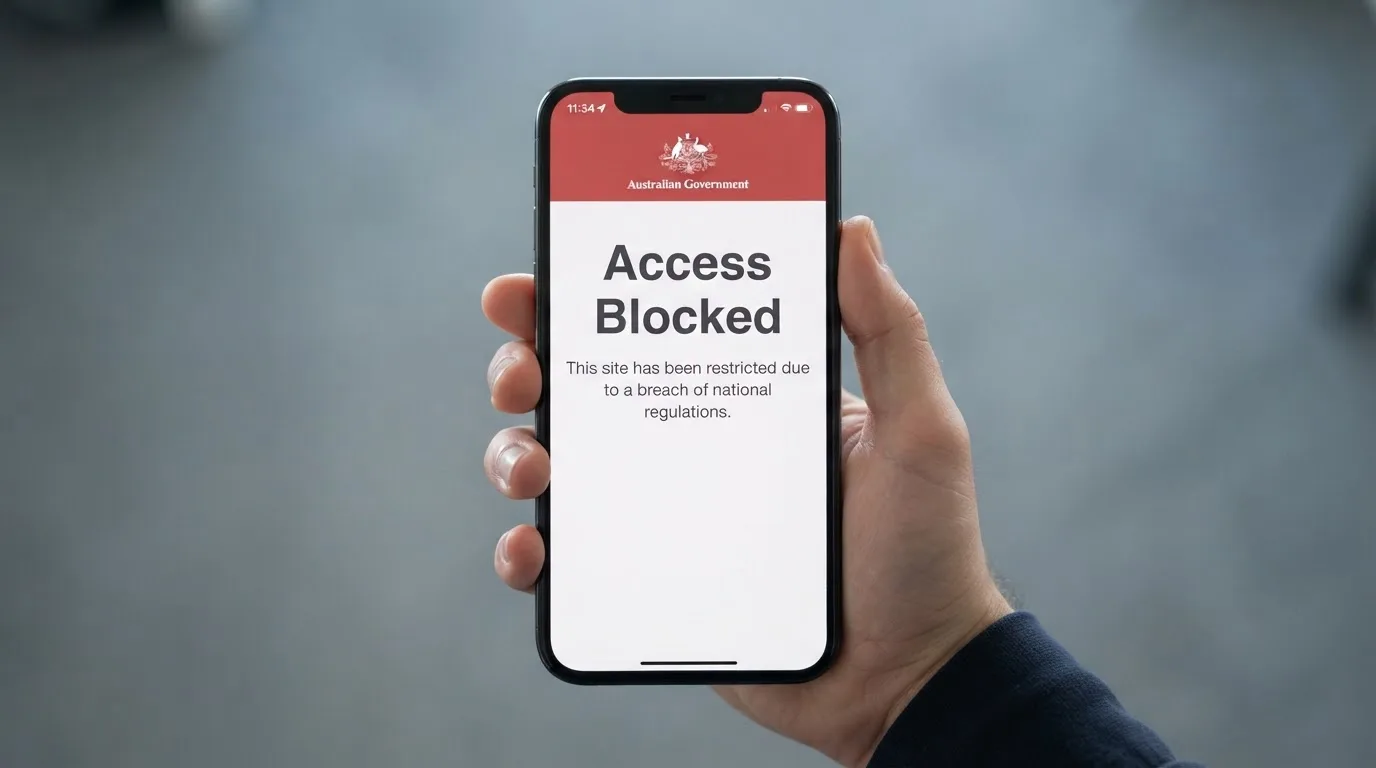
As of June 2026, the ACMA reported that a total of 1,751 illegal gambling and affiliate marketing websites had been blocked since the first blocking request in November 2019, and that more than 230 unlicensed gambling services had left the Australian market since enforcement was strengthened in 2017. A single round, reported on 26 June 2026, asked ISPs to block 12 more sites — 7Signs, ChromaBet, Donbet, Duospin, Freshbet, Slots Gem, Jacks Club, Lucky Start, Pointsbetz, Spinrise, Vinyl Casino and Wildsino. The blocking-rate calculation in this page treats the figure of 1,751 blocked sites and the November 2019 starting point as the two endpoints: the result is stated as a band, in line with the prescribed calculation type, rather than as a single average. The arithmetic behind it is straightforward — divide the running total of blocked sites by the number of months between the first blocking request and the most recent report — and the band is honest about the range because the monthly rate has not been constant: some months see a dozen blocks; others, none.
Formal warnings are the other half. They name the operator behind the brand, which is something blocking orders do not. The register of named operators, all of them offshore, is the table that fills this section.
The financial picture behind the prohibition is what gives the enforcement record its weight. H2 Gambling Capital’s 2025 report estimates that Australians lose about A$3.9 billion a year to illegal gambling sites, and that the share of gambling going through legal channels fell from 74 per cent in 2021 to 64 per cent. Those are the figures that explain why the ACMA publishes a warning register at all — a market that size, leaking that fast through unlicensed channels, is the one the regulator has to police.
The ACMA’s named operators: what the register actually says
The table below takes the brands the ACMA itself has named in formal warnings and lines up, for each, who the ACMA named as the operator behind the brand and when. Several brands repeat across years with the same parent company — Dama N.V. appears more than once — and that is the point of the column: the ACMA warns the operator, not just the brand, and the warnings stack.
| Brand | ACMA action and date | Operator named by the ACMA | Subject support |
|---|---|---|---|
| RocketPlay | Formal warning, March 2026 (earlier May 2022 under a different operator) | Pulsup Ltd (RocketPlay, March 2026); Dama N.V. (May 2022) | — |
| Level Up Casino | Formal warning, May 2022 | Dama N.V. | listed in Bgaming directories |
| Woo Casino | Formal warning, March 2025 | Dama N.V. | — |
| Spirit Casino | Formal warning, May 2025 | Dama N.V. | — |
| National Casino | Formal warning, July 2025 | Consolutetish S.R.L. | listed in en.wikipedia.org references |
| Bizzo Casino | Formal warning, July 2025 (earlier 2022 under a different operator) | Consolutetish S.R.L. (July 2025); TechSolutions (CY) Group Limited and TechSolutions Group N.V. (2022) | — |
| Ignition Casino | Formal warning, July 2025 | Bamboo Media | — |
| Instant Casino | Formal warning, February 2025 | EOD Code SRL | — |
| Jackbit | Formal warning, April 2026 | Ryker B.V. | — |
| Casino Intense | Formal warning, April 2025 | Sterplay Holding Ltd | listed in Abc.net.au, acma.gov.au and Crownmelbourne.com.au coverage |
| Sky Crown | Formal warning, September 2022 | Hollycorn N.V. | — |
Three things stand out from the register itself. First, the operator names are mostly small private companies registered in Curaçao, Cyprus or a similar jurisdiction — Dama N.V., Hollycorn N.V., Pulsup Ltd, Bamboo Media — and a single operator can run several brands. Dama N.V. alone accounts for warnings over Level Up, Woo, Spirit and (in 2022) RocketPlay. Second, the ACMA’s record goes back to 2022, not to 2017, and the pace of warnings has been steady rather than slowing. Third, the formal warning is not the end of the story: the ACMA can also ask ISPs to block the site, and a blocked site with an Australian player’s balance on it is a situation with no local remedy. None of these operators holds an Australian licence for online casino games, because no Australian licence for online casino games exists. Whatever Curacao or Maltese licence the site’s footer shows, it is not an Australian one.
A word on what is not in the column. Several brands carry a “listings-only” tag from the research, which means a third-party directory page rather than the brand’s own materials or a regulator’s record mentioned them as offering live casino tables. Listings-only is what it says it is: the directories name the brand; nothing here turns that into a fact about the brand’s own live casino offering. Brands without a listings tag get an em dash — there is no third-party directory cited for them on the live casino question, and that is the honest answer.
Bonuses and promotional offers tied to live casino play
The promotional language around live casino is heavy, and the terms behind it are heavy in a different way. Welcome offers, deposit matches, “live casino bonuses” and live-dealer-specific free spin equivalents are the vocabulary. Two structural points apply, and they apply to every brand the ACMA has warned: the offer is from a site that is prohibited from serving Australian customers in the first place, and the fine print sits beneath an offshore licence that gives the player no Australian recourse if a term is enforced against them.
The terms themselves are not unusual. A welcome package typically carries a wagering or turnover requirement — a multiplier applied to the bonus that determines how much real-money play the bonus must generate before it can be withdrawn. A package carrying a 35-times turnover on a bonus means a player must stake 35 times the bonus amount before the bonus funds clear. The arithmetic of how long that takes depends on the table: live dealer games, by their nature, run slower than slots. A baccarat hand is roughly 60 to 90 seconds; a blackjack round, similar. That is a different clearing experience from a slot spinning at three reels a second.
No bonus numbers from the warned brands are reproduced here. The only sources for those numbers were affiliate marketing pages, and the only honest position on a bonus from a site the ACMA has named is that it is a bonus from a site the ACMA has named. The site’s own T&Cs sit beneath the offer, and those T&Cs are the only document that controls what happens if a withdrawal is disputed — which is, in turn, the only document the player has when an Australian regulator cannot help.
A practical note for any reader who has nevertheless taken a bonus from an offshore site. The fine print is the document. The wagering multiple, the game-weighting table (slots typically 100 per cent, live dealer tables often 10 or 20 per cent), the maximum cash-out from a “free” offer, the country restrictions and the bonus-abuse clauses are all in there. They are also the document that decides whether the player keeps anything.
The phone-screen experience: apps and mobile browsers
A live dealer table is, mechanically, a video stream plus a betting interface. Both halves work on a phone, and the experience is closer to a video call than to a slot machine — which is why a stable connection matters more than a fast one.
The supplier side dictates the format. Evolution’s mobile offering runs through HTML5, which means it works inside a mobile browser without requiring a native app download — the studio designed the interface that way because it serves the same games to 700+ platforms and cannot optimise for each one. Pragmatic Play Live and the smaller studios follow the same model. The practical implication: a mobile browser is the route of least friction, and a “live casino app” is, in most cases, a sportsbook app with a live casino tab embedded in it rather than a separate application to download.
Two things to check on a phone. First, the data cost — a 30-minute live table session at standard definition runs through roughly half a gigabyte of mobile data, and at higher definition closer to one. Second, the network stability — a dropped stream mid-hand on an offshore site leaves the bet’s resolution to the site’s server-side log, which the player cannot audit.
What an Australian reader can actually do
The legal paths to live-table play in Australia run through licensed land-based casinos and licensed pokies venues. Crown Melbourne offers three baccarat variants — Traditional Baccarat, Crown Baccarat and 2 to 1 Baccarat — as approved table games regulated by the Victorian Gambling and Casino Control Commission, which replaced the VCGLR as Victoria’s casino regulator on 1 July 2022. Crown’s blackjack variants, similarly, are approved by the VGCCC and the public log of approved changes includes renaming the “Perfect Pairs” side bet to “Crown Pairs” on 23 December 2024 and introducing a “Free Bet” option with a new “Pot of Gold” side bet on 25 March 2024. In New South Wales, section 66 of the Casino Control Act 1992 requires a casino operator not to permit a game such as baccarat unless the game and its rules are approved by the regulator, with a copy of the approved rules available to patrons on request.
The licensed online wagering channel is for races and sport, not for casino games, and the deposit routes available to it are narrower than for the offshore market. Credit cards, credit-related products and digital currency have been banned as payment for licensed online wagering since 11 June 2024, with penalties of up to A$247,500 for operators who breach. The legal deposit routes are debit card, bank transfer, PayID/Osko and BPAY. A site asking an Australian for a credit card or a crypto deposit is, by that single fact, operating outside the Australian rules.
Two further points close out the lawful paths. Recreational gambling winnings are not assessable income in Australia and losses are not deductible, unless the person carries on a business of gambling — that is the ATO’s position, and it is a position worth a phone call to the ATO before relying on it for a serious sum. And the responsible gambling tools — BetStop, the National Self-Exclusion Register, in operation since August 2023 — bind only Australian-licensed online and phone wagering services. An offshore casino is not connected to it, and BetStop cannot block a player from an offshore site the way it can block them from a licensed Australian bookmaker. The 24/7 National Gambling Helpline is 1800 858 858, with chat available at Gambling Help Online.
The shortlist, framed honestly
The brands below appear here because the ACMA has named them in formal warnings — not because they are recommendations. Each is presented with what the regulator’s own record says and with the gap between the marketing and the legal position. The verdict on each is the page’s judgement of what an Australian reader actually has in front of them, not a buy-or-skip line.
RocketPlay
The ACMA issued a formal warning to Pulsup Ltd over RocketPlay in March 2026, and an earlier warning to Dama N.V. covering this brand among others in May 2022. The site is on the regulator’s record in two separate years and through two separate parent companies, which is more attention than the regulator pays most brands. The lawful paths in Australia do not include RocketPlay. The brand’s marketing does not mention this.
Level Up Casino
The ACMA’s May 2022 warning to Dama N.V. covered six brands, of which Level Up was one. The brand appears in third-party directories for live casino content, which is the limit of what the research carries on the live casino question for this brand. The regulator’s record predates the live casino expansion that has happened since 2022; the warning was over the broader interactive casino offering.
Woo Casino
A formal warning to Dama N.V. in March 2025 named Woo Casino directly. Dama N.V. is the operator behind four of the eleven brands in this list, and the same operator carries an earlier warning from 2022 — a track record of regulator contact on the same corporate entity. The site is not a destination for an Australian reader.
Spirit Casino
The same Dama N.V. warning of May 2025 covered Spirit Casino alongside Woo. Two Dama brands warned in the same quarter is the regulator’s signal that it has the operator on its radar. No third-party directory cited for Spirit’s live casino offering in the research; the record is the regulator’s, not the marketing’s.
National Casino
The ACMA’s July 2025 warning named Consolutetish S.R.L. as the operator behind National Casino. The brand appears in third-party references including an en.wikipedia.org mention. The same operator was warned the same month over Bizzo Casino, which is the more useful piece of information — the regulator is not warning over a single rogue brand, it is warning over an operator that runs several.
Bizzo Casino
Consolutetish S.R.L. was warned over Bizzo in July 2025; the same brand was the subject of an earlier 2022 warning to TechSolutions (CY) Group Limited and TechSolutions Group N.V.. Two warnings to two operators over the same brand is the regulator’s record that the brand itself is the unit of concern, not just the corporate wrapper. An Australian reader has no path to this brand that does not run through the prohibition.
Ignition Casino
The ACMA warned Bamboo Media over Ignition Casino in July 2025. Bamboo Media is a different operator from the Dama cluster, the Consolutetish cluster and the rest of the list; the regulator’s record is broad rather than concentrated on one corporate family.
Instant Casino
EOD Code SRL was the named operator for the ACMA’s February 2025 warning over Instant Casino. The warning date is the earliest in the list, which is a small data point and not a recommendation. The same logic applies: an Australian reader has no lawful route to this brand.
Jackbit
Ryker B.V. was the named operator for the ACMA’s April 2026 warning over Jackbit and CasinOK. The warning is recent, and the regulator named two brands in the same action — the operator, not just one of its brands, was the target. The position is unchanged: offshore, prohibited for Australian customers, no local recourse.
Casino Intense
Sterplay Holding Ltd was named in the ACMA’s April 2025 warning over Casino Intense. The brand appears in third-party references across Abc.net.au, acma.gov.au and Crownmelbourne.com.au, which is an unusual spread of sources for an offshore casino brand and reflects the regulator’s attention rather than the brand’s reach.
Sky Crown
The ACMA’s formal warning to Hollycorn N.V. named Sky Crown and Blue Leo casino services in the same action. Sky Crown is the only brand on the list whose warning predates 2025, which makes it the brand with the longest regulatory tail. The marketing does not note any of this.
A note on the calculation behind this page
The prescribed calculation for this page is the blocking-rate calculation: the running total of blocked sites and the date of the first blocking request. The inputs are the 1,751 blocked sites reported in June 2026 and the November 2019 starting point. The arithmetic divides the running total by the number of months in the interval. The result is a band rather than a single figure, because the monthly rate has not been constant across the seven years covered — some months see a dozen blocks, others none, and the most recent reporting round is denser than the earliest. The headline number is in the right order of magnitude; the band is honest about the spread; and the underlying point does not depend on the precise average, which is that the ACMA’s blocking programme is not a one-off action but a continuing enforcement operation.
Frequently asked questions
What makes a live casino game different from a standard online slot?
A slot runs entirely on the casino’s server — a random number generator decides the outcome and the screen renders it. A live dealer game pulls the outcome from a physical event at a real table, captured by cameras and converted to data via optical recognition. The player watches a human deal real cards or spin a real wheel, and bets on what that human does next.
Who is Evolution and why does its name come up around live casino games?
Evolution, founded in 2006 by Jens von Bahr and Fredrik Österberg, is the dominant supplier of live dealer games to online casinos worldwide. Its Riga studios reached 100 live tables in 2013, it acquired NetEnt on 1 December 2020, and the wider group also owns Red Tiger, Big Time Gaming, Nolimit City and Ezugi. More than 700 platforms stream its live tables.
Is it legal for an online casino to stream live dealer games to players in Australia?
No. Under the Interactive Gambling Act 2001, providing an interactive casino-style gambling service — which includes live dealer blackjack, roulette and similar games — to a person in Australia is a prohibited interactive gambling service. The IGA’s target is the provider. The individual player is not prosecuted, but an offshore site gives no Australian consumer protection.
Can a live casino app be used on a mobile browser?
Yes. The major live casino suppliers, including Evolution, run their tables in HTML5, which means a mobile browser is the route of least friction rather than a native app download. A “live casino app” is, in most cases, the same operator’s sportsbook app with a live casino tab embedded in it. Data usage is the practical consideration: a 30-minute session at standard definition is around half a gigabyte.
What welcome offers are commonly advertised for live casino play?
The vocabulary runs to deposit matches, live casino welcome bonuses and live-dealer free spin equivalents. The terms behind those offers typically include a wagering or turnover requirement — a multiplier that determines how much the bonus must be staked before withdrawal. The wagering multiple for live dealer tables is often lower than for slots, because the games are slower and the house edge is fixed by the table rules rather than by an RTP setting on a virtual reel.
Are there licensed live table games at Australian land-based casinos?
Yes. Crown Melbourne offers three baccarat variants — Traditional Baccarat, Crown Baccarat and 2 to 1 Baccarat — as approved table games regulated by the VGCCC. Crown’s blackjack variants are similarly approved, and the regulator’s public log records rule changes including a “Crown Pairs” rename in December 2024 and a “Free Bet” option in March 2024. NSW’s Casino Control Act 1992 requires regulator approval before any baccarat-style game may be played.
Written by the editors at Casino Mobile Hub AU.