
Instant payout online casinos in Australia: the legal picture, the payment rails, and the gap between them
Currency and licence data current as of 6 November 2026 and verified against the Australian Communications and Media Authority’s published register of formal warnings and blocking requests.

The phrase “instant payout casino” promises something the Australian market does not, and has not since 2001, actually contain. The Interactive Gambling Act makes it an offence to provide online casino games, online pokies and in-play betting to anyone in Australia; no state or territory issues a licence for any of it. Every “instant payout online casino Australia” page that hands over a deposit link is offering a service the provider can be warned about, blocked and fined for, and an Australian player can have funds trapped in. This page is built around that gap rather than around it.
What follows covers what an Australian reader actually has. The licensed wagering operators that sit on the legal side of the line. The payment rails — PayID, Osko, BPAY, the Apple Pay and Google Pay wallet layer — that do clear in seconds and that an offshore site can claim to use without any of the consumer protections that surround them on this side. The thirteen operators the ACMA has formally warned in the last four years alone, named with the date and the operator behind them. And the figures behind the trade: roughly A$3.9 billion a year flowing to unlicensed offshore sites, and 1,751 blocking requests the ACMA has issued since November 2019. The arithmetic, not the marketing, is where this page lives.
Table of Contents
- What the Interactive Gambling Act 2001 actually says, and what the ACMA does about it
- Responsible play: BetStop, the helpline, and what each of them actually covers
- Crypto and the offshore site: what the payment picture actually looks like
- How “instant” actually settles: the practical mechanics
- The shortlist: thirteen operators the ACMA has formally warned
- Operator write-ups: each brand against the standard the page applies
- Where an Australian reader actually stands
- Frequently asked questions
What the Interactive Gambling Act 2001 actually says, and what the ACMA does about it
The Interactive Gambling Act 2001, tightened by the Interactive Gambling Amendment Act 2017, makes it an offence to provide a “prohibited interactive gambling service” to a person physically in Australia. A prohibited service is any online casino game, any online pokie and in-play betting on a sporting event; wagering on races and sporting events before the event, lotteries and keno all fall outside the prohibition and are licensed in practice by the Northern Territory Racing and Wagering Commission, which regulates 52 of Australia’s online bookmakers including Sportsbet, Bet365 and Ladbrokes, holds no full-time staff and meets monthly in Darwin.

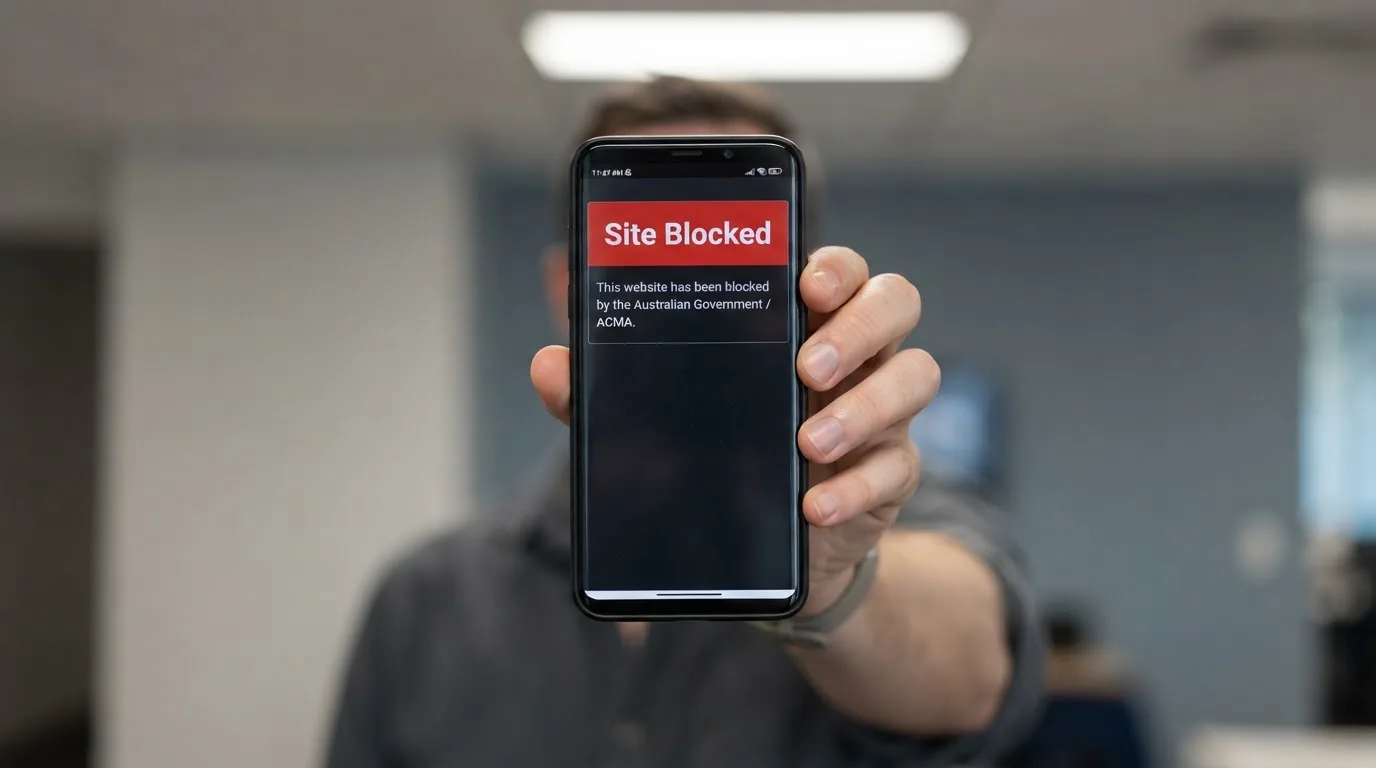
The individual player is not prosecuted. The IGA targets the provider, and the ACMA — the Australian Communications and Media Authority — is the body that investigates. Its three enforcement levers are well-defined: a formal warning naming the operator and the offending service, a written notice to the provider, and a request to Australian internet service providers to block the website at the DNS level. The provider ignores a formal warning and the next step is a blocking request; the site disappears from Australian connections, the balance the player left on it does not.
Between November 2019 and the round reported on 26 June 2026 the ACMA asked ISPs to block 1,751 illegal gambling and affiliate marketing websites and more than 230 unlicensed gambling services left the Australian market entirely since enforcement was strengthened in 2017. The June 2026 round alone added twelve more: 7Signs, ChromaBet, Donbet, Duospin, Freshbet, Slots Gem, Jacks Club, Lucky Start, Pointsbetz.com, Spinrise, Vinyl Casino and Wildsino.
The wider trade figure sits behind that count. H2 Gambling Capital’s 2025 report estimates Australians lose about A$3.9 billion a year to illegal gambling sites, and the share of gambling that goes through legal channels fell from 74% in 2021 to 64%. The licensed wagering market grew; the offshore share grew faster. The legal architecture is in place. The marketing reach of the unlicensed trade is the thing the architecture is racing.
The 2026 reform that sits one step ahead of this page
The Interactive Gambling Amendment (Gambling Reform) Bill 2026 passed Parliament on 19 August 2026. Its advertising and inducement measures commence on 1 January 2027. The law is enacted; the start date has not arrived. On a page published in 2026 the bill is a fact about the next calendar year, not a rule an Australian reader can act on today.
Responsible play: BetStop, the helpline, and what each of them actually covers
The most important distinction on a page about offshore casinos is that almost every player-protection tool an Australian is told to use only works against Australian-licensed operators. Once a balance sits at an offshore site, the protections effectively do not reach it.
BetStop — the National Self-Exclusion Register — has been live since August 2023 and binds every Australian-licensed online and phone wagering service. A registration blocks the punter from opening new accounts and from placing new bets with any operator connected to the register. An offshore casino is not connected to it. Self-excluding through BetStop does not, by itself, stop an offshore site from accepting a deposit from the same person. The register is the legal industry’s answer; it is not the offshore industry’s.
The National Gambling Helpline on 1800 858 858 is free, runs 24/7 and offers online chat through Gambling Help Online. The line and the chat cover gambling as a whole — licensed wagering, the pokies at the local pub, the offshore site that took the deposit anyway. A call costs nothing and is not recorded against the caller.
The bank-side layer sits alongside both. Westpac’s gambling block refuses authorisation of any transaction registered under the merchant category code “Betting/Casino Gambling” on eligible personal credit and debit cards. ANZ’s gambling block, activated inside the ANZ app, also blocks gambling transactions routed through a digital wallet such as Apple Pay on an eligible card, and removal after activation requires a 48-hour waiting period. Commonwealth Bank lets customers apply a gambling lock to eligible cards through the CommBank app, with the same caveat that not every gambling-related purchase is guaranteed to be stopped.
Each of those bank blocks works against the licensed Australian merchant ecosystem, where the MCC code is reliable. Against an offshore site that runs on a different processing stack the picture is less tidy; the block tends to catch the licensed bookmakers first. Worth setting regardless, because the bank-level block is also the most direct way to short-circuit a late-night reload on a licensed sports account.
Crypto and the offshore site: what the payment picture actually looks like
Australian-licensed wagering services have not been able to accept credit cards or credit-related products since the Interactive Gambling Act was amended in 2023; the rule took effect on 11 June 2024 and carries penalties up to A$247,500 for an operator that breaches it. The rule also constrains gambling use of linked digital wallets — Apple Pay tied to a credit card is caught by the same prohibition. Crypto sits at the other end of the spectrum: it is one of the payment types the same amendment closes off for licensed wagering. An Australian-licensed operator will not accept a Bitcoin deposit. An offshore operator frequently will, which is precisely why the marketing for “instant payout crypto casino” tends to point offshore.
The case for crypto as a payout rail rests on a small set of facts that are real. A Bitcoin or Ethereum transfer settles on the chain in minutes, and the cash-out side is the same transfer in reverse. From the player’s perspective the speed is genuine: the casino’s “pending” window plus one on-chain confirmation is faster than a card authorisation window on most bank-to-bank paths.
The case against it sits in the same sentence. The speed is genuine, and the consumer protection is not. There is no Australian complaints body for a dispute with an offshore crypto casino. There is no Australian regulator to escalate to. There is no equivalent of a chargeback because there is no card network sitting over the transfer. The transaction is fast because nothing sits over it. If the operator delays a withdrawal, the only recourse is the chain itself, which is irrevocable by design. Bitcoin casino instant payout is a real thing; Bitcoin casino instant refund of a disputed withdrawal is not.
The PayID picture sits on the other side of the same line, and it is the closer an Australian reader gets to “instant” inside a regulated path. Paying to a PayID shows the account holder’s name before the transfer is sent — Australian Payments Plus warns that being asked to transfer to a PayID by an illegal gambling site almost certainly means a scam site. Osko settles bank-to-bank between participating Australian banks in under a minute, 24/7, whether addressed to a BSB and account number or to a PayID. By April 2025 more than 25 million PayID identifiers had been registered on the New Payments Platform. PayID-based instant transfers are available at over 100 Australian financial institutions. The platform itself became accessible to the public on 13 February 2018 and is owned by New Payments Platform Australia Ltd, a non-profit whose 13 shareholders include the Reserve Bank of Australia and the major banks. Participants are required to keep monthly outages under two minutes. It is the closest the Australian market has to a true instant rail, and it sits inside licensed wagering, not outside it.
BPAY sits beside it. BPAY has operated in Australia since 1997, is available in the online banking of over 140 banks and financial institutions and is offered by over 95,000 businesses; the payer enters the Biller Code and the Customer Reference Number printed on the bill. BPAY is run by Australian Payments Plus, the same operator as PayID and Osko. It is not instant — settlement is the next business day, not under a minute — but it is auditable in a way an offshore wire transfer is not, because every BPAY payment lands on an Australian bank statement with a CRN that ties back to the biller.
The mobile-wallet layer adds another wrinkle. By the end of 2025 Apple Pay, Google Pay and Samsung Pay collectively accounted for around 45% of all card payments in Australia by number. Apple does not charge consumers to use Apple Pay; any surcharge on an Apple Pay transaction is the merchant’s own card-processing fee. Apple states that transaction limits and PIN requirements for Apple Pay purchases are set by the card issuer or merchant, not by Apple itself. None of that changes the gambling prohibition — the merchant category code on the underlying card still decides whether the transaction is declined — but it changes the optics. A punter who sees “Apple Pay accepted” on a checkout page is not seeing a sign that the wallet somehow overrides the underlying rule. The underlying rule is still the underlying rule.
American Express sits on a different footing. Amex was established in 1850 as a freight-forwarding company and became a card issuer with its first charge card on 1 October 1958, and unlike Visa or Mastercard’s four-party network it traditionally issues cards and processes transactions itself as a three-party scheme. The Reserve Bank of Australia’s July 2025 review proposes removing surcharges only on eftpos, Mastercard and Visa transactions, explicitly leaving American Express outside the scope of the proposed surcharge ban. For an Australian punter the practical point is that an Amex surcharge, where it applies, is the merchant’s own margin — and that gambling merchants are a category where surcharging has historically been heaviest.
AUSTRAC’s threshold-transaction-report rule, which requires reporting of transfers of A$10,000 or more, applies only to physical cash. Ordinary electronic bank transfers are not subject to that per-transaction reporting requirement regardless of amount. An A$9,500 PayID transfer to a licensed Australian bookmaker and an A$9,500 PayID transfer to an offshore casino both clear through the banking system without triggering the threshold report. The distinction that matters is not AUSTRAC’s; it is the consumer-protection envelope around the receiving account, which is the licensed wagering envelope for one and nothing for the other.
How “instant” actually settles: the practical mechanics
Three layers separate a marketing claim of “instant payout” from the bank balance it is supposed to land on.
The first layer is the casino’s own pending window. Most operators impose a delay between “withdrawal requested” and “withdrawal released” — typically 24 to 72 hours, occasionally longer, sometimes shorter on a verified account. The pending window is where identity checks, anti-money-laundering checks and bonus-abuse checks happen. An offshore operator with a thin verification queue can shorten this window; an offshore operator that needs to do the checks because it has not done them up front can lengthen it indefinitely. The fastest advertised times are operators with the lightest front-end verification — which is the same attribute that makes a disputed withdrawal hard to chase later.
The second layer is the payment rail. Osko between participating Australian banks settles in under a minute. A standard BPAY payment settles next business day. A bank wire to an international account settles in one to five business days, sometimes longer, with correspondent-bank fees deducted on the way. A Bitcoin transfer settles in minutes once it is released. A USDT (Tether) transfer on a low-fee chain settles similarly. The rail is the part the casino can advertise honestly: it is the part of the chain the casino does not control.
The third layer is the receiving-side friction. Australian banks apply their own screening on incoming transfers, and a first-time transfer from an unfamiliar offshore remitter can be held for a review. PayID and Osko, where the receiving bank is also an Australian bank, have nothing of the kind. The fastest end-to-end path for an Australian punter who is also using a licensed operator is PayID out of the betting account into a bank that participates in Osko, which is essentially every Australian retail bank. The fastest end-to-end path for an offshore site, in raw settlement time, is a crypto transfer; the rest of the picture is the consumer-protection picture above.
A claim of “instant” on a casino’s homepage almost always conflates the first layer with the second. A 24-hour pending window plus a 5-minute Osko transfer is still a 24-hour payout. A zero-pending offshore crypto site plus a 10-minute Bitcoin confirmation is genuinely close to instant, with the caveats already laid out.
What verification actually costs the “instant” claim
The five checks most often run between withdrawal request and release are the ones most often skipped at signup. Identity verification — a passport or driver’s licence scan, sometimes a selfie. Address verification — a recent utility bill or bank statement. Payment-method verification — a screenshot of the card used to deposit, or a screenshot of the crypto wallet. Source-of-funds checks, which can include payslips or bank statements, and which tend to fire only above an operator-set threshold. Anti-money-laundering screening against the operator’s own rule set, which can be automated and silent or manual and slow.
A site that promises “instant” without telling the reader which of those checks run at signup and which run at withdrawal is promising the marketing claim, not the operation. The honest version of “instant” on an Australian-relevant site is: PayID in, PayID out, identity verified once at signup, no bonus with a turnover requirement that would force a second identity check at withdrawal. The licensed wagering market can deliver that, with the consumer-protection envelope around it. The offshore market can deliver faster raw settlement times and cannot deliver the envelope.
The shortlist: thirteen operators the ACMA has formally warned
The set below is built from one source only: the ACMA’s own register of formal warnings. Every brand on this list has received a formal warning under the Interactive Gambling Act 2001 for offering prohibited services to Australians. Where a brand is in this list and not in any other is not because the ACMA has acted against every other brand equally; it is because the ACMA has acted against these and the publisher has not gone beyond what the regulator has published.
The format of each entry is the same: the brand name, the operator the ACMA named in its warning, the date the warning was issued, and where the ACMA has acted more than once the earlier warning as well. The “online casino games cannot be licensed anywhere in Australia” line sits beneath every entry, because every brand on the list is offshore and no Australian jurisdiction licenses the product they offer.
| Brand | ACMA action and date | Operator named by the ACMA | Subject support |
|---|---|---|---|
| RocketPlay | Formal warning, March 2026; earlier Dama N.V., May 2022 | Pulsup Ltd (Rocketplay.com.au) | Listings only — affiliate trade coverage |
| Level Up Casino | Formal warning, May 2022 | Dama N.V. | Listings only |
| Woo Casino | Formal warning, March 2025 | Dama N.V. | — |
| Spirit Casino | Formal warning, May 2025 | Dama N.V. | — |
| National Casino | Formal warning, July 2025 | Consolutetish S.R.L. | Listings only |
| Bizzo Casino | Formal warning, July 2025; earlier TechSolutions, 2022 | Consolutetish S.R.L. | Listings only |
| Ignition Casino | Formal warning, July 2025 | Bamboo Media | — |
| Instant Casino | Formal warning, February 2025 | EOD Code SRL | Listings only |
| Jackbit | Formal warning, April 2026 | Ryker B.V. | — |
| Casino Intense | Formal warning, April 2025 | Sterplay Holding Ltd | Listings only |
| Sky Crown | Formal warning, September 2022 | Hollycorn N.V. | — |
The table is wider than it is short. Eleven operators, four of them Dama N.V. brands named across two separate ACMA actions (RocketPlay, Level Up Casino, Woo Casino and Spirit Casino), and the rest spread across separate corporate vehicles. The list is not the offshore casino market — it is the offshore casino market that the ACMA has formally named. The list is also not a recommendation, in either direction: an Australian reader who reaches for any brand on the list is reaching for a site whose operator the ACMA has already decided is offering prohibited services.
The column on “subject support” reflects what the trade-side listings say about each brand’s coverage of the instant-payout search, drawn from the affiliate and review pages that populate on a search. Listings-only means the brand has trade-side coverage that mentions instant payouts, without an independently verifiable figure to attach. An em dash means there is no relevant trade-side listing in the consulted set. Neither column is a statement about the operator itself; both are statements about what the listings say.
The pattern underneath the table is the slow one: warning, then warning, then warning. The ACMA’s July 2025 round named Bamboo Media over Ignition Casino and Consolutetish S.R.L. over National Casino and Bizzo Casino on the same day; Bizzo Casino had already been the subject of a 2022 formal warning to TechSolutions. The April 2026 round added Ryker B.V. over Jackbit and CasinOK. Each operator that is warned, ignores the warning, and re-emerges under a different corporate vehicle stays on the list; the regulator moves on; the marketing rotates. The page’s role is to make that rotation legible, not to chase it.
What the ACMA’s blocking rate actually shows
The blocking record is arithmetic. The ACMA issued its first blocking request in November 2019 and had directed ISPs to block 1,751 illegal gambling and affiliate marketing websites by the round reported on 26 June 2026. That is 1,751 blocking requests over roughly 80 months, which works out to an average of close to 22 blocks a month across the period, with the pace increasing in the more recent rounds rather than slowing. The June 2026 round alone asked ISPs to block 12 more. The arithmetic is not a forecast; it is the regulator’s published record, scaled by the calendar. The band the page can responsibly state is that the ACMA has been blocking sites at a steady monthly rate since late 2019, with individual rounds varying from a handful to a dozen and the total having crossed four figures several times over.
The condition on the figure is the one that matters. The 1,751 figure counts every site the ACMA has asked ISPs to block, not every operator. Many operators run several brands across several domains, and the ACMA blocks domains rather than operators; one operator warned three times can be the source of several dozen blocked domains over the years. The figure also does not count the sites that left the Australian market voluntarily after a warning, of which the ACMA records “more than 230” since enforcement was strengthened in 2017. The monthly block rate is a tractable signal; the underlying operator count sits behind it.
Operator write-ups: each brand against the standard the page applies
The eleven brands on the ACMA’s published register do not get a write-up here in the sense a marketing-driven shortlist would give them. They are described, named against the regulator’s action, and judged against the standard an Australian reader is entitled to apply: does this brand’s existence inside the ACMA’s warning list change what an Australian punter should do, and for whom does it still suit anyone.
RocketPlay
The ACMA’s March 2026 formal warning named Pulsup Ltd over Rocketplay.com.au. The same brand was already on the register: Dama N.V. received a formal warning covering six casino brands in May 2022, and RocketPlay was one of them. Two warnings from two operators across four years is the pattern that the regulator’s enforcement record is built around. The trade-side listings describe instant-payout features for the brand without an independently verifiable settlement figure. The right reading for an Australian is the one that applies to every brand on this list: the casino product is prohibited under the IGA, the site is named on the regulator’s published register, and the balance a punter leaves on it is exposed to the next blocking round.
Level Up Casino
Dama N.V. received the May 2022 formal warning that covered Level Up Casino alongside five other brands, and the same operator has since been warned again over Woo Casino and Spirit Casino. The pattern is the same as RocketPlay’s, with the earlier date on the register. The brand does not change the assessment.
Woo Casino
The ACMA issued a further formal warning to Dama N.V. over Woo Casino in March 2025, three years after the May 2022 round. The same operator, a different brand, the same product. A punter moving from one Dama N.V. brand to another is moving within the same operator’s record, not to a different one.
Spirit Casino
The ACMA issued a further formal warning to Dama N.V. over Spirit Casino in May 2025, in the same wave of activity as the Woo Casino warning. The same operator, the same architecture of marketing. The only verdict the page can honestly write is the one the regulator has already written.
National Casino
The ACMA’s July 2025 round named Consolutetish S.R.L. over National Casino. The brand has trade-side listings that mention instant payouts without an independently verifiable settlement figure. The “online casino games cannot be licensed anywhere in Australia” line applies. An Australian punter has no Australian consumer protection over a balance held at the brand.
Bizzo Casino
The ACMA’s July 2025 round named Consolutetish S.R.L. over Bizzo Casino, and the brand had already been the subject of a 2022 formal warning to TechSolutions Group. Two operators, two warnings, the same product. The trade-side listings carry an instant-payout claim without a verifiable figure attached.
Ignition Casino
The ACMA’s July 2025 round named Bamboo Media over Ignition Casino. There is no relevant trade-side listing for the brand in the consulted set, and the page records the absence rather than inventing a figure to fill it. The product is prohibited; the operator has been named; the page’s read of the brand is the regulator’s read of it.
Instant Casino
The ACMA issued a formal warning to EOD Code SRL over Instant Casino in February 2025. The brand name mirrors the search that brought a reader to this page, which is worth noting because it is also the marketing premise the brand is built on. The trade-side listings show the brand on the instant-payout search; the regulator’s own record is the answer to whether the premise is one an Australian punter should rely on.
Jackbit
The ACMA’s April 2026 round named Ryker B.V. over Jackbit and CasinOK in the same action. The brand sits on the latest edge of the regulator’s published record. There is no relevant trade-side listing in the consulted set, and the page does not invent one. The product is prohibited; the operator has been named; the page’s read is the regulator’s.
Casino Intense
The ACMA’s April 2025 round named Sterplay Holding Ltd over Casino Intense. The brand has trade-side listings that reference the instant-payout search; the figure attached is not independently verifiable. The verdict on the page is the verdict on every brand on the list.
Sky Crown
The ACMA’s September 2022 warning named Hollycorn N.V. over Sky Crown and Blue Leo together. The brand has been on the register longest in the current set, and the trade-side listing coverage is the thinnest of the brands on the table. The product is prohibited; the operator has been named; the page does not soften either fact.
Where an Australian reader actually stands
The honest version of “instant payout online casino Australia” does not describe a market; it describes a gap between what the search implies and what the law allows. The licensed wagering operators — Sportsbet, Bet365, Ladbrokes and the rest of the NTRWC’s 52 — offer pre-event betting on racing and sport, with PayID and Osko as the closest the Australian market has to an instant payout rail. The bank-side blocks sit over them. BetStop binds them. A dispute with one has an Australian complaints body to escalate to.
The offshore market offers faster raw settlement and none of that. The thirteen operators named on the ACMA’s register across the last four years are the ones the regulator has decided are offering prohibited services. The brands rotate; the operators behind several of them reappear under different corporate vehicles; the marketing reaches further than the enforcement. The page’s role is to make the gap legible, not to fill it with a recommendation that an Australian reader cannot honestly act on.
The summary, in the order the shelves close on this page: the Interactive Gambling Act 2001 prohibits the product; the ACMA enforces it through warnings, blocking requests and published registers; BetStop and the National Gambling Helpline cover the player-side, with the caveat that the offshore market sits outside both; the payment rails — PayID, Osko, BPAY, the wallet layer — are real, fast and Australian, and the offshore site can advertise them without the consumer-protection envelope around them; the licensed wagering operators are the only Australian-relevant option an Australian punter can actually use; the offshore “instant payout casino” market exists because the marketing reach exceeds the enforcement reach, and an Australian reader is on the wrong side of that gap the moment a balance sits offshore.
The most useful one-sentence summary the page can offer is also the one the law offers: the only Australian-relevant way to settle a gambling balance instantly is to keep it on the Australian side of the line.
Frequently asked questions
Does “instant payout” mean the money is truly available immediately?
Not usually, and almost never as the headline word suggests. Most casinos impose a pending window — commonly 24 to 72 hours — between a withdrawal request and the funds actually being released to the payment rail. The fastest published times combine a zero or very short pending window with a fast rail, and even then the rail’s speed is the only part the casino fully controls.
Which Australian payment rail is built for near-instant transfers?
Osko, which sits on the New Payments Platform and settles bank-to-bank between participating Australian banks in under a minute, 24/7, addressed to either a BSB and account number or a PayID. PayID-based instant transfers are available at over 100 Australian financial institutions; more than 25 million PayID identifiers had been registered on the platform by April 2025. BPAY settles the next business day and is the slower auditable alternative.
Is it legal for an online casino to advertise instant payouts to Australians?
Advertising a prohibited interactive gambling service to a person in Australia is itself a breach of the Interactive Gambling Act 2001. The ACMA has issued formal warnings to offshore operators over brands including Instant Casino, Rocketplay.com.au, Woo Casino, Spirit Casino, National Casino, Bizzo Casino, Ignition Casino, Casino Intense, Jackbit and Sky Crown. The brand name on the marketing and the regulator’s published record are the two facts that decide the question.
Can a cryptocurrency withdrawal really be instant?
A Bitcoin or Ethereum transfer settles on the chain in minutes, which is the genuine speed an offshore crypto casino can advertise. The same speed is what makes the transfer irrevocable once sent, which is the consumer-protection cost of using the rail. There is no Australian complaints body for a dispute with an offshore crypto casino, and crypto is one of the payment types the same amendment closes off for licensed Australian wagering.
What verification steps can delay an otherwise instant payout?
The five checks most often run between withdrawal request and release are identity verification, address verification, payment-method verification, source-of-funds checks above an operator-set threshold, and anti-money-laundering screening. The fastest payouts are the ones that run those checks at signup rather than at withdrawal; the slowest are the ones that have not done them up front. A site that does not say which it does is hiding the variable that decides the actual speed.
Should a claimed instant payout change how much someone trusts a site?
An instant-payout claim on its own changes nothing. The consumer-protection envelope around the operator does. A licensed Australian wagering operator with PayID and Osko as the payout rail is the only Australian-relevant path that combines real speed with real recourse. An offshore operator with a faster advertised time and no Australian complaints body is offering the speed without the envelope, and the gap is the part an Australian punter pays for.