
High roller casino bonuses in Australia: why the shortlist you want cannot exist
The phrase “high roller casino with bonus” reads as a shopping question. It is not, for anyone sitting in Australia. No operator is licensed here to offer online casino games at all, regardless of stake size, and the bonus layer stacked on top of a prohibited service is the same prohibition with a multiplier attached. A “best of” list built from offshore brands is not a list the page can honestly hand a reader; this one works the other way around. It explains what the search term is actually asking for, where it runs into the Interactive Gambling Act 2001, and what a player with serious money behind them can lawfully use.

Data current as of 30 October 2026, checked against the ACMA’s formal-warning register.
Table of Contents
- The high roller segment, and what makes a player one elsewhere
- The legal landscape: what the ACMA has done, and what that means at the boundary
- Responsible play: what tools actually apply from Australia
- Payments and payout speed: how money actually moves
- Bonuses and free spins: how the marketing layer actually works
- Mobile and app experience: the phone is where the player lives
- Specific games, providers and live tables: what the catalogue looks like
- The eleven brands on the ACMA’s formal-warning register
- How the page is constructed, and what it is not
- Practical notes for a player who has decided to keep playing offshore
- The lawful routes, laid out plainly
- The block on the ACMA’s record, and what it tells a reader
- Frequently asked questions
The high roller segment, and what makes a player one elsewhere
A high roller is, in industry shorthand, a player who wagers significantly more per hand or spin than the median customer — a profile most often defined by deposit thresholds in the thousands, by per-spin limits well above the standard table ceiling, and by an account manager assigned to a single named contact. The mechanics that build up around that profile are familiar in any open market: matched deposit bonuses with heavier caps, higher table limits, faster withdrawals, occasional loss rebates, and loyalty tiers that move on annual volume rather than per-session loss.

None of those mechanics depend on the legality of the underlying offer. The matched deposit, the rebate, the VIP host — these are marketing surfaces. What sits under them, in this country, is the part the law cares about: an Australian-licensed wagering service can offer sports and racing bets placed before the event, lotteries, and keno; it cannot offer a slot spin, a blackjack hand or a roulette wheel online, whatever stake the player brings to it. The high roller framing adds size to a product that is not on the shelf.
Where the common assumptions about high-roller play fail
The intent behind “best high roller casino with bonus Australia” carries three expectations together, and the third one is what the page cannot honour. A reader wants a curated shortlist, a comparison, and a place to play. The first two are editorial work; the third requires an Australian-licensed online casino, and there are none. So the page closes the first two expectations by laying out the legal frame plainly, naming the offshore brands the ACMA has already acted against, and pointing the reader at what is lawful — licensed wagering, land-based casinos and licensed pokies venues — for the part of Australia the reader is reading it from.
The fundamental shape of the prohibition
The Interactive Gambling Act 2001, tightened by the Interactive Gambling Amendment Act 2017, makes it an offence to provide a prohibited interactive gambling service to a person in Australia. A prohibited service is one that offers online casino games — slots, table games, live dealer rooms — or in-play sports betting. The provider carries the offence, not the player. The minimum age for any Australian-licensed wagering product is 18. What is licensed is wagering on races and sporting events placed before the event, lotteries, and keno; in practice the body doing that licensing, for online bookmakers such as Sportsbet, Bet365 and Ladbrokes, is the Northern Territory Racing and Wagering Commission, which holds its monthly meeting in Darwin with no full-time staff of its own.
This is the frame every other shelf sits inside.
See also High cashback bonuses in Australia.
The legal landscape: what the ACMA has done, and what that means at the boundary
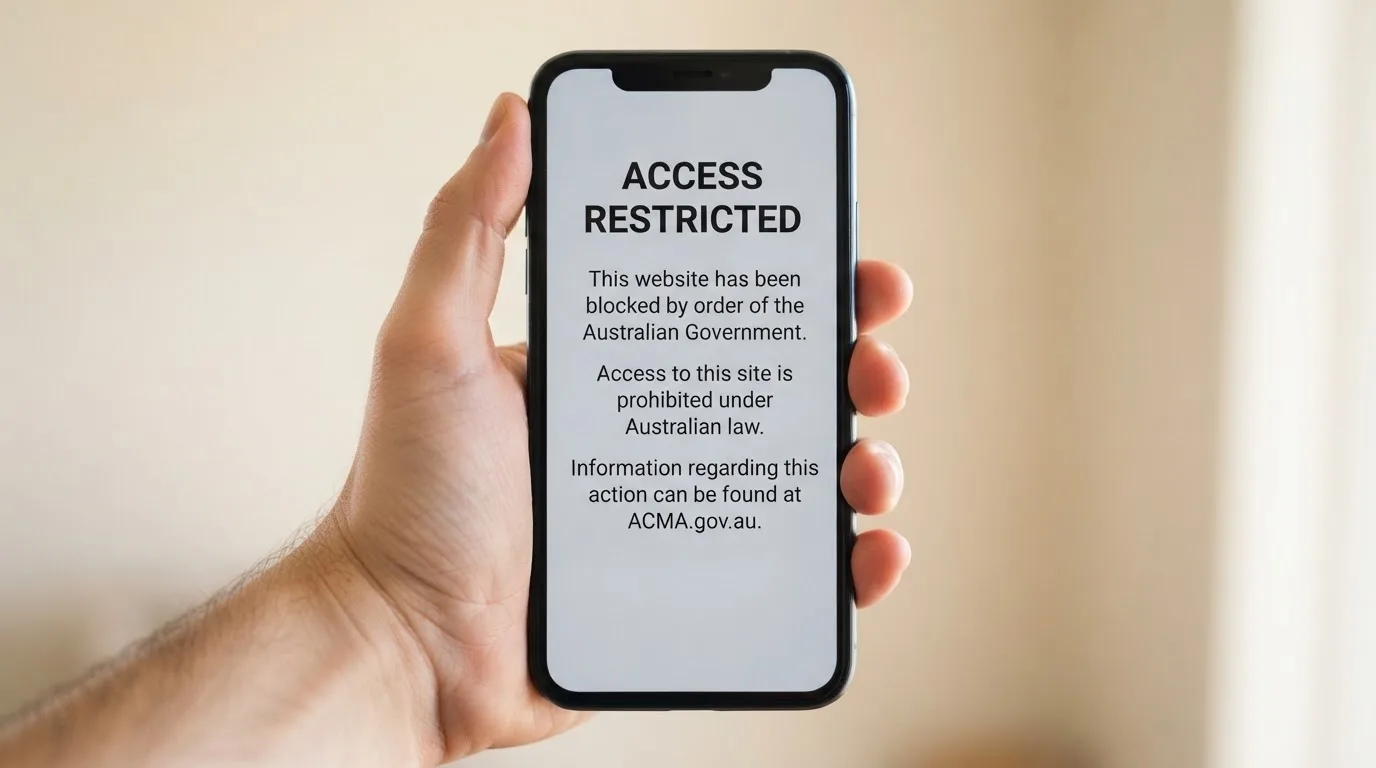
The ACMA investigates complaints, issues formal warnings, and asks Australian internet service providers to block sites that offer prohibited services. A formal warning is not the end of the process; it is the regulator’s way of recording that a site has been told, in writing, that what it is offering is unlawful in Australia. Subsequent blocking requests follow when the service continues to be accessible from Australian IP addresses.
| Blocking Statistic | Detail |
|---|---|
| Cumulative sites blocked | 1,751 (since November 2019) |
| Services exited market | 230+ (since 2017) |
| Recent blocking round | 12 sites (June 2026) |
The cumulative blocking total is the most concrete measure of how the prohibition has actually been applied. By the latest round reported on 26 June 2026, 1,751 illegal gambling and affiliate marketing websites had been blocked since the first blocking request went out in November 2019. That is the running total after more than six years of enforcement, against a backdrop in which more than 230 unlicensed gambling services had already left the Australian market since enforcement was strengthened in 2017. The most recent round named 12 more sites for blocking: 7Signs, ChromaBet, Donbet, Duospin, Freshbet, Slots Gem, Jacks Club, Lucky Start, Pointsbetz, Spinrise, Vinyl Casino and Wildsino.
The blocking-rate band: running the 1,751 cumulative blocked sites against the November 2019 starting point gives a range of roughly 250 to 290 sites blocked per year on average across the full period, with the recent pace closer to the higher end as monthly blocking rounds have continued. The condition on that figure is the seven-year window; treat it as an order of magnitude rather than a calendar.
What an offshore licence does and does not buy
Several of the brands a reader meets in search results display a Curaçao or Anjouan licence badge. Those licences are issued to the operator, not to the player, and they do not extend Australian consumer protection to anyone sitting in Australia. A complaint about a refused withdrawal is not heard by an Australian regulator; the offshore licence holder is the only party with a contractual relationship with the player, and that relationship runs under the operator’s own house rules. A site that can be blocked under the IGA can also be blocked with a balance still sitting in the account, and there is no Australian authority to appeal to when that happens.
H2 Gambling Capital’s estimate of what flows around the prohibition
H2 Gambling Capital’s 2025 estimate puts the annual loss to illegal gambling sites at about A$3.9 billion, and shows the share of gambling that flows through legal channels falling from 74% in 2021 to 64% in the most recent reading. The number is an estimate rather than an audited figure, and it captures all forms of illegal wagering rather than only the casino segment. What it does say plainly is that the prohibition does not turn off demand; it pushes demand offshore.
Responsible play: what tools actually apply from Australia
The responsible-gaming shelf for an Australian reader contains two layers: tools that bind Australian-licensed operators, and tools that bind the player through their own bank. They do different jobs, and only one of them reaches an offshore casino.
BetStop and the National Self-Exclusion Register
BetStop is the National Self-Exclusion Register, run by the ACMA and live since August 2023. A registered exclusion is enforced by every Australian-licensed online and phone wagering service — a sportsbook, a racing book, a lottery operator. It does not bind an offshore casino, which is not connected to the register at all. A player who excludes themselves through BetStop has removed themselves from the licensed side of the market; the offshore side still answers their own marketing, accepts their deposits, and applies its own withdrawal rules. For anyone whose concern is the kind of play an Australian-licensed operator can verify, BetStop is the only self-exclusion mechanism that carries weight on this side of the law.
The support line that sits beside BetStop is the National Gambling Helpline on 1800 858 858, free and 24/7, with chat at Gambling Help Online. These are funded services, separate from any operator, and they are the right first call for someone whose deposit pattern has shifted in a way they did not plan.
Bank-level gambling blocks
The second layer is at the card or account level, and it does reach an offshore operator in one specific way — by refusing the deposit at the point of authorisation. Westpac’s gambling block works at card level: it declines authorisation on transactions that register under the merchant category code for Betting/Casino Gambling on eligible personal credit and debit cards. ANZ’s gambling block, activated in the ANZ app, blocks gambling transactions on an eligible card including those made through a linked digital wallet such as Apple Pay. Commonwealth Bank offers a similar lock in the CommBank app, applying it to eligible cards. Each of these blocks works only on the issuing bank’s own cards; each carries a caveat that not every gambling transaction will be blocked, and that some non-gambling transactions may be blocked in error.
Two practical notes on removing a block: ANZ’s block, once turned on, requires a 48-hour waiting period before it can be removed. The Westpac and Commonwealth Bank blocks are managed inside the relevant app, with their own cool-off or removal rules. The block is a blunt instrument — it does not distinguish between a sports bet, a lottery ticket, an online casino deposit, or an in-app purchase at a gaming vendor — and that bluntness is also its strength, because the merchant category code the bank is matching against does not distinguish either.
Payments and payout speed: how money actually moves
The shelf the search term pulls in includes phrases built around high roller casino no deposit bonus and high roller PayID casino. Both of them run into the same wall as the bonus layer: no Australian-licensed online casino exists to either pay out or accept a no-deposit offer. What the shelf can do is describe the lawful rails an Australian player has for the licensed wagering they can place, and the rails an offshore operator will accept, and how those two routes differ in cost, speed and protection.
PayID and Osko, on the lawful side
Australia’s New Payments Platform went live on 13 February 2018 and is now owned by Australian Payments Plus, a non-profit whose shareholders include the Reserve Bank of Australia and the major banks. PayID is the addressing layer on top of the platform; Osko is the settlement layer that delivers a transfer between participating banks in under a minute, 24/7, including weekends and public holidays, whether the payment is addressed to a BSB and account number or to a PayID. By April 2025 more than 25 million PayID identifiers had been registered on the platform, and the service is available at over 100 Australian financial institutions.
PayID has a safety feature that matters at the offshore boundary: paying to a PayID shows the name of the account holder before the transfer is sent. Australian Payments Plus warns that being asked to transfer to a PayID on an illegal gambling site almost certainly means a scam site. The warning is not about the technology — PayID itself is a clean address — it is about the fact that a lawful operator does not need to route a player’s deposit through a personal-looking account. A reader who sees a PayID on a casino cashier page is being steered around the regulated banking system, and that is its own answer.
The credit-card and digital-wallet boundary
Under amendments to the Interactive Gambling Act that took effect in 2024, Australian-licensed online wagering services cannot accept payment by credit card or other credit-related products. The restriction extends in practice to linked digital wallets, because the underlying funding source is still a credit product. The Reserve Bank’s July 2025 review of merchant card costs proposed removing surcharges on eftpos, Mastercard and Visa transactions, and explicitly left American Express outside the scope of that change — Amex operates a three-party scheme that issues cards and processes transactions itself, rather than the four-party network Visa and Mastercard run. The practical consequence for a punter is that any surcharge they see on Amex is a separate fee structure, not a regulated one.
The wider digital-wallet layer matters at a different scale. By the end of 2025 Apple Pay, Google Pay and Samsung Pay together accounted for around 45% of all card payments in Australia by number. Apple does not charge consumers a fee for using Apple Pay in stores, online or in apps; any surcharge is the merchant’s processing fee, not Apple’s. The transaction limits and PIN requirements on an Apple Pay purchase are set by the card issuer or the merchant, not by Apple — which is also why ANZ’s gambling block reaches an Apple Pay transaction funded by an eligible ANZ card, and why a wallet does not undo a bank-level block.
BPAY, bank transfer, and the cash-reporting boundary
BPAY has been operating in Australia since 1997 and is available through the online banking of more than 140 banks and financial institutions, accepted by over 95,000 businesses. The payer enters the Biller Code and the Customer Reference Number printed on the bill; BPAY settles through the standard banking rails and shows on the player’s statement as a BPAY payment. BPAY is run by Australian Payments Plus, the same operator that runs PayID and Osko, and is owned equally by ANZ, Commonwealth Bank, National Australia Bank and Westpac through Cardlink Services Limited.
AUSTRAC’s threshold-transaction-report rule, which requires reporting of transfers of A$10,000 or more, applies only to physical cash. Ordinary electronic bank transfers, including a high-value transfer to an offshore operator’s account, are not subject to that per-transaction reporting requirement regardless of the amount. The rule matters more as background than as a constraint on this specific shelf — it explains why a six-figure transfer through normal banking will not by itself trigger a report — but it does not change the fact that the transfer is leaving Australia into an account that is not connected to Australian consumer protection.
What payout speed looks like on the lawful side
For licensed wagering, payout speed is a function of the platform the operator runs: same-day through PayID/Osko, next business day for BPAY, and the standard one-to-three business days for a direct bank transfer that does not run on the New Payments Platform. The fastest settlement on the lawful side is a PayID or Osko withdrawal back to the originating Australian bank account, and that is the upper bound the reader is comparing against when an offshore site advertises “instant payouts”.
Bonuses and free spins: how the marketing layer actually works
A high roller bonus is, in open markets, a matched deposit at a higher cap than the standard offer, often paired with a higher wagering multiple and a higher table limit. The shape matters because the shape is what the marketing copy hides: a 200% match up to A$5,000 with a 40x wagering requirement on the bonus means A$200,000 of qualifying turnover before any of the bonus balance is withdrawable, and the table on which that turnover counts is limited to whichever games the operator excludes from the wagering contribution. The bigger cap and the bigger percentage do not change the underlying arithmetic, they just multiply the size of the wagering load.
What a wagering requirement costs the player
A turnover requirement of 40x on a A$5,000 bonus asks for A$200,000 of qualifying wagers before the bonus balance converts to withdrawable cash. At a slot house edge in the band the operator advertises — say 4% — the expected loss against that turnover sits around A$8,000, before any win is set against it. A table-game bonus restricted to slots, or weighted at 10% toward wagering, lengthens the grind and shifts more of the expected loss into the bonus-clearing phase. None of that arithmetic is exotic; it is the same calculation the marketing copy is built to keep the reader from doing.
The two phrases the page refuses to print are the bonus code and the voucher code, because the only sources for either are affiliate marketing pages. The mechanics — matched deposit, turnover multiple, game weighting, max-cashout cap, expiry window — are what the reader needs to recognise when an offer shows up in their inbox.
What changes when the offer is prohibited
What changes on the Australian side is that the offer is the second wrong layer on top of the first wrong layer. An offshore operator offering a 200% high-roller match to an Australian player is offering a prohibited service with a marketing premium attached; the bonus terms are real to the operator’s cashier but unenforceable to the player through any Australian channel. A refused withdrawal, a bonus term changed mid-clear, a game that contributed 0% toward wagering without warning — the player’s only recourse is the offshore licence holder’s own dispute process, run on the operator’s own rules. The matched deposit doubles the size of the loss the player is trying to recover, which doubles the incentive for the operator to find a reason not to pay it out.
High roller casino bonuses in Australia — More on this topic at casino mobile au.
Mobile and app experience: the phone is where the player lives
The mobile shelf in the search term is built around high roller casino app and high roller mobile casino. On the lawful side, the phone is where licensed wagering platforms have put their weight for a decade: a Sportsbet or Bet365 app on an Australian phone accepts a debit-card deposit, a PayID transfer, a BPAY payment, and lays out racing and sports markets before the event. The experience is well-built and is the one the reader is comparing against when an offshore casino site pitches its own mobile play.
On the offshore side, the mobile experience is a browser-based lobby optimised for portrait orientation, with a cashier built around the deposit methods the operator accepts from the country the player is in. From Australia that means, in practice, an offshore operator pushing a path the Australian-licensed side cannot offer: a credit-card deposit routed through a digital wallet, a cryptocurrency transfer, or a PayID payment to an account that does not match a registered business name. The phone makes the cashier one tap away, and the same one tap is the moment the boundary with Australian law is crossed.
The bank-level gambling blocks discussed above run on the phone as well as on desktop: the Westpac, ANZ and Commonwealth Bank apps let the player toggle the block from the device the deposit would otherwise leave from. Turning the block on at the moment a marketing email arrives is a different habit from turning it off at the moment a withdrawal is delayed, and the habit matters more than the technology.
Specific games, providers and live tables: what the catalogue looks like
A high-roller catalogue in an open market is a filtered view of the operator’s full library: high-limit blackjack with table minimums in the hundreds, baccarat at the maximum stakes the live studio runs, roulette wheels with no upper table cap, and a slots catalogue fronted by the highest-volatility titles the provider publishes. The volatility framing is what separates the high-roller slots selection from the casual one — the same paytable structure, but a paytable weighted toward rare large wins rather than frequent small ones, so a session either breaks early or runs out without paying much along the way.
What the Australian reader can lawfully play at stake
The lawful analogue is the licensed Australian land-based casino floor: Crown Melbourne, Crown Perth, The Star Sydney, The Star Gold Coast, Treasury Brisbane, Adelaide Casino, and the casino at Skycity Darwin. Each runs a high-roller room with baccarat, blackjack and roulette at table limits well above the main floor’s, alongside a poker room that hosts cash games at the upper stake tiers. These are the venues that match the search term’s intent, with the difference that the player has to be physically present. Pokies venues — clubs and pubs licensed to host gaming machines — are the other lawful channel, with stake sizes set per machine by the relevant state or territory regulator and BetStop exclusions honoured at the door.
Where the offshore catalogue meets the ACMA register
The catalogue an offshore casino offers from a Curaçao or Anjouan licence is built by a handful of large studio groups: Evolution runs the live-dealer rooms, Pragmatic Play and Play’n GO supply a large slice of the slot catalogue, and the rest of the lobby is filled by Nolimit City, Hacksaw Gaming, BGaming and a long tail of smaller studios. The point at which the catalogue meets Australian law is the cashier: every deposit an Australian player makes into one of these operators funds a session of prohibited gambling service, regardless of which studio built the game.
The eleven brands on the ACMA’s formal-warning register
Each brand below is one the ACMA has named in a formal warning under the Interactive Gambling Act 2001 for offering prohibited online casino services to people in Australia. This is not a ranking, not a shortlist, and not a recommendation. The only reason each name appears on the same page is the same reason: a regulator has already told the operator, in writing, that what it is offering to Australians is unlawful. The subject-support field reflects where third-party listings happen to name the brand in passing, not an endorsement of the operator’s offer.
| Brand | ACMA action and date | Operator named by the ACMA | Subject support |
|---|---|---|---|
| RocketPlay | Formal warning, March 2026; earlier warning over the same operator, May 2022 | Pulsup Ltd (RocketPlay); earlier Dama N.V. | Listings only — Gambling Insider |
| Level Up Casino | Formal warning, May 2022 | Dama N.V. | Listings only — Westpac |
| Woo Casino | Formal warning, March 2025 | Dama N.V. | — |
| Spirit Casino | Formal warning, May 2025 | Dama N.V. | — |
| National Casino | Formal warning, July 2025 | Consolutetish S.R.L. | Listings only — acma.gov.au, austrac.gov.au, betstop.gov.au |
| Bizzo Casino | Formal warning, July 2025; earlier warning, 2022 | Consolutetish S.R.L.; earlier TechSolutions | Listings only — Gambling Insider |
| Ignition Casino | Formal warning, July 2025 | Bamboo Media | — |
| Instant Casino | Formal warning, February 2025 | EOD Code SRL | Listings only — EcoPayz, PayID |
| Jackbit | Formal warning, April 2026 | Ryker B.V. | — |
| Casino Intense | Formal warning, April 2025 | Sterplay Holding Ltd | Listings only — Gambling Insider |
| Sky Crown | Formal warning, September 2022 | Hollycorn N.V. | — |
The pattern the table lays bare is that the regulator’s targets are not small fly-by-night operations: Hollycorn N.V., Dama N.V., TechSolutions and the others behind these brands run large multi-brand estates that appear in Australian-facing marketing regardless of the warning on file. The fact that a brand sits on the formal-warning register is not, by itself, news the marketing will surface for a player; the fact that it sits there is the news the page is laying out.
What the table is telling the reader, beyond the names
Three readings sit on top of the rows. The first is that the same operator group reappears across multiple brand names — Dama N.V. appears behind RocketPlay (in its earlier incarnation), Level Up Casino, Woo Casino and Spirit Casino; Consolutetish S.R.L. appears behind National Casino and Bizzo Casino. A warning over one brand in the group is not the end of the group’s marketing to Australians under its other names; the operator group is the unit of enforcement, and a reader who recognises the parent sees the warning spread wider than the row suggests.
The second reading is the date spread. The earliest warning on the list is September 2022, the most recent is April 2026. The ACMA’s enforcement is not a one-off campaign; it is a continuing cycle, with formal warnings issued across the period and blocking rounds that follow when a service stays accessible from Australian IP addresses. A brand that has not been warned in 2026 has not been warned yet, not been cleared; the register is updated as the regulator acts, not as the industry cleans itself up.
The third reading is what the subject-support column actually carries. Where research only finds the brand name mentioned in a third-party listing — a gambling-industry trade page, a payment-processor’s own terms, the regulator’s own register — that is what the column records. It is not a verdict on the brand’s offer; it is a verdict on what could be found outside the marketing. For Woo Casino, Spirit Casino, Ignition Casino, Jackbit and Sky Crown, the column is empty because no such listing surfaced, and that absence is recorded as an absence rather than papered over.
How the page is constructed, and what it is not
The page works as a single argument: a search term that asks for a high-roller online casino with a bonus cannot be answered with a shortlist, because no licensed operator offers that product in Australia, and a shortlist of unlicensed operators is a list the reader is better off reading as a list of brands the regulator has already contacted. The shelves that follow that opening argument are the ones the search term drags in — payments, bonuses, mobile, games — and each of them lands on the same point: the lawful side of the boundary is real and well-built; the unlawful side is the side the search term is asking about.
What the page is not: it is not a guide to using a VPN to reach an offshore operator; it is not a comparison of bonus offers the marketing has not provided the data for; it is not a recommendation that any of the eleven named brands is a place to play. It is a description of the boundary, with the brands the ACMA has named on one side of it and the lawful Australian channels on the other.
What the IGA does and does not do
The Interactive Gambling Act 2001, as amended in 2023 and 2017, makes the provision of a prohibited interactive gambling service to a person in Australia an offence. The offence is on the provider, not on the player; an Australian resident who plays at an offshore casino is not prosecuted under the IGA. What the player gives up is the Australian consumer protection that comes with a licensed service — no Australian complaints body, no recourse through an Australian court if a withdrawal is refused, no guarantee the site will still be accessible next week. The 2026 reform bill passed Parliament on 19 August 2026 and its advertising and inducement measures commence on 1 January 2027 — law with a start date, not yet in force.
The tax position is straightforward for a recreational player: gambling winnings are not assessable income under section 6-5 of the ITAA 1997, and losses are not deductible, unless the player carries on a business of gambling. The Australian Taxation Office treats gambling as a personal activity for the overwhelming majority of players, and the question of whether a particular reader has crossed into business is a question the reader needs to ask the ATO directly rather than answer from a guide.
Practical notes for a player who has decided to keep playing offshore
The page does not recommend offshore play. It assumes the reader has already made that decision and lays out the conditions that follow from it.
A PayID transfer to a casino cashier should show the account holder’s name before the transfer is sent, and Australian Payments Plus has flagged that a casino asking for a PayID payment is almost certainly a scam site by structure. A credit card, a credit-linked digital wallet or a cryptocurrency deposit is a route the Australian-licensed side does not allow, and that restriction is what marks a deposit method as belonging to the offshore side of the boundary. The bank-level gambling block on Westpac, ANZ or Commonwealth Bank cards will refuse many of these deposits at the point of authorisation, with the caveat that the block does not catch every gambling transaction and may block some non-gambling ones in error.
The bonus layer compounds the cost of an unsuccessful session rather than softening it. A matched deposit of 200% with a 40x wagering requirement asks for a multiple of the bonus in qualifying turnover before any bonus balance is withdrawable, and the game weighting the operator applies restricts where that turnover counts. The maximum cashout cap and the expiry window are the two terms a reader should read before claiming, because they are the two terms the bonus is engineered to enforce.
The lawful routes, laid out plainly
For a reader whose aim is high-stakes play in a regulated environment, the lawful Australian options sit in three places. Licensed wagering on sports and racing is the largest, with the major operators running pre-event markets at the stake levels the player wants; the bonus layer is a different product from a casino bonus, but the matched-deposit and the refund-on-loss shape exist in this market too. Licensed land-based casinos run high-roller rooms in each state capital, with baccarat, blackjack and roulette at table limits well above the main floor; the casino is the venue that most directly matches the search term’s intent, with the constraint that the player has to be there. Licensed pokies venues — clubs and pubs with gaming-machine entitlements — run pokies at stake sizes set per state, and a BetStop exclusion is honoured at the door.
The phone is the access point for the licensed wagering side; the venue is the access point for the casino and pokies side. Both routes sit on the lawful side of the Interactive Gambling Act 2001, both routes carry Australian consumer protection, and both routes honour a BetStop exclusion. The bonus layer the search term asks for exists on the licensed wagering side in a different form from the casino bonus the term assumes; on the casino and pokies side the bonus layer is the loyalty programme the venue runs for the player’s tier, not a matched deposit at the cashier.
The block on the ACMA’s record, and what it tells a reader
A$3.9 billion a year, on H2 Gambling Capital’s 2025 estimate, leaves Australia through illegal wagering sites. The legal-channel share of gambling fell from 74% in 2021 to 64% in the most recent reading. The 1,751 blocked sites and the 230-plus services that have left the market since 2017 are the regulator’s record against that flow; they are not a closed ledger. The blocking rate the arithmetic produces — roughly 250 to 290 sites per year on average across the November 2019 to mid-2026 window — is the rate at which the regulator has been able to remove individual sites from Australian reach. It does not describe the rate at which new sites appear, which is a separate count the regulator does not publish in the same form.
What the figures together say is that the prohibition is enforced as an ongoing process, not a one-off action, and that the process catches individual sites faster than it catches the demand the prohibition creates. A reader who is choosing where to place a deposit is choosing between an Australian-licensed channel with consumer protection and a BetStop exclusion that binds, and an offshore channel with neither. The ACMA’s register is one input into that choice; the IGA is the frame the choice sits inside.
Frequently asked questions
What deposit level qualifies a player as a high roller at a casino?
In open markets the threshold is set by the operator rather than the industry, and most commonly sits in the low thousands per deposit or per month before the account is moved to a managed tier with a named host. In Australia the threshold is moot: no licensed online casino exists to assign a tier to, and the offshore operators that advertise a high-roller tier are offering a prohibited service the moment the deposit is accepted from an Australian IP address.
Do high roller bonuses come with heavier wagering requirements?
Yes. A higher matched percentage and a higher bonus cap are paired with a higher multiple on the wagering requirement, because the operator is taking more risk on the bonus side and shifts the qualifying-turnover load onto the player. The arithmetic is the same as for a standard offer — bonus multiplied by the wagering factor equals the qualifying turnover — and it is what the marketing copy is built to keep the reader from doing.
Is it legal for an online casino to offer high roller bonuses to Australians?
No. The Interactive Gambling Act 2001, as amended, makes it an offence to provide a prohibited interactive gambling service — including online casino games — to a person in Australia. A high-roller bonus layered on top of a prohibited service is the same offence with a marketing premium attached. The player is not prosecuted under the IGA; the offshore operator carries the offence, and the player gives up Australian consumer protection by playing on that side of the boundary.
Can high roller status be reached through a PayID deposit?
PayID is a payment addressing layer, not an account-status trigger, and it does not confer high-roller status on the player at the receiving end. On the licensed wagering side it is the fastest lawful deposit rail; on the offshore side Australian Payments Plus has flagged a PayID request on a casino cashier page as a strong indicator of a scam structure, because a lawful operator routes deposits through registered business accounts rather than personal-looking ones.
Are high-roller tables offered at licensed Australian land-based casinos?
Yes. Crown Melbourne, Crown Perth, The Star Sydney, The Star Gold Coast, Treasury Brisbane, Adelaide Casino and Skycity Darwin each run a high-roller room with baccarat, blackjack and roulette at table limits well above the main floor’s, alongside poker cash games at the upper stake tiers. The constraint is that the player has to be physically present; the licensed Australian land-based casino is the venue that most directly matches the search term’s intent on the lawful side of the boundary.
What should a high-spending player check before trusting a casino site?
Whether the operator is licensed in the player’s own jurisdiction is the first check, and for an Australian reader that means whether the site offers a licensed wagering product at all — sports, racing, lotteries or keno — rather than prohibited online casino games. The bank-level gambling block on Westpac, ANZ or Commonwealth Bank cards is a second check the player can apply without the operator’s cooperation. BetStop is a third check that binds the licensed side. On the offshore side, no check an Australian player can run reaches the operator’s compliance team, and that asymmetry is the deciding factor.